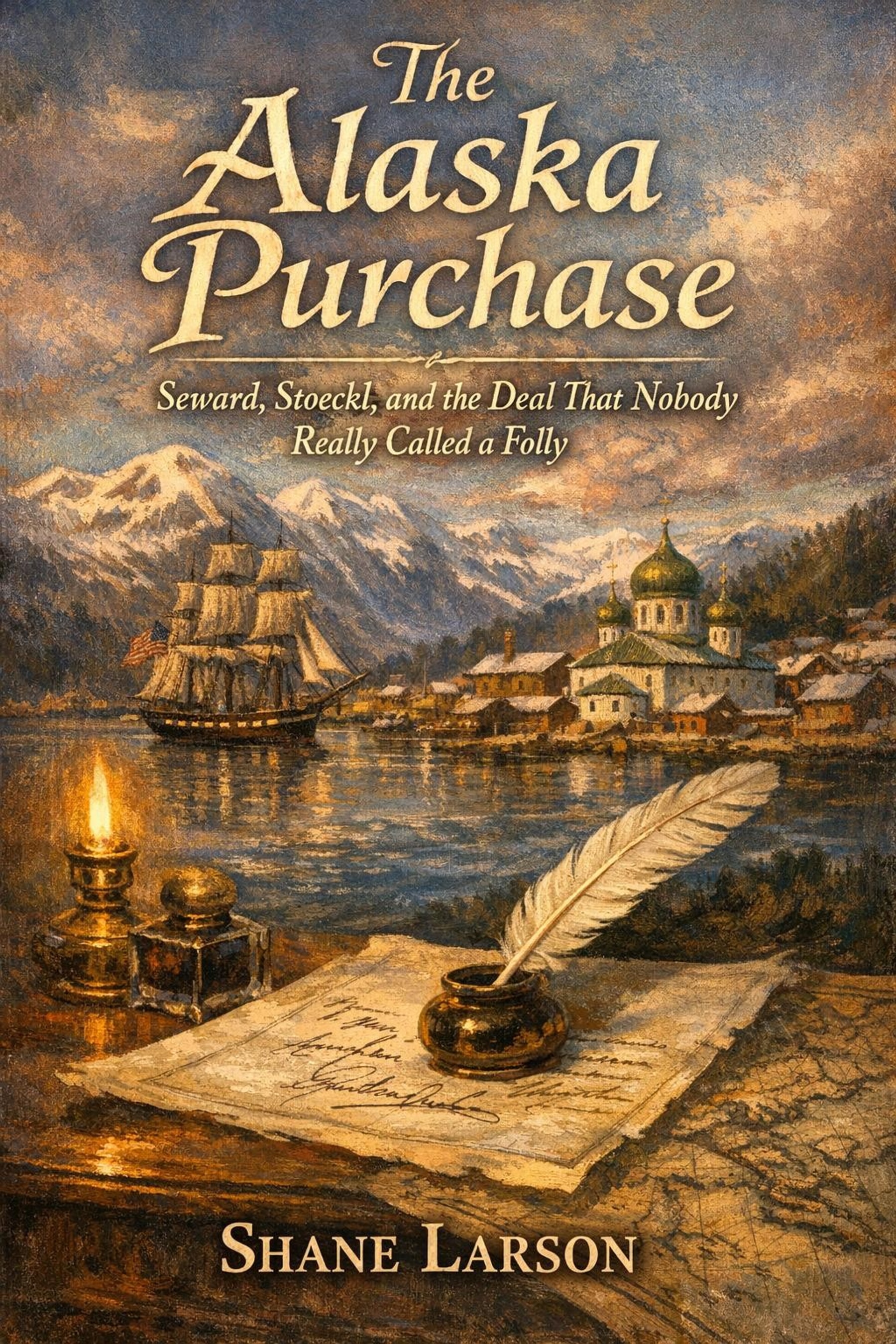
The Alaska Purchase
Seward, Stoeckl, and the Deal That Nobody Really Called a Folly
By Shane Larson
About This Book
On 18 October 1867, on the hill above the harbour at Sitka, the Russian flag would not come down. The story told afterwards is that it fouled on the pole, that a sailor had to be sent up to cut it loose, and that it fell onto the bayonets of the Russian guard below; the last governor's wife is said to have fainted. Those are reported details, flagged as such. What is not in doubt is that General Lovell Rousseau took possession for the United States that afternoon and a territory of 586,412 square miles changed hands.
Outside the old Russian stockade sat a Tlingit town whose people had never submitted to anyone. Their leaders made an objection that the Americans wrote down imperfectly: the Russians could not sell what they had never owned. That sentence is what this book is built around.
The Deal Was a Night. The Book Is Thirty Years.
The Alaska Purchase is usually told as a two-week story with a punchline: a Russian minister interrupts a card game, the lamps are lit at the State Department, a treaty is signed before dawn, a nation laughs, and gold proves the laughter wrong. Most of the newspapers of 1867 supported the treaty, and the Senate needed ten days to ratify it. Opposition was real, but it was loudest among Andrew Johnson's enemies, and it did its damage in the House, which sat on the money for fifteen months while it tried to remove the President.
The harder story starts after the flag changes. The Alaska Purchase: Seward, Stoeckl, and the Deal That Nobody Really Called a Folly runs from the Crimean War, which taught St. Petersburg in 1854 that it could not defend its American colony, to the Organic Act of 1884, the first time Washington admitted it had to govern what it had bought. In between are the years the familiar version skips: a decade of Army rule, a customs collector left in charge of a territory twice the size of Texas, the residents of Sitka appealing to a British warship in 1879, and two Tlingit towns shelled by the U.S. Navy, Kake in 1869 and Angoon in 1882.
The Russian side gets equal weight, because it was the harder decision. Grand Duke Konstantin first put the sale on paper in 1857; the meeting of December 1866 that settled it sent Eduard de Stoeckl back to Washington with a floor price of five million dollars. What he came home with, and what he did with part of it, a House committee investigated in 1868 and never resolved. The book sets out the evidence and leaves the verdict where the record leaves it: unproven.
Why I Wrote This
I live in Alaska. The last Monday in March is Seward's Day here and 18 October is Alaska Day; both are state holidays. The treaty they commemorate is the founding document of the state I live in, and the version of it I carried around was the one everybody carries: a frozen waste, a jeering country, a visionary vindicated by gold. It came apart as soon as I started reading. The Senate took ten days. The real story was in the seventeen years afterwards, when the country that had bought Alaska could not be bothered to govern it, and in what the Tlingit said on the day the flag changed.
The other thing that held me was Part Four. I recently built a small cabin here with hand tools, in a place where the nearest help is a long way off. A territory with no courts, no land law and no way to record who owned a house is not an abstraction when you live somewhere like that. You learn fairly quickly what a government is for.
Frequently Asked Questions
Was the Alaska Purchase really called Seward's Folly?
Rarely, in 1867. The jokes were real, "Walrussia" and "Seward's icebox" among them, but they came mostly from one New York newspaper and Andrew Johnson's political enemies, and the Senate ratified the treaty 37 to 2 ten days after it was signed. The phrase grew during the Klondike gold rush and in twentieth-century textbooks. The book also gives space to the historians who warn that the correction can go too far.
How much did the United States pay for Alaska?
$7,200,000 in gold, under the treaty signed on 30 March 1867: for roughly 586,412 square miles, a little under two cents an acre. The money was not paid until the House voted the appropriation in July 1868, and the fur-seal lease on the Pribilof Islands returned close to the purchase price over the following twenty years.
Did Alaska Natives agree to the sale?
No, and they were not asked. Article III of the treaty left the "uncivilized native tribes" subject to whatever laws Congress later chose, and Tlingit leaders objected at Sitka that Russia had never owned the land it was selling. The Court of Claims found in the Tlingit and Haida's favour in 1959, and the Alaska Native Claims Settlement Act of 1971 settled the claims of all of Alaska's Native peoples. The book gives that argument its own chapter.
Were congressmen bribed to approve the Alaska Purchase?
Nobody knows, and the book says so. Some of the $7.2 million paid to Stoeckl was spent in Washington and never accounted for, a House committee investigated in 1868 and 1869 without reaching a firm conclusion, and Andrew Johnson later recorded what Seward had told him. The evidence is set out in full and the verdict is left as unproven.
Is this a narrative history or an academic study?
A narrative history, written from public-domain sources: the treaty, the Congressional Globe, the 1868 House report, Frederick Seward's recollections, the 1867 newspapers and Tlingit community accounts. Where the record is contested, on the flag ceremony, the shellings and the money, it says so. About 74,000 words, thirteen chapters in four parts, with three appendices.
If You Liked This, You Might Like
- No Law Below the Pass — a novel of Skagway in 1898, where the thieves were the government, and the legal vacuum this book describes seen from the boardwalk a generation on.
- Sitting Bull — federal Indian policy in the same decades on the other side of the continent, and a people the treaties were written about rather than with.
- The Notebook — the American survey that gives the Alaska Purchase its usual one line, with the impeachment and Gilded Age context behind this book's Washington chapters.
- The Pinkertons — nineteenth-century America without a federal police force, the same institutional gap that left a territory to a customs collector.
The purchase was popular, quick and cheap; the ownership was negligent for a generation and fell hardest on the people who had been there all along. This book tells both halves, and ends in Alaska.
What You'll Learn
- **Why Russia let go.** The attack on Petropavlovsk in 1854, a colony kept out of the war by agreement rather than strength, and a ministry that decided the Americans were the lesser risk.
- **The minister and the secretary.** Stoeckl, a quarter century in Washington with an American wife; Seward, Lincoln's rival, with an assassin's scars on his face.
- **The haggling.** From five million to seven, the extra two hundred thousand to clear the Russian-American Company's privileges, and the night the clerks were called out of bed.
- **Article III.** The clause that set aside the "uncivilized native tribes" for whatever laws Congress might later make, and what it meant to the people it described.
- **Sumner's speech and the vote.** Three hours on 8 April 1867, a name borrowed from the Unangan, and a tally of 37 to 2 that has never fitted the legend.
- **Where the money went.** The appropriation of July 1868, the payments alleged in Washington, the House investigation, and the myth that the gold went down with a ship.
- **Seventeen years without a government.** The Army, the customs house, HMS *Osprey*, the Navy, and the Pribilof fur-seal lease whose revenues came close to the purchase price within twenty years.
- **Not theirs to sell.** The Tlingit argument at the transfer and the road from 1867 to the Court of Claims and the Alaska Native Claims Settlement Act of 1971.
New American History releases and free chapters — no spam, unsubscribe anytime.
More in This Genre
View all →