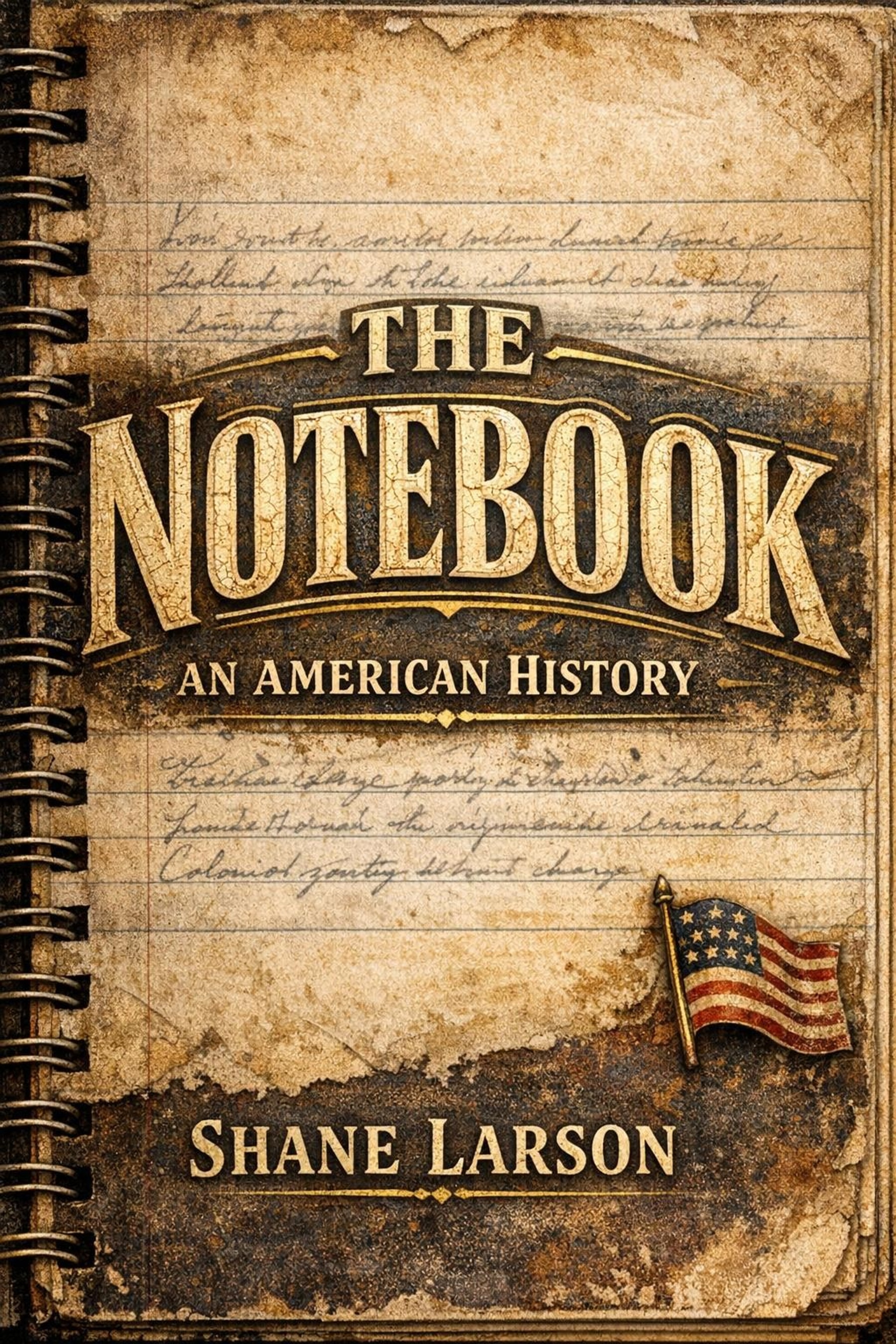
The Notebook
An American History, Rebuilt from a Real Classroom's Notes, 1990–1991
By Shane Larson
About This Book
The syllabus on the board said the course would cover 1500 to 1870. The last dated page of the notes covers Ronald Reagan.
Somewhere between those two facts sits an entire American history course — two semesters, September 1990 to June 1991, one professor talking and one teenager writing as fast as he could. The professor ignored his own end date and taught straight through Reconstruction, the Gilded Age, two world wars, the Cold War, and the Baby Boom, right up to the edge of the present he was standing in. In the spring, lecturing on the arms race, he told the class that eventually Russia would give up. The Soviet Union dissolved six months after his final lecture. He was predicting the news, and the news was already happening, and nobody in the room knew.
That teenager was me. This book is what became of my notebook.
The Argument
American history survey courses have a reputation as forced marches through names and dates. This one was something else, and the notes prove it. Underneath the parade of presidents ran four sustained arguments the professor returned to all year — arguments distinctive enough that, thirty-five years later, they were worth rebuilding into a finished narrative history of the United States.
He opened the year not with Columbus or Jamestown but with a diagram of the English class ladder: two hundred aristocratic families, sixteen thousand gentry families, and the cottagers and paupers below. Colonial America, he argued, imported that machine whole and watched it mutate on the frontier — and its fingerprints are on everything from John Winthrop's Massachusetts to the Constitution's careful filters on popular will. He taught the Enlightenment and the Great Awakening not as opposites but as parallel fires, two versions of the individual conscience burning against inherited authority, converging on the same revolution. He argued that America, having refused a state church, built a functional substitute anyway — a civic faith he called the Religion of the Republic, with the Declaration and the Constitution as scripture and democracy itself as doctrine. And he gave the Baby Boom more lecture hours than the Constitutional Convention, treating one generation's demographics, music, and midlife anxieties as history's latest act while that generation was still in it.
This book keeps all four arguments intact and follows them from the Puritan gentry to Reagan's second term. It corrects the record where the notes got it wrong. It never pretends the notebook said something cleaner than it did.
Why I Wrote This
I found the notebook in a box I had moved at least a dozen times without opening. I knew my own handwriting immediately; I remembered almost nothing else — not the professor's name, not the classroom, not a single specific day of a course I apparently attended for ten months. But the notes remembered. Reading them, I could watch a serious teacher build a serious argument about America, lecture by lecture, and I could also watch 1991 happening in the margins: the S&L crisis used to explain the Panic of 1873, the Gulf War coloring the verdict on 1945. The thing had become a primary source while it sat in the box. Turning it into a real history — checked, corrected, completed, with every seam showing — felt less like writing a book than like finishing a thirty-five-year-old assignment properly this time.
Frequently Asked Questions
Is this a memoir or an actual history book?
It is an actual history book — a complete narrative survey of American history from colonial settlement to the Reagan administration. The notebook provides the structure, the emphases, and the interpretive argument, and the first-person frame appears mainly in the introduction and conclusion. The twenty chapters between them are straight narrative history.
Do I need to know anything about American history before reading it?
No. The course this book rebuilds was a survey, designed to carry a student from zero, and the book works the same way. Readers who already know the standard story will get something different: the pleasure of watching a distinctive argument reorganize familiar material, plus the apparatus showing exactly where the source held up and where it didn't.
How accurate can a book built from a student's notes actually be?
That question is the book's engine. Everything was checked against the historical record: errors are corrected in the text, and every correction is logged openly in a dedicated appendix rather than patched silently. Where the notes were illegible or missing, the book says so and fills the gap with mainstream scholarship, identified as fill. The result is more transparent about its sourcing than most popular histories, not less.
Does the book cover the Civil War and both World Wars?
Yes — secession through Appomattox, and the fullest single stretch of the notebook is its six weeks of World War II lectures, from the causes through the Pacific, D-Day, and the Manhattan Project. The book also preserves an honest imbalance: the professor spent roughly one week on Civil War battles and six on World War II, and the book flags that proportion as part of the historical record of how the era was taught.
What is the "Religion of the Republic"?
It was the professor's name for his central thesis: that America, having deliberately refused an established national church, built a civic substitute — fundamental law standing above government, the founding documents functioning as scripture, democracy fused with evangelical Protestantism into a national faith. Scholars know a cousin of this idea as American civil religion; the notebook's version is more specific and more argumentative, and the book traces it across two centuries.
If You Liked This, You Might Like
- Doggerland — the same method pointed at a drowned country: an unconventional body of evidence, handled with the seams deliberately showing.
- The Dime Novel West — how America manufactured its own frontier mythology in print, a story that runs straight alongside this book's Parson Weems and Religion of the Republic chapters.
- The Pinkertons — the agency that appears in this book breaking the Molly Maguires and the Homestead strike, given its own full account.
A year of American history, taught by a professor whose name is lost and preserved by a sixteen-year-old who kept up — completed, corrected, and finally finished.
What You'll Learn
- Twenty chapters spanning five centuries, from the English class system the colonists carried ashore to the last dated lecture in June 1991 — a complete narrative history of the United States built on one classroom's telling of it.
- The Religion of the Republic thesis, given a full hearing — how fundamental law, civic scripture, and the American Mission did the work of an established church, and how that faith quietly secularized without ever losing its grip.
- A six-week reconstruction of World War II as it was taught in 1991, by a professor working from the era's own numbers and stories, with the Gulf War playing on that winter's televisions.
- The notebook's strangest proportion honored in full: nearly a fifth of the book belongs to the Baby Boom — its five regional styles of early rock and roll, its campus revolts, its divorce spike, and the professor's line that nostalgia is "the arthritis of the baby boomers."
- A concordance appendix mapping every chapter to the exact notebook pages and lecture dates it was built from, so the source is always one lookup away.
- An appendix of corrections logging every error in the original notes — the wrong D-Day date, the garbled statistics, the urban legends repeated as fact, and the professor's opinions delivered with a historian's authority.
- A who's who of roughly 130 figures, Winthrop to Reagan, each identified by the role they play in the notebook's telling rather than by encyclopedia boilerplate.
- The missing pages marked missing. Three pages of the notebook did not survive. The book tells you where the gaps fall instead of inventing what filled them.
Included with Kindle Unlimited — read it free if you're a member.
New American History releases and free chapters — no spam, unsubscribe anytime.