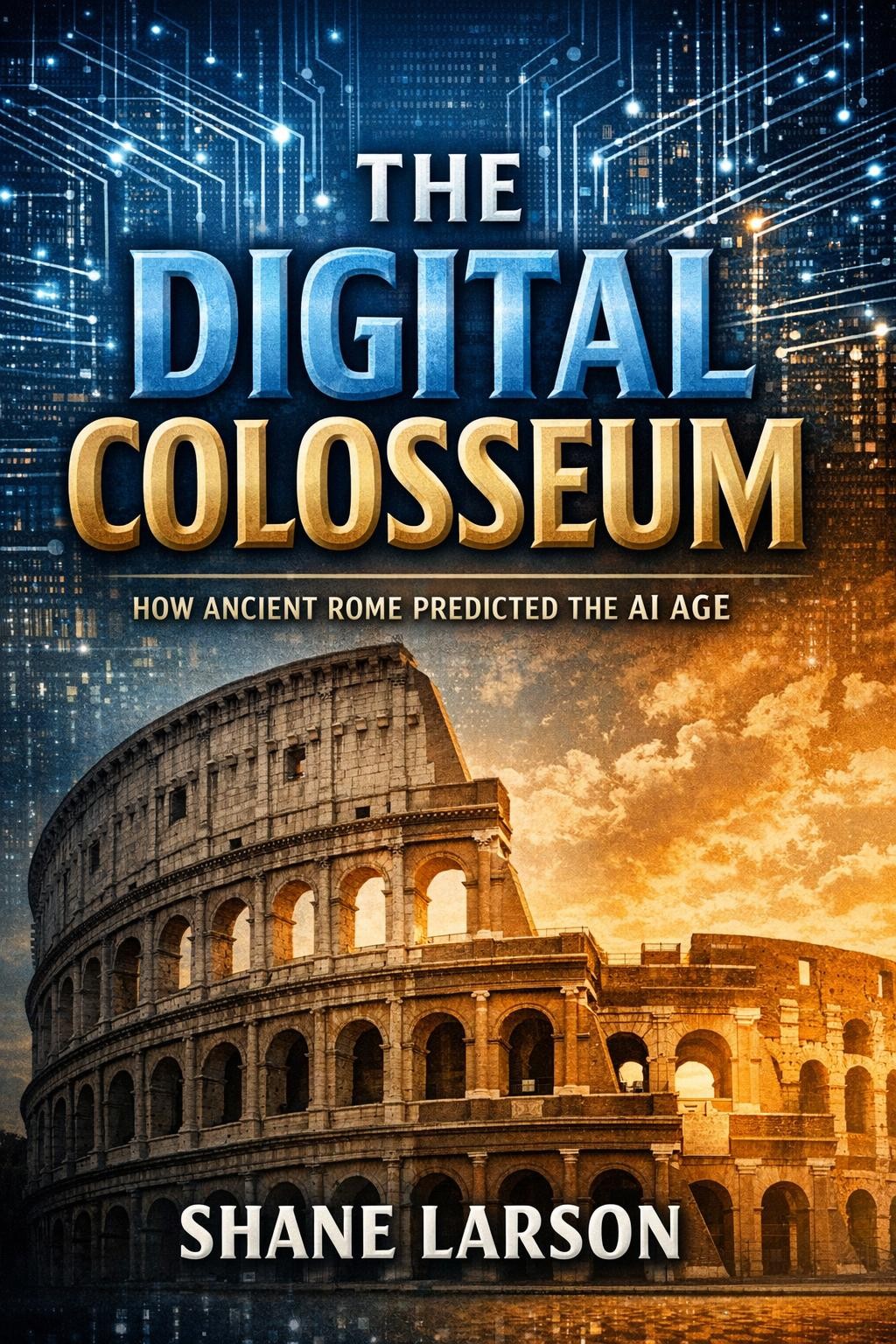
The Digital Colosseum
How Ancient Rome Predicted the AI Age
By Shane Larson
About This Book
Every few months, someone compares the fall of Rome to whatever crisis is in the news. The comparisons are almost always shallow.
Rome had roads, we have the internet. Rome had bread and circuses, we have social media. The parallels get trotted out, the column gets written, and nothing useful is learned from either the history or the present.
This book is not that.
The Roman Empire faced challenges that are structurally identical to those created by artificial intelligence — not because history mystically repeats itself, but because certain problems emerge whenever a civilization reaches a specific threshold of complexity, scale, and technological capability. Rome hit that threshold with roads, aqueducts, and slave labor. We are hitting it with neural networks, cloud infrastructure, and automated systems. The surface details are different. The underlying dynamics are the same.
What you'll learn:
- Why Roman roads and modern digital infrastructure create the same dual-use vulnerability — and what Rome's experience reveals about securing systems whose entire value comes from openness
- How the latifundia system that hollowed out Rome's middle class is structurally identical to AI automation displacing knowledge workers — and what happened politically when Rome failed to address the resulting inequality
- Why the Praetorian Guard's transformation from protector to kingmaker is the original AI alignment problem — and what Diocletian's structural solution teaches us about redesigning systems that have captured their overseers
- How Rome governed provinces it could not directly see, and why distributed AI systems face the same principal-agent problem two thousand years later
- Why the Eastern Roman Empire survived a thousand years after the West collapsed — and what that divergence reveals about which organizations and nations will navigate AI successfully
- How Roman propaganda at continental scale prefigured AI-generated content, deepfakes, and algorithmic amplification
- Why standardization won Rome an empire and then locked it into decline — the same trajectory facing AI systems built on converging architectures
This book is for you if you are fascinated by Rome and want to understand why its patterns keep surfacing in the modern world, you work in AI or technology and want historical depth for the structural challenges you face daily, or you enjoy big-idea crossover books like Sapiens, Guns Germs and Steel, or The Lessons of History.
The parallels are specific. The analysis is structural. Both the history and the technology are handled with genuine depth by an author with established catalogs in both domains.
Rome's story didn't end with collapse. It ended with a thousand-year survival by the half that adapted.
The question is not whether AI will transform civilization. It will. The question is whether we will be Rome — or Byzantium.
Included with Kindle Unlimited — read it free if you're a member.
New Ancient History releases and free chapters — no spam, unsubscribe anytime.