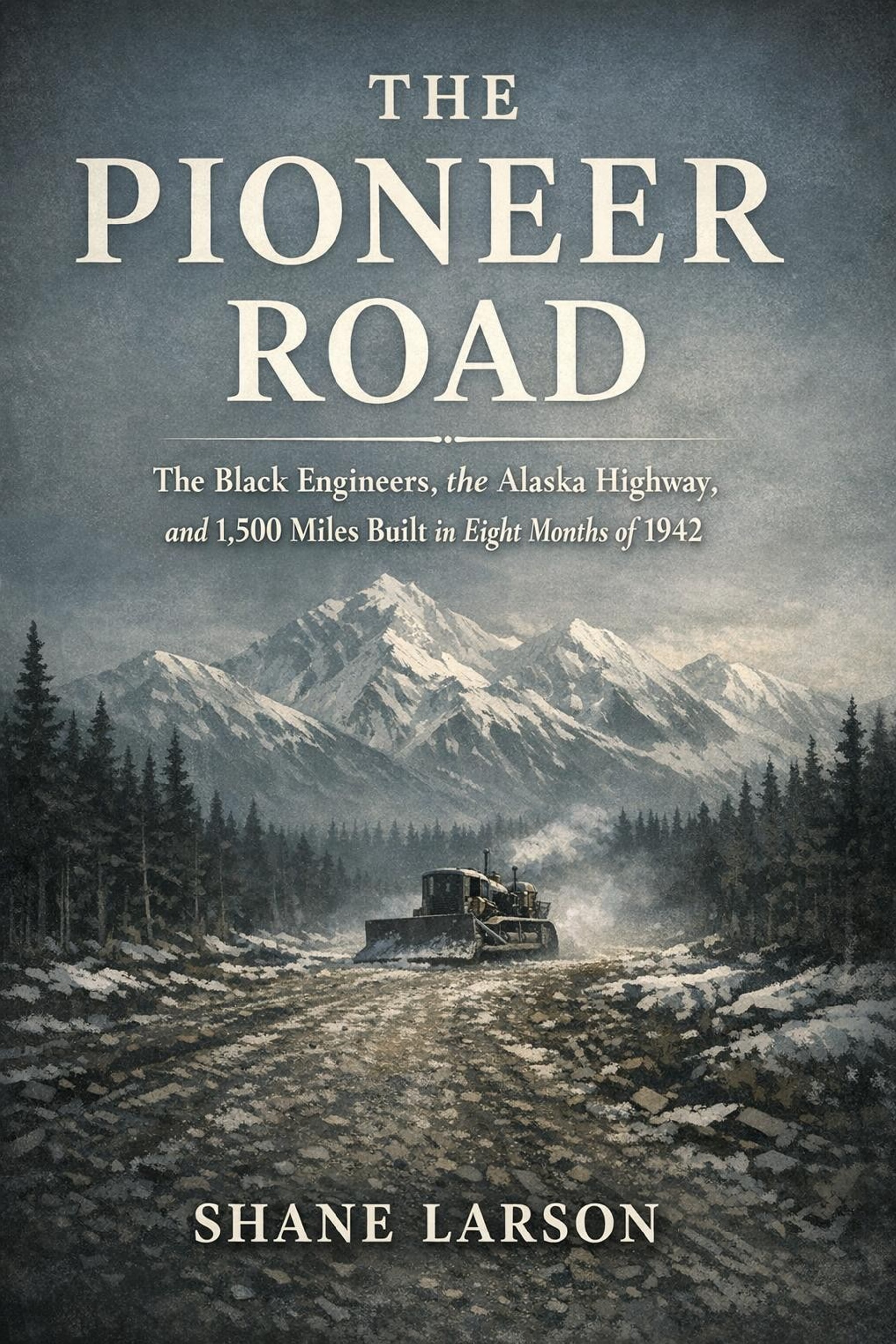
The Pioneer Road
The Black Engineers, the Alaska Highway, and 1,500 Miles Built in Eight Months of 1942
By Shane Larson
About This Book
On November 20, 1942, on a bluff the Army had named Soldiers Summit, above Kluane Lake in the Yukon, four soldiers stood in about fifteen below zero holding a ribbon while a Canadian cabinet minister and the secretary of the Territory of Alaska cut it. Two of the four men on the ribbon were Black. One of them, Corporal Refines Sims Jr., had driven the bulldozer that closed the last gap in the road four weeks earlier. The speeches thanked two governments, the officers in command and the engineer branch of the Army. They did not name his regiment, or the other two Black regiments that had built roughly a third of the road under the officials' boots.
The ribbon came down, the convoys started, and the highway's story as it reached the newsreels and the postwar books was, for about fifty years, one those regiments barely appeared in.
Nearly four thousand of the soldiers who built the Alaska Highway in 1942 were Black men the commanding general in Alaska had asked the War Department not to send. This is the road's history, told with them in it.
The Pioneer Road: The Black Engineers, the Alaska Highway, and 1,500 Miles Built in Eight Months of 1942 follows the whole project, from the 1930s lobbying nobody would fund through one frantic season, the rebuild, the pipeline, the air route to Siberia, the reckoning with Canada, and the slow return of two men to a photograph.
A Road Built Because a Government Was Afraid
For a decade before the war, a Fairbanks engineer and two international commissions tried to sell Washington and Ottawa on a highway to Alaska and failed. Pearl Harbor changed the arithmetic. In February 1942 the United States decided to build it through Canada along a chain of airfields Canada had already laid out, at American expense, with the Canadian section to be handed over when the war ended.
What followed was a race against the calendar. Troops reached the Dawson Creek railhead in March, ahead of breakup. The first crews to strip the moss off permafrost watched the ground beneath turn to soup and swallow their grade. Twelve men drowned when a pontoon barge went over on Charlie Lake in May, and bridges went out with the summer rivers. Seven regiments pushed the track toward each other from both ends until it closed near Beaver Creek on October 25.
Three of those regiments, the 93rd, 95th and 97th Engineer General Service Regiments, were Black, under white officers. They camped apart, were kept out of the towns by standing order, and at the start had less of the heavy machinery the work demanded. What they did with what they had is on the record: the 95th, once it got bulldozers, bridged the Sikanni Chief River in eighty-four hours by its own count, and the 97th, landed at Valdez with the thinnest equipment on the project, drove southeast through the worst permafrost on the route until its lead machine met the 18th's at Beaver Creek. The book gives this as documented, and separates it from what has hardened into legend.
Why I Wrote This
I live in Alaska, at the top end of this road. It is the only way to drive here, and the version of its story most people up here carry is short: eight months, ten thousand soldiers, an engineering marvel, a handshake in the snow. That was my version too.
What I did not have was the names. When I learned who was in the handshake, and that a third of the men on the road were soldiers a general had asked to keep out of the territory, the gap between the picture and the story was what I could not let go of. The fact was never hidden; the Army's own paperwork said who built the road, and the Black press printed the photograph in 1942. It simply stopped being the picture people reached for, for half a century. I wanted the road written whole, with the Black regiments where the record puts them, the Canadians and the First Nations where they belong, and the legends checked in both directions.
Frequently Asked Questions
Is this a narrative history or a reference book about the Alaska Highway?
Narrative history, about 74,000 words in thirteen chapters. The 1942 season is the spine, told by place, unit, month and machine, with named soldiers, Black and white, as its characters; no composite characters, no invented dialogue. Three appendices do the reference work: a mile-by-mile guide, a regimental timeline, and a glossary with a who's who.
Does it cover the Canol pipeline and the Lend-Lease air route to Russia?
Yes, a chapter each. Canol ran from the Norman Wells field over the mountains to a refinery at Whitehorse, and its chapter covers the Black 388th Engineer Battalion's part in it. The air route chapter follows the Northwest Staging Route to Fairbanks.
Is the book useful if I am driving the Alaska Highway?
That is what Appendix A is for. It walks the historic road from Mile 0 at Dawson Creek through Fort Nelson, Watson Lake, Whitehorse, Soldiers Summit and Beaver Creek to Delta Junction, with what happened at each place in 1942 and what is there now.
Does it cover the First Nations and Alaska Native communities along the route?
As a thread through the book, not a closing chapter: the guides and packers the locating parties depended on, the epidemics that came up the road, the Kluane Game Sanctuary of 1943, and the land-claim settlements of later decades. Oral histories are paraphrased and attributed.
Were the Black regiments really given only hand tools?
No, and the book says so. The record shows the 97th arriving with very little heavy equipment, the 95th doing hand labor until its bulldozers came in late summer, and all three getting less, and later, than the white units. The absolute version cannot be traced to a unit record, and repeating it gives a skeptical reader a way to dismiss the documented version.
If You Liked This, You Might Like
- The Inca Highway — another road driven through country that fought it, by a state that knew the road itself was the instrument of control.
- Bass Reeves — a documented life from the Black frontier, told by the same rule this book follows: the record over the legend.
- The Oil Was a Clock — the Pacific war of 1941–42 from the Japanese side: the fear that put bulldozers at Dawson Creek.
- The Alaska Purchase — how the territory at the end of this road became American, long before anyone could drive to it.
The road the Army apologized for in its own reports is still the only way to drive to Alaska, and the two men who closed it near Beaver Creek are back on the panels where its story is told. This is how it was built, who built it, who paid for it, and how long the story took to catch up with the picture.
What You'll Learn
- Permafrost, muskeg and corduroy: what a pioneer road actually was, why scraping it clean destroyed it, and how soldiers learned to build on a frozen swamp in a season.
- The equipment question, handled as the debate it is: what the records show about the Black regiments' machinery and when it arrived, and where the "hand tools only" story comes from.
- Contact Creek and Beaver Creek: the two meetings that joined the road, and whether the famous handshake photograph was caught or posed.
- The real highway of 1943, the Canol project that refined oil at Whitehorse for roughly a year, and the Senate committee that asked whether it was worth the money.
- Nearly 8,000 Lend-Lease aircraft handed to Soviet crews at Fairbanks, and the argument that the airfields, not truck traffic, were the road's real wartime value, with the counter-case given its due.
- A foreign army in Canada's north: more Americans than Canadians in the region by 1943, and why Ottawa paid for everything the Americans had built before the handover of April 1, 1946.
- The people already there: Dane-zaa, Kaska, inland Tlingit, Southern Tutchone and Upper Tanana communities as guides and workers, the epidemics of 1942 and 1943, and the sanctuary that closed Kluane to the people who hunted it.
New Military History releases and free chapters — no spam, unsubscribe anytime.
More in This Genre
View all →