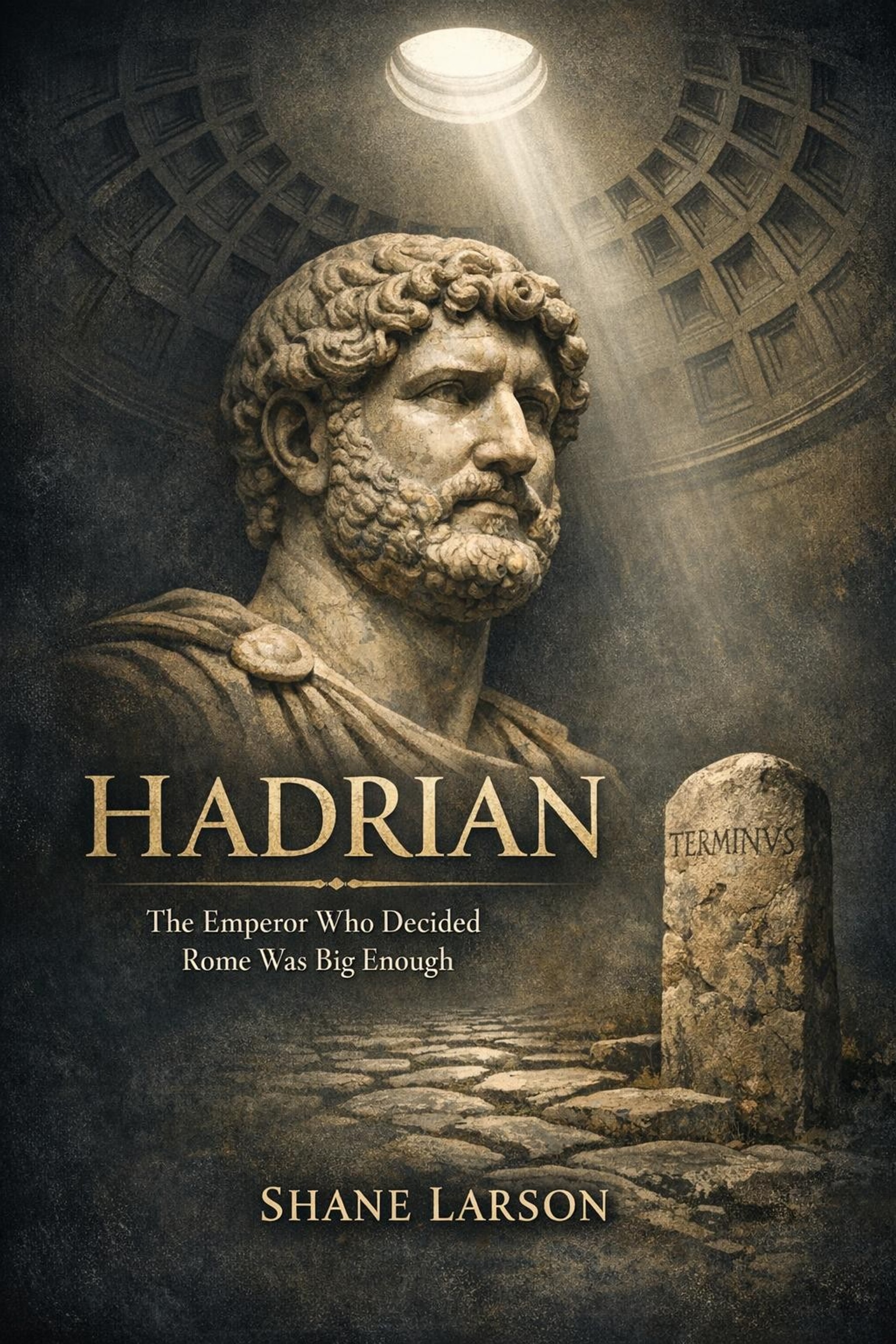
Hadrian
The Emperor Who Decided Rome Was Big Enough
By Shane Larson
About This Book
On a busy avenue in Athens, beside the ruins of the largest temple in Greece, a marble gateway stands with a line of Greek cut into each face. The side facing the Acropolis says that this is Athens, the former city of Theseus. The side facing the new quarter answers it: this is the city of Hadrian, and not of Theseus. A Roman emperor had put his name across the oldest city in the Greek world, in the 130s AD, and the Athenians built the gateway for him. He had just finished a temple the Athenians had been failing to finish for six hundred years.
In Rome the same man put his name on almost nothing. The Pantheon, rebuilt from the ground up under a concrete dome that is still the widest unreinforced one on earth, carries the name of Agrippa, who had built the one that burned. The Senate would have been glad to leave Hadrian's name off everything, and when he died in July 138 it tried to: the senators moved to annul his acts and refuse him a god's honours. His heir had to plead for them in person.
The Emperor Who Said Enough
Hadrian: The Emperor Who Decided Rome Was Big Enough is a life of the man rather than a history of the reign. It tells him as a person, and his court as a world of named people: the cousin who adopted him, the empress who arranged his marriage, the brother-in-law who sabotaged his carriage and whom he ordered dead nearly forty years later, the sacked secretary who had written The Twelve Caesars, the Greek professor who said it was unwise to argue with the master of thirty legions, and the sixteen-year-old he picked out to rule two generations ahead.
The argument running under the life is about one decision. Hadrian came to power at Antioch in August 117 with his predecessor's eastern conquests collapsing around him, and within weeks he gave them up. No emperor had ever done that. Rome had assumed since its foundation that there would always be another province, and the aristocracy's whole reason for existing rested on the assumption. Hadrian spent the rest of his reign making the retreat permanent: a palisade along the German frontier, a wall across Britain, a Parthian king met at the Euphrates and talked out of a war, and legions drilled hard for campaigns he had no intention of fighting. The frontiers he fixed held for three hundred years, and the Senate understood what he had told it and never forgave him.
The book takes that hatred seriously. The reign opened with four of Trajan's generals killed without trial while Hadrian was still on the road to Rome, and closed with the ninety-year-old Servianus and his teenage grandson forced to die so that neither could inherit. In between, the emperor who wept in public for a drowned young man and laid out a city on the Nile for him also broke nearly every expert who contradicted him. The poet and the killer were the same person, and the book does not resolve him into either.
Why I Wrote This
I came to Hadrian through a vote that nearly happened. I knew the Pantheon, the Wall and the villa, and like most people who had read the famous novel about him I thought I knew the man: reflective, melancholy, at peace with his cruelties. Then I read that the Senate of 138 had tried to annul his acts and deny him a god's honours, and that the attempt failed only because his successor begged. I wanted to know what the people who actually worked with him had seen. The answer was a man far harder to like and far more interesting: touchy, jealous, generous, brilliant, and unable to lose an argument. The novelist had to resolve him into one voice. A historian does not, and with Hadrian I think it is a mistake to try.
Frequently Asked Questions
Do I need to read The Height of Empire first?
No. The Height of Empire tells the century from Nerva to Commodus as a sequence and gives Hadrian's reign about three chapters as policy. This book assumes none of it and tells the life from birth to deification.
Is this the history behind Memoirs of Hadrian?
In large part, yes. The Introduction and Conclusion discuss Marguerite Yourcenar's novel at length, where it follows the sources and where it chose among them or invented. The book does not quote it. It is the record the novel was built on, told without a single narrating voice to smooth the contradictions over.
How does the book handle Antinous?
Plainly. It states what the ancient writers say the relationship was, and says just as plainly that his age and the manner of his death are unknown. The three ancient explanations of the drowning are set out in Chapter 8 and left open. There is no sexual detail and no modern label imposed on either man; the subject is the grief and what it produced.
How much of the book is about Hadrian's Wall?
One scene of about six hundred words in Chapter 4: the decision in 122 and why a line of stone fitted the policy of an emperor who had just decided the empire would grow no further. The construction, the garrison and the three centuries that followed belong to the companion volume on the Wall itself.
How reliable are the sources for Hadrian's life?
Worse than readers usually expect. The main narrative source is a biography written around 395 by one author posing as six, who mixed real material from Hadrian's lost autobiography with gossip and forgery; Dio survives only in a Byzantine summary. The inscriptions, coins, papyri and buildings are far firmer, and every chapter says which kind of evidence a claim rests on.
If You Liked This, You Might Like
- The Height of Empire — the same reign told as policy inside the century from Nerva to Commodus, so that Hadrian's retreat can be measured against Trajan's conquests before it.
- Marcus Aurelius — the life of the sixteen-year-old Hadrian chose two generations ahead, who kept the frontiers where his adoptive grandfather had drawn them and never once thanked him in writing.
- The Parthians — the empire on the far side of the line Hadrian restored in 117, and the view from the east of the conquests Trajan made and Hadrian gave back.
An emperor who could see, alone among his contemporaries, that an empire had limits, and who never found any for his own authority over the people nearest him. This book holds both facts at once.
A standalone biography beside Rome: From Village to Empire, and the first of three companion titles on Hadrian, his Wall and his Britain.
What You'll Learn
- **A boy called the Greekling**: the Spanish-Roman family at Italica, the orphan who became Trajan's ward, the Greek obsession that earned a nickname his relatives did not mean kindly, and the teenage hunting trip that got him recalled to Rome.
- **Twelve years on the road**: the two great journeys of 121 to 125 and 128 to 132, with the bill paid by the towns the court passed through, and an appendix giving the itinerary year by year with its evidence.
- **The parade ground at Lambaesis**: the stone text of a speech Hadrian made to a legion in Numidia in July 128, praising the cavalry and the speed of their wall-building, and what it says an army is for once conquest has stopped.
- **Antinous**: the young man from Bithynia who drowned in the Nile in October 130, what the ancient writers say the relationship was, the fact that his age is unknown, and the grief that produced a city, a cult, a star and an obelisk.
- **The dome and the villa**: how the Pantheon's concrete was graded lighter toward the oculus, why Agrippa's name stayed on the front, and what a palace eighteen miles outside Rome said about his view of the capital.
- **The bitter end**: the adopted heir who died on New Year's Day 138, the killings, Antoninus adopted on condition he adopt Marcus and Lucius Verus, the months at Baiae begging for poison, and five lines of Latin to a departing soul.
New Ancient History releases and free chapters — no spam, unsubscribe anytime.
More in This Genre
View all →