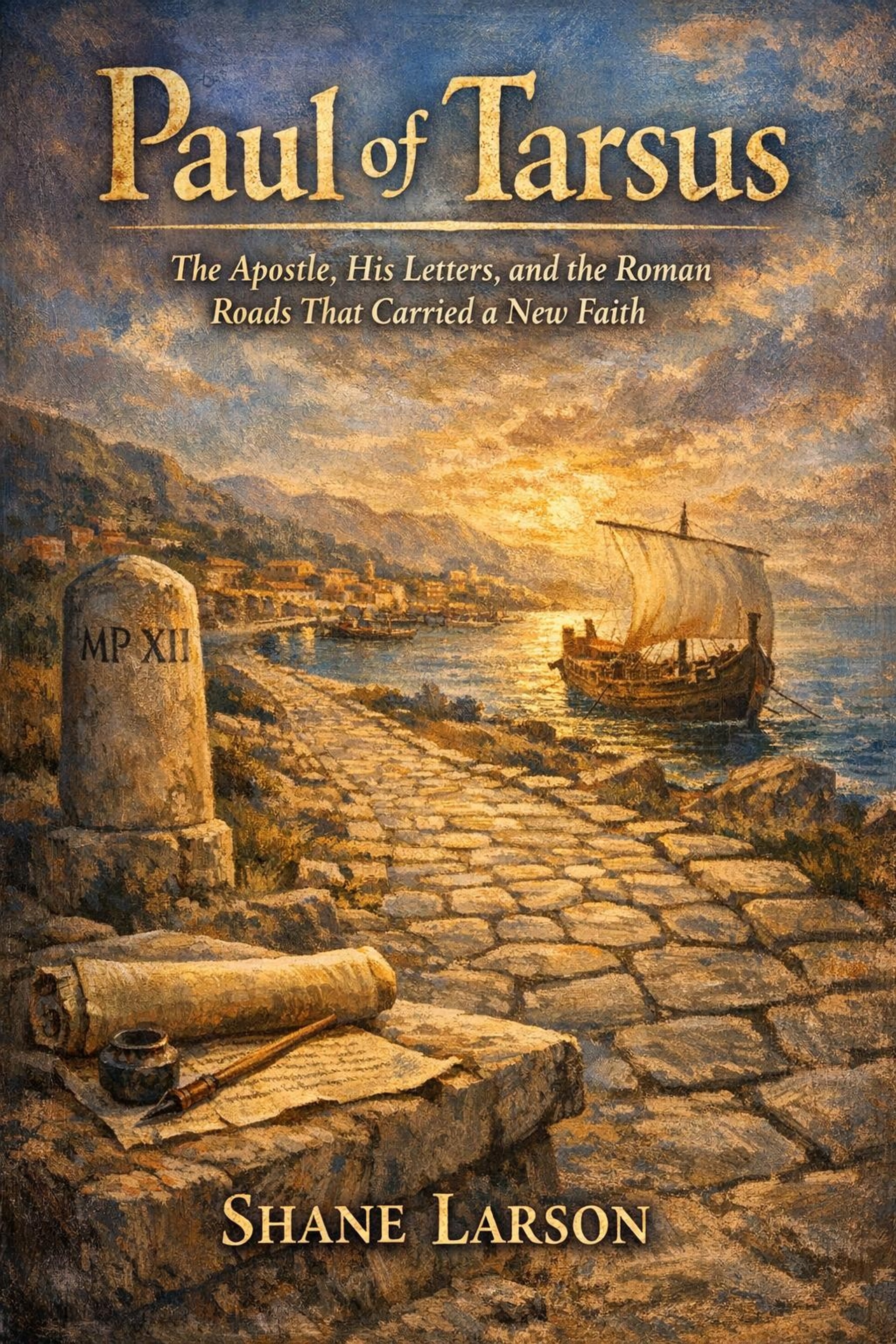
Paul of Tarsus
The Apostle, His Letters, and the Roman Roads That Carried a New Faith
By Shane Larson
About This Book
Near the end of the longest letter in the New Testament, after Paul has sent greetings to more than two dozen people by name, a second voice breaks in for a single sentence. "I Tertius, who wrote this epistle, salute you in the Lord" (Rom 16:22). Then Paul resumes. The room is a house in Corinth, the winter of 56 to 57 or thereabouts. The man with the pen is a trained scribe; the man dictating is a Jewish tentmaker in his fifties, writing to an assembly in Rome he had never visited. A woman named Phoebe, from the harbour town seven miles away, would carry the finished sheets.
It is the only moment in the letters when the reader sees how they were made, and it opens a question the New Testament never answers. If a scribe held the pen for Romans, how much did scribes do? Thirteen letters carry Paul's name. Scholars across the confessional spectrum accept seven as his beyond serious doubt. The other six are argued over, and the argument does not run between believers and sceptics; it runs through both camps.
The letter taking shape in that room would be opened, centuries on, by a weeping rhetoric teacher in a Milan garden, by a friar lecturing in Wittenberg, and by a reluctant clergyman in a London meeting house in 1738, and each would say it changed his life. Acts, which gives the Damascus road, the journeys and the shipwreck, never mentions that Paul wrote a letter at all.
Letters First, Acts Second, and Then the Stones
The letters are Paul in his own voice, written to groups of a dozen or two dozen people meeting in somebody's house. Acts is the view from a generation later, by an admirer writing probably in the 80s or 90s, and it is the only source that makes Paul a Roman citizen, a pupil of Gamaliel, and a witness at the stoning of Stephen. The two disagree on things as basic as how many times he went to Jerusalem: three in the letters, five in Acts. Paul of Tarsus: The Apostle, His Letters, and the Roman Roads That Carried a New Faith follows one rule. Where Acts stands alone, the prose says "Acts says". Where the two conflict, the reader gets both accounts and is told which way the argument leans.
Then there are the stones, each given its discovery date and its limits. A limestone letter of the emperor Claudius, pieced together at Delphi from fragments published between 1905 and 1913, names Gallio as proconsul of Achaia, and the emperor's titles at its head date the term to 51–52; every date in Paul's life is counted from that stone. A paving block at Corinth, found in 1929, names an Erastus who may or may not be the city treasurer Paul greets in Romans. Two warning stones from the Jerusalem Temple, found in 1871 and 1935, carry the death penalty for Gentiles who passed the barrier, the law Paul was accused of breaking. And there are the roads and sea lanes that let a craftsman from Cilicia found a community in Macedonia and correct it by post from Ephesus; the book uses him to show the empire at work.
It takes no position on what happened to Paul outside Damascus, because no document can confirm or refute it. A reader who holds that he saw the risen Christ and a reader who thinks otherwise will find the same man in these pages, doing the same things for the same stated reasons.
Why I Wrote This
What hooked me was how early he is. The oldest Christian document in the world is not a gospel but a piece of private correspondence, and its author had never met the man it is about. Then I learned that a broken stone at Delphi is the reason anyone can put a year on it at all, and I was gone. Most books about Paul are written from inside a church tradition or against one, and I belong to neither camp. I had nothing to defend and nothing to prove, so I could put the traditional reading and the critical one on the same page and let them argue. The other draw was the roads. Paul is the best-documented ordinary traveller the first century has, and following him is a way of seeing the Roman East from the workshop bench to the governor's tribunal.
Frequently Asked Questions
Is this a Christian book or a skeptical one?
Neither, and the Introduction says so. The book describes what Paul claimed and what he did about it, and does not rule on whether the risen Jesus appeared to him, because no document can.
Do I need to know the New Testament before reading it?
No. Every letter and every episode from Acts is introduced as it comes up, and Appendix B summarises all thirteen letters plus Hebrews.
Which letters did Paul actually write?
Seven are accepted by nearly all scholars: Romans, 1 and 2 Corinthians, Galatians, Philippians, 1 Thessalonians and Philemon. Three are seriously debated, and most critical scholars place 1 and 2 Timothy and Titus after Paul's death, with a serious minority defending them. The book is built on the seven, and every use of a disputed letter is flagged.
Was Paul a Roman citizen?
Only Acts says so; the letters never mention it. The book gives the arguments for and against and says "if Acts is right" wherever citizenship carries the story.
Is it useful for a trip following Paul's journeys through Greece and Turkey?
Yes, within limits. Appendix C covers fifteen cities from Tarsus to Rome: what each was in Paul's day, what he did there according to which source, and what survives, from the bema at Corinth to St Paul's Bay on Malta.
If You Liked This, You Might Like
- Nero — the emperor under whom tradition places Paul's execution, and the family of Seneca, whose brother Gallio heard Paul's case at Corinth.
- The Julio-Claudians — the Claudius whose expulsion of Jews from Rome sent Prisca and Aquila to Corinth, and whose titles on the Delphi stone date Paul's stay there.
- The Height of Empire — the roads, provinces and sea lanes Paul travelled, seen a few generations later from the top down.
- Masada — the Judaea of Felix and Festus, Paul's jailers at Caesarea, and the war that did more than he ever did to turn a Jewish movement into a religion of the nations.
The stones, the roads and the letters are all still there. This book walks them in the order the evidence allows, says which source each scene stands on, and stops where the record stops.
What You'll Learn
- **Tarsus and the two names** — a Greek university city on the Cydnus, and why a Diaspora Jew carried both "Saul" and "Paul" from birth, so that the switch in Acts is not a conversion story.
- **The basket over the wall** — Paul's escape from Damascus while the agent of a Nabataean king guarded the gates, and why a king who died around 40 anchors the early chronology.
- **The quarrel over circumcision** — Galatians 2 beside Acts 15, the handshake with James, Cephas and John, and the day Paul withstood Peter "to the face" at Antioch and lost the room.
- **Corinth under Claudius** — Prisca and Aquila, expelled from Rome; the dating puzzle in seven words of Suetonius; and the hearing before Gallio, Seneca's brother.
- **Seven letters, six disputed** — the methods and their limits, the forgeries nobody defends (3 Corinthians, the Letter to the Laodiceans, fourteen letters between Paul and Seneca), and two passages in the undisputed letters that may have been added later.
- **The traditional reading and its rivals** — the Lutheran Paul, the New Perspective, and "Paul within Judaism", set out as a live argument.
- **Custody and shipwreck** — two years under Felix at Caesarea, the appeal to Caesar, and Acts 27, the most detailed ancient sea voyage to survive, tested against the Maltese coast in 1848.
- **Ephesus in photographs** — nine of my own photographs, from the theatre of the silversmiths' riot to the council house, each captioned with whether it stood in Paul's day.
- **Three appendices** — two chronologies side by side, all thirteen letters plus Hebrews with their authorship status, and a gazetteer of the cities with what a visitor can see now.
Included with Kindle Unlimited — read it free if you're a member.
New Ancient History releases and free chapters — no spam, unsubscribe anytime.