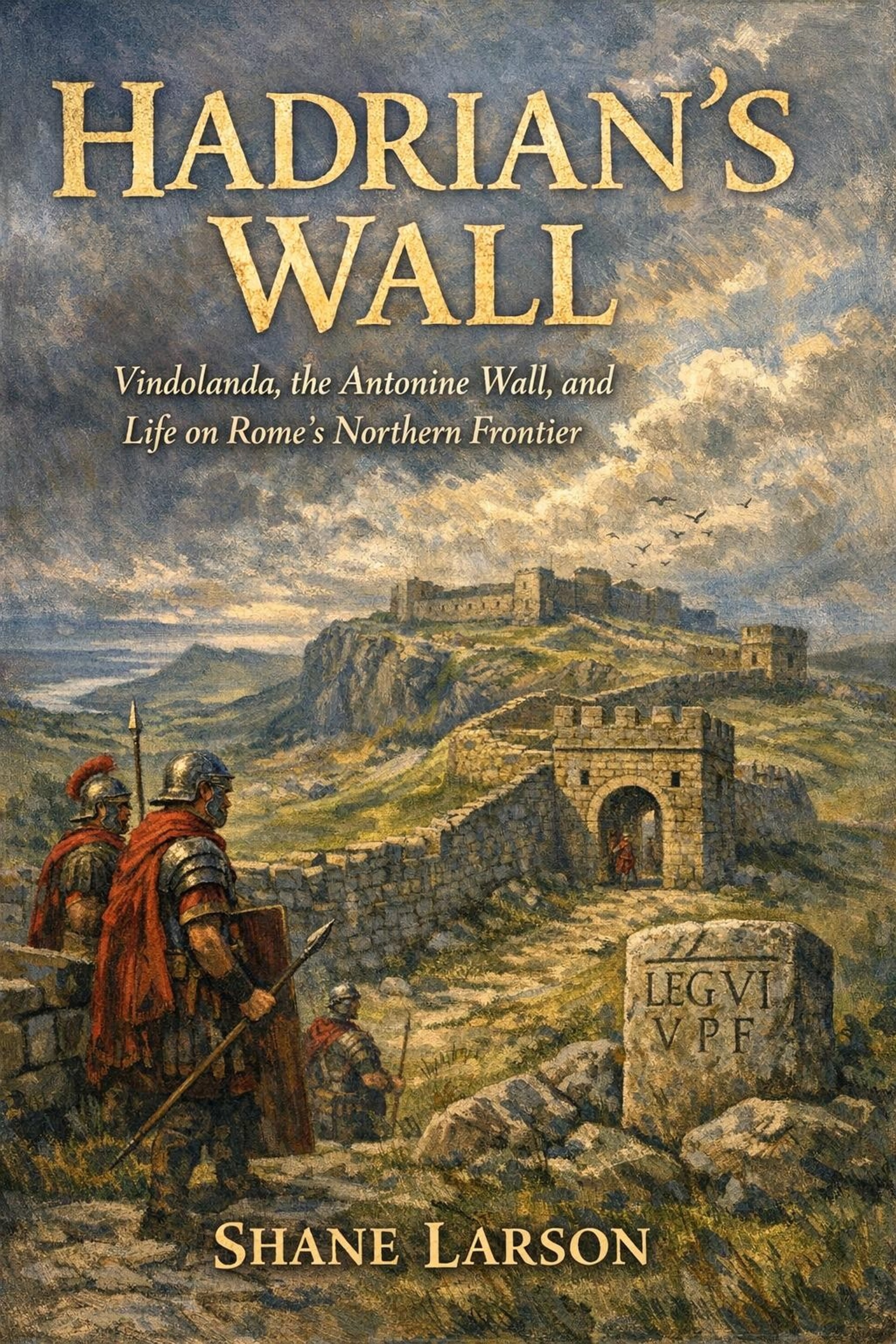
Hadrian's Wall
Vindolanda, the Antonine Wall, and Life on Rome's Northern Frontier
By Shane Larson
About This Book
In 1878 workmen digging south of the Roman fort at South Shields, on ground that had once been its cemetery, turned up a sandstone tombstone a little under four feet high. It shows a woman in a high-backed wicker chair, a distaff and spindle on her lap, a basket of wool at one side and a locked jewellery box at the other. The Latin beneath says that Barates of Palmyra put it up to Regina, his freedwoman and his wife, a Catuvellaunian by birth, who lived thirty years. Below the Latin there is one more line, in the Aramaic script of a caravan city in the Syrian desert, and it ends with a single word that means alas.
A trader from the far side of the empire, a woman born near St Albans and once his slave, a sculptor trained in the workshops of Palmyra, and a grave on a cold coast at the mouth of the Tyne. Nothing about Hadrian's Wall says better who actually lived on it. The line itself is what everyone comes to see. The people on it take more finding, and they are what this book is for.
A Border That Kept Being Rebuilt
Hadrian's Wall: Vindolanda, the Antonine Wall, and Life on Rome's Northern Frontier is a biography of a place over three centuries of use and fifteen more of afterlife. It runs from the Roman army's retreat out of Scotland in the 80s AD, when the frontier came to rest on a road across the narrow neck of Britain, to the walkers on today's National Trail, and it treats the Wall as the protagonist and the garrison as the cast.
The first thing it does is put the Wall in its place. Hadrian came in 122 and ordered a line from the Tyne to the Solway, but the forts he found were already a generation old, and the road they stood on, the Stanegate, had been the frontier since the 80s. The people whose letters survive in the mud at Vindolanda, the prefect Flavius Cerialis and his Batavian cohort, the Tungrian commander whose clerk recorded that only 296 of his 752 men were in camp, belong to that road and not to the Wall. Their paperwork describes the problem the Wall was built to solve.
The second thing is to take the Wall apart and ask what it was for. Eighty Roman miles, stone east of the Irthing and turf west, a fortified gate at every mile, two turrets between, a ditch in front, the Vallum behind, and in the end fifteen to seventeen forts. A wall with that many gates was not built to keep everyone out. The book argues that it was a membrane rather than a dam, a line for channelling people, cattle and goods through doorways where soldiers could count and watch them, and it gives the objections their full weight, including the berm pits and the north-facing fort gates that look very much like an army expecting trouble.
The third thing is to follow the line to its end, which was not a departure. Nobody marched south in 410. The coin supply stopped around 402, the units turned local, and at Birdoswald somebody laid the floors of two timber halls across the collapsed granaries and went on being important.
Why I Wrote This
I came to the Wall through the socks. One of the first tablets read from Vindolanda was a note about a parcel of socks, sandals and underpants, and the more I read about the site the more I found that the letters everyone quotes from Hadrian's Wall were written before Hadrian's Wall was there. That reversed the story I thought I knew. The Wall was not the start of the frontier but a renovation of one, and it went on being renovated for three hundred years. I also wanted a book that did what the stones cannot, which is to put people on the line: the prefect's wife, the trader with his hides, the Palmyrene and his British wife, the sick men on the strength report. And I wanted one a walker could carry, with a gazetteer that says what is Roman, what is reconstructed, and which century you are standing in.
Frequently Asked Questions
Was Hadrian's Wall the border between England and Scotland?
No, and it never was. The Wall lies entirely in England; the modern border runs north of it along its whole length, by a few miles at the Solway end and by more than sixty at the Tyne.
How much of the book is about the Vindolanda tablets?
The bulk of Part One. The book paraphrases them in its own words rather than quoting the published translations, cites each by its inventory number, and gives twenty of them in an appendix with date, writer and why each one matters.
Does the book cover the Antonine Wall?
Yes, in a full chapter. The turf wall between the Forth and the Clyde, begun in 142 under Antoninus Pius and abandoned within roughly a generation, with the debates over why it was built and when it was left.
Is this a guidebook for walking Hadrian's Wall Path?
It is a history first, written with the walker in mind. The gazetteer in Appendix A goes east to west, site by site, and says what can be seen, what is reconstructed, and how each place fits the story. No opening hours or prices, because those date.
How much is about the emperor Hadrian himself?
One chapter, on the visit of 122 and what the decision to build announced. This is a book about the frontier and the people on it, not a biography of the man who gave it his name.
If You Liked This, You Might Like
- Boudica — the revolt that burned London sixty years before Hadrian came north; Regina's people, the Catuvellauni, lost their capital in it.
- The Height of Empire — the empire-wide story of the years in which Hadrian decided Rome had edges, with the Wall as one frontier among many.
- Hadrian — the life of the emperor who ordered the line in 122, and why a man who had just given up Trajan's conquests wanted a wall.
- Teutoburg Forest — Rome's other northern limit, fixed by a disaster in a German forest rather than by an emperor's survey.
A line of stone across the narrowest part of Britain, eighty gates in it, and three hundred years of people walking through them. The stones kept the shape of what the army did. The mud at Vindolanda kept the people.
A standalone history on the British shelf, alongside Boudica.
What You'll Learn
- **The Vindolanda tablets as objects**: ink on birch and alder, preserved without oxygen, read under infrared since 1973, and what they say about kitchens, leave requests, oysters and the view of the Britons from inside the fort.
- **Building eighty miles**: three legions working in lengths, a broad foundation that became a narrow wall partway through, forts added to a design that had not included them, and why the western third was turf.
- **The eighty-gates problem**: the century-old debate over the Wall's purpose, from the 1921 paper that set its terms to the recent case for a harder military reading, with the book's position argued against its best objections.
- **The Antonine Wall in full**: forty Roman miles of turf between the Forth and the Clyde, begun in 142 and given up within about a generation, with the distance slabs and the argument over why it was built and why it was left.
- **Life on the line**: the Housesteads latrines, the settlements outside the gates, soldiers' marriages before and after the ban was lifted, and two bodies under a floor with a knife point in one of them.
- **The gods of a mixed garrison**: a well holding more than 13,000 coins, a Mithraeum, a Germanic war god and his two companions, a Syrian goddess at Carvoran, and the thin late trace of Christianity.
- **The afterlife**: Lanercost Priory built from Roman blocks, a road laid on the Wall after the 1745 rising, an antiquarian who walked the length of it at seventy-eight, and the Pilgrimages that turned a ruin into a monument.
- **Three appendices**: a walker's gazetteer from Wallsend to Bowness, twenty tablets with the book's own paraphrases, and a timeline from AD 70 to 410.
New Ancient History releases and free chapters — no spam, unsubscribe anytime.