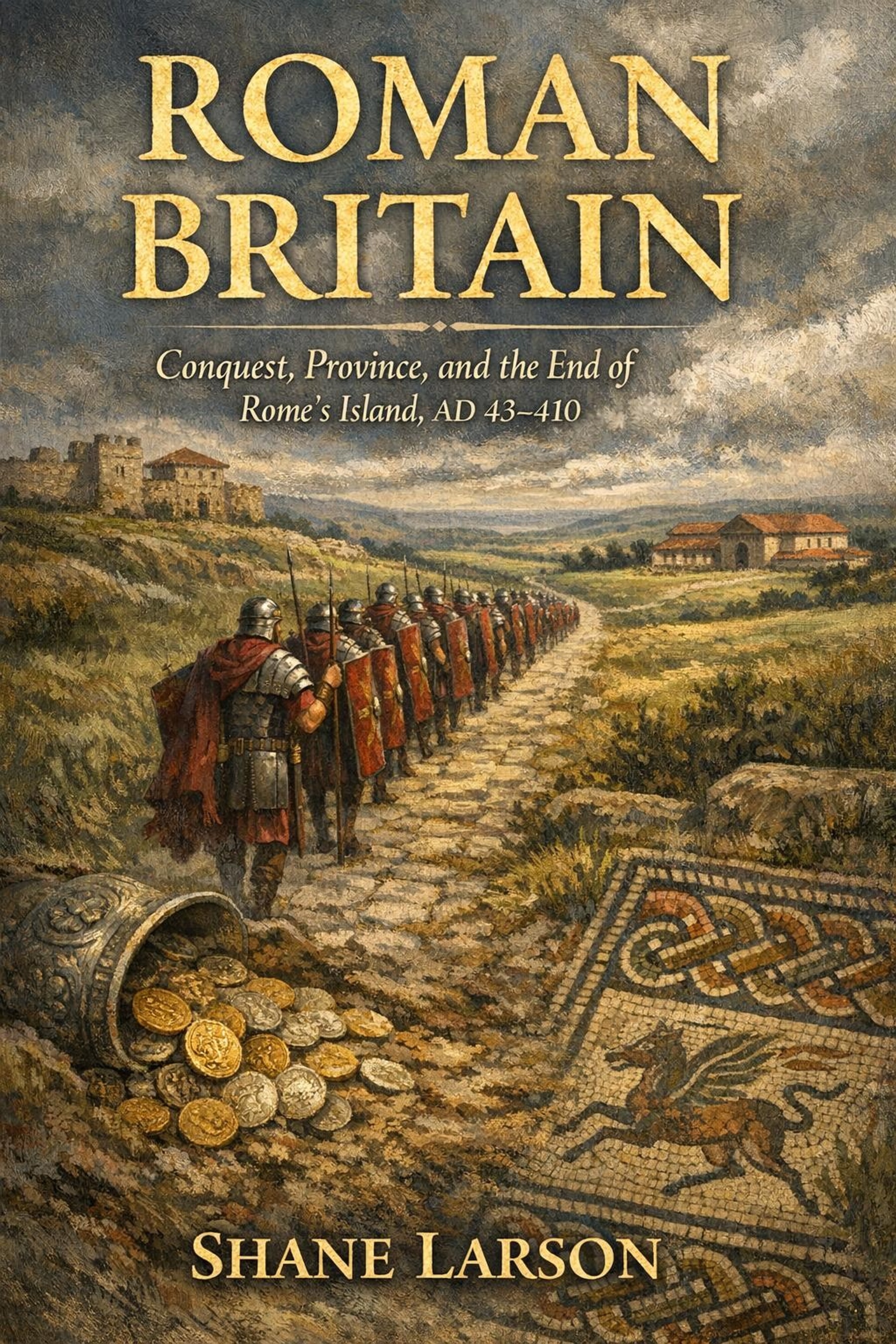
Roman Britain
Conquest, Province, and the End of Rome's Island, AD 43–410
By Shane Larson
About This Book
In the mid-80s AD, on a terrace above the River Tay in Perthshire, a Roman legion was building the fortress from which it meant to hold Scotland. Barracks, a hospital, granaries, a headquarters with its foundations laid. Then the order came to go. The men dismantled what they had built, broke the pottery, filled in the drains, and dug a pit into which they tipped something like 875,000 iron nails, so that no Caledonian smith would ever turn them into spearheads. Then they marched south, and the north was never garrisoned on that scale again.
Nobody wrote that down. The nails were found in 1960, and they say something no Roman author admits: that the conquest of the island, the battle in the far north that Tacitus made his father-in-law's finest hour, ended in a demolition. The frontier the province is most famous for was drawn where the retreat happened to stop.
That is the pattern of Roman Britain. The loud story is in a Latin text with an agenda. The true story is usually in the ground, and it is usually quieter and stranger.
Three and a Half Centuries, Mostly Underground
Roman Britain: Conquest, Province, and the End of Rome's Island, AD 43–410 tells the whole span of Rome's rule over the island in one narrative, from Caesar's two failed summers to the decade when the money stopped arriving and the province switched itself off. That span is 367 years, longer than the time between the English Civil War and today, and the people at the end of it, hoarding silver spoons in Suffolk, were as far from the people at the beginning as we are from Shakespeare.
Almost nothing written about Roman Britain was written by a Briton. Where the British speak for themselves it is on lead and wood: the hundred-odd curse tablets from the hot spring at Bath, the letters from the fort at Vindolanda, the wax tablets from under a London office block, one of them dated 8 January AD 57. Everything else is roads, villas, forts, coins by the hundred thousand, hoards and rubbish pits, and more of it has come out of the ground since 1990 than in all the centuries before. So every chapter is anchored to a site or an object that can still be seen, and every claim that matters says what kind of evidence it rests on.
Five arguments run the length of the book. The conquest never finished; Scotland was entered and abandoned three times. "Romanization" is a debate between Haverfield, Millett and Mattingly, not a fact, and most Britons never lived in a Roman building. Britain made emperors by arithmetic, because it held a large army far from the centre: Albinus, Carausius, Constantine, Magnus Maximus and Constantine III all came out of it. The fourth century was in parts the richest the island would see until the later Middle Ages. And there was no departure. What happened after 400 was a switching-off, system by system, while the people who had lived inside the system stood and watched.
Why I Wrote This
Boudica left me at AD 61 with three hundred and fifty years of the province still to go, and I kept finding that the parts I wanted to read about were the parts the popular histories skipped. The fourth century especially. Everyone knows the invasion and the Wall and the legions leaving; almost nobody knows that the Cotswolds were being floored with mosaics while the Rhine cities burned. Then I read the argument that Honorius's letter of 410, the single most quoted date in the island's Roman history, may have been sent to the toe of Italy, and I realised the ending I had been taught rested on one sentence in a careless compiler. That was enough. I wanted the version where the schoolbook story is taken apart piece by piece and what replaces it is a province you can walk through, site by site, with the evidence for every claim named as you go.
Frequently Asked Questions
Do I need to read Boudica first?
No. This is a standalone history and it supplies the background from Caesar onward. The years from 43 to 61 get one and a half chapters here and the revolt about fifteen hundred words, because Boudica already tells it in full and readers who want it at length are pointed there.
Did the Romans really leave Britain in 410?
No legion sailed in 410; the last field army had gone to Gaul in 407 with a usurper, the coin supply had stopped around 402, and in 409 the Britons expelled the remaining imperial officials themselves. The famous letter rests on one sentence in Zosimus, and a respectable body of scholars thinks that sentence is about Bruttium in southern Italy. The book gives both readings and does not pretend the matter is settled.
How much of this book is about Hadrian's Wall?
One chapter of fourteen. The Wall appears as part of the northern frontier, alongside the Stanegate and the Antonine Wall, with enough to see what it was for and what it cost the province to keep. The garrison, the Vindolanda letters in detail, and the Wall's long afterlife belong to a book of their own.
Is this a narrative history, an archaeology book, or a textbook?
A narrative, with people and objects as the spine. It assumes no Latin and no previous reading. But because most of Roman Britain is known from excavation rather than from writers, it says what kind of evidence each claim stands on, and it gives the live scholarly disagreements as disagreements.
How long is the book, and is it part of a series?
About 75,000 words, roughly 235 pages in the paperback, in fourteen chapters across three parts plus an introduction, a conclusion and three appendices. It is a standalone title on the British shelf, sitting between Boudica and The Norman Conquest.
If You Liked This, You Might Like
- Boudica — the revolt of AD 60 or 61 told in full; this book hands the first eighteen years of the province to that one.
- The Norman Conquest — the next time an army crossed the Channel and kept what it took, and the far end of the shelf this book begins.
- The Black Death — the other time Britain lost the apparatus of ordinary life within a generation, and a companion for the collapse-versus-transformation argument in the last chapter.
Rome held the island for longer than it has been since the Civil War, and the ground has kept more of the story than the writers did.
A standalone history on the British shelf, following Boudica.
What You'll Learn
- Claudius's sixteen days, the mutiny at Boulogne, a landing that may or may not have been at Richborough, and a client king's palace at Fishbourne whose floors are the reward for choosing the right side in AD 43.
- Caratacus, Cartimandua and Agricola, with Tacitus's speeches flagged as Tacitus's, and Boudica's revolt in fifteen hundred words with a pointer to the book that tells it in full.
- The Bath curse tablets, in which bathers ask the goddess to visit sleeplessness and worse on whoever took their cloak, read as the nearest thing to the voice of ordinary Roman Britain.
- The countryside that stayed British: roundhouses beside villas, tin and lead and Dolaucothi gold, slavery, and the Romanization debate laid out with the evidence for each side.
- An emperor dying at York in 211 and another proclaimed there in 306, with Carausius in between, running Britain as an independent empire and quoting Virgil on his coins.
- The golden age of the villas: Chedworth, Bignor, Woodchester and Lullingstone, the Mildenhall silver, a Christian mosaic with the face of Christ on a dining-room floor, and the question of who paid.
- The end in sequence: the conspiracy of 367, Magnus Maximus in 383, the last field army leaving in 407, the officials expelled in 409, and the letter of 410 with the argument over who it was sent to.
- Three appendices: a timeline from 55 BC to AD 450, a visitor's gazetteer region by region, and the governors, usurpers and ancient authors with a note on what each is worth.
New Ancient History releases and free chapters — no spam, unsubscribe anytime.
More in This Genre
View all →