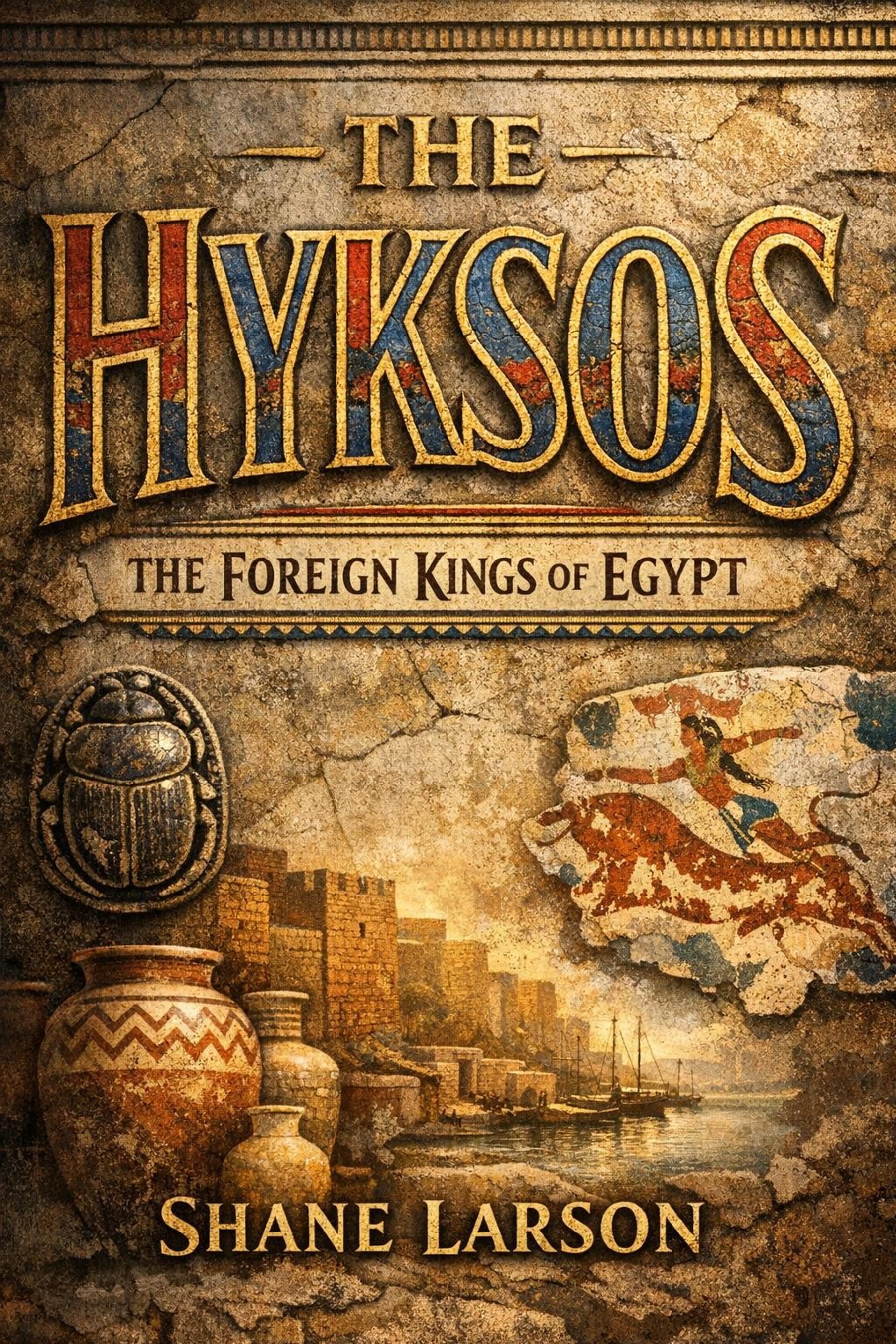
The Hyksos
The Foreign Kings of Egypt
By Shane Larson
About This Book
In the early 1990s, Austrian excavators working a low mound in the eastern Nile Delta began pulling painted plaster out of the dirt beside a ruined palace platform. The fragments showed acrobats vaulting over the backs of charging bulls, set against a maze pattern, in a style every archaeologist in the Mediterranean knew on sight. It was Minoan work — the art of the palaces of Crete, six hundred miles of open sea away. Nothing like it had any business being in Egypt.
The mound was Tell el-Dab'a, and the buried city beneath it was Avaris: capital of the foreign kings who ruled northern Egypt for a century in the middle of the second millennium BC — the dynasty history knows, through a chain of errors, as the Hyksos. The frescoes were only the most photogenic surprise. Half a century of excavation has produced Canaanite temples on Egyptian soil, warriors buried with donkeys at their tomb doors, harbors full of imported wine jars, and — nowhere at all — the layer of ash and arrowheads the invasion story requires.
Because there was supposed to be an invasion. For two thousand years, the only surviving account of this century said barbarians out of the east had burned Egypt's cities, razed its temples, and enslaved its people, until heroic Theban kings drove them out. Almost none of it survives contact with the ground.
This book tells the story of Egypt's century under foreign kings — and of the fifteen centuries Egypt spent lying about it. During the Second Intermediate Period, when the crown's authority crumbled, kings with West Semitic names took power in the Delta, wrote their names in cartouches, worshipped a fusion of Egyptian and Levantine gods, and governed the richest land in the ancient world through the same offices as the pharaohs before them. Egypt was not conquered so much as partitioned: a foreign dynasty in the north, a reduced Egyptian dynasty at Thebes, and a Nubian kingdom pressing from the south.
And the kings were not strangers. In 2020, researchers analyzed the tooth enamel of seventy-five people buried at Avaris across the city's lifespan. Strontium isotope ratios in enamel record where a person spent childhood — the Nile floodplain leaves one chemical signature, foreign geology another. An invading army would show up as a spike of foreign-born adults at the takeover. Instead, the generations buried before the foreign dynasty were mostly raised abroad, while those buried during it were increasingly born in Egypt. The immigrants came first, and the kings emerged from among their descendants. Not an invasion — a takeover from within, by a community already long at home.
The stakes go beyond one dynasty's reputation. The Hyksos century is when Egypt acquired the horse, the light war chariot, and the composite bow — the toolkit that made the New Kingdom an empire. The Egypt of Thutmose III at Megiddo was built with the weapons and doctrine of the very dynasty it expelled, then spent its imperial age insisting that dynasty had been nothing but a horde. How a state rewrites its own past is the thread that runs through the whole book.
Why I Wrote This
I wrote this book because of a translation error. Heka khasut means "rulers of foreign lands." It was a title, held by individual kings, the way "chieftain" is a title — and somewhere between an Egyptian priest writing in Greek and the European scholars who inherited him, the title became the name of a people. Then the people who never existed got blamed for an invasion that, on the evidence of the ground itself, never happened either. Fifteen centuries of history writing rest on that slip.
What finally caught the error was not a better theory but tooth enamel and potsherds — evidence the winners never thought to falsify, because they never imagined anyone could read it. I find that genuinely satisfying: the propaganda was carved in granite, and the truth was sitting in the cemeteries the whole time. This is the least-covered major period of Egyptian history, the recent science has had almost no popular treatment, and it seemed worth a book.
Frequently Asked Questions
Who were the Hyksos and where did they actually come from?
A West Semitic-speaking population from the Levant that settled the eastern Nile Delta over generations while Egyptian kings still ruled it. The dynasty most likely emerged from that resident community when central authority failed, though whether the royal house itself was homegrown or arrived from a Levantine kingdom is still open; the conclusion weighs every serious candidate.
Were the Hyksos really invaders of ancient Egypt?
The evidence now points strongly to no: no destruction layer at Avaris, no burning in the "burned" temples, and an immigrant population arriving generations before the foreign kings took power. The book still presents the invasion model fairly before testing it, and it is honest that the newer model is the current best reading, not a settled fact.
Do I need any background in Egyptian history to read this?
No. The book opens with the Middle Kingdom at its height so you understand what came apart, and the era's tangled chronology is sorted into a clear appendix table, so the narrative never stops to fight about dates.
Is this narrative history or an academic book?
Narrative history, built on the excavation reports, the isotope studies, and the source criticism, but written as a story with an argument. The technical material lives in three appendices, and ancient texts are paraphrased or quoted only from identified public-domain translations.
How settled is the science behind the book's argument?
Not fully settled, and the book says so. The isotope work is one study of one cemetery population; its strength is that it points the same direction as the stratigraphy and the material culture. No royal tomb of the dynasty has been found, and the conclusion states plainly what discovery would settle the question.
Does the book cover Tutankhamun, Ramesses, and the later New Kingdom?
No. The story ends where the empire begins — the fall of Avaris and Thutmose III at Megiddo, the direct consequence of the century before him. This is the origin story of that era, not a survey of it.
If You Liked This, You Might Like
- Akhenaten — the empire the Hyksos century built is the empire Akhenaten inherited and nearly wrecked; the two books bracket the New Kingdom from either end.
- Tutankhamun — the chariots and composite bows buried in the famous tomb are direct descendants of the military toolkit this book traces into Egypt.
- The Hittite Empire — the other great chariot power of the Bronze Age, and the rival Egypt's new outward-facing army would eventually meet at Kadesh.
A hundred years of foreign rule, fifteen centuries of denial, and an empire built with the expelled dynasty's own weapons. The missing chapter of Egyptian history, told from the evidence instead of the propaganda.
What You'll Learn
- The word itself, taken apart: how *heka khasut* — "rulers of foreign lands," an Egyptian title for individual kings — was garbled into Greek as "Hyksos," then transformed into the name of a people who never existed.
- The unraveling of the Middle Kingdom: how a state strong enough to track a dozen herdsmen in written dispatches lost the Delta within a few generations.
- Avaris in full — the harbor, the Canaanite temples, the donkey burials, and the Minoan bull-leaping frescoes — and why the excavated city looks nothing like a conquerors' garrison.
- A plain-language account of how strontium isotope analysis works, what the tooth-enamel study of the Avaris cemeteries found, and what it can and cannot prove.
- The divided Egypt the official story flattens: Thebes, Avaris, and Nubian Kerma — including the intercepted letter in which the foreign king proposed a two-front alliance against Thebes.
- The chariot revolution, handled honestly: when the horse, the light chariot, and the composite bow reached Egypt, and the genuinely open question of who brought them.
- The war of expulsion through its own sources — Seqenenre's shattered skull, Kamose's proclamations read as propaganda, and a marine's firsthand account of the fall of Avaris.
- How the erasure was engineered — usurped monuments, state ideology, and the chain of retellings that carried the horde narrative into modern textbooks.
New Ancient History releases and free chapters — no spam, unsubscribe anytime.
More in This Genre
View all →