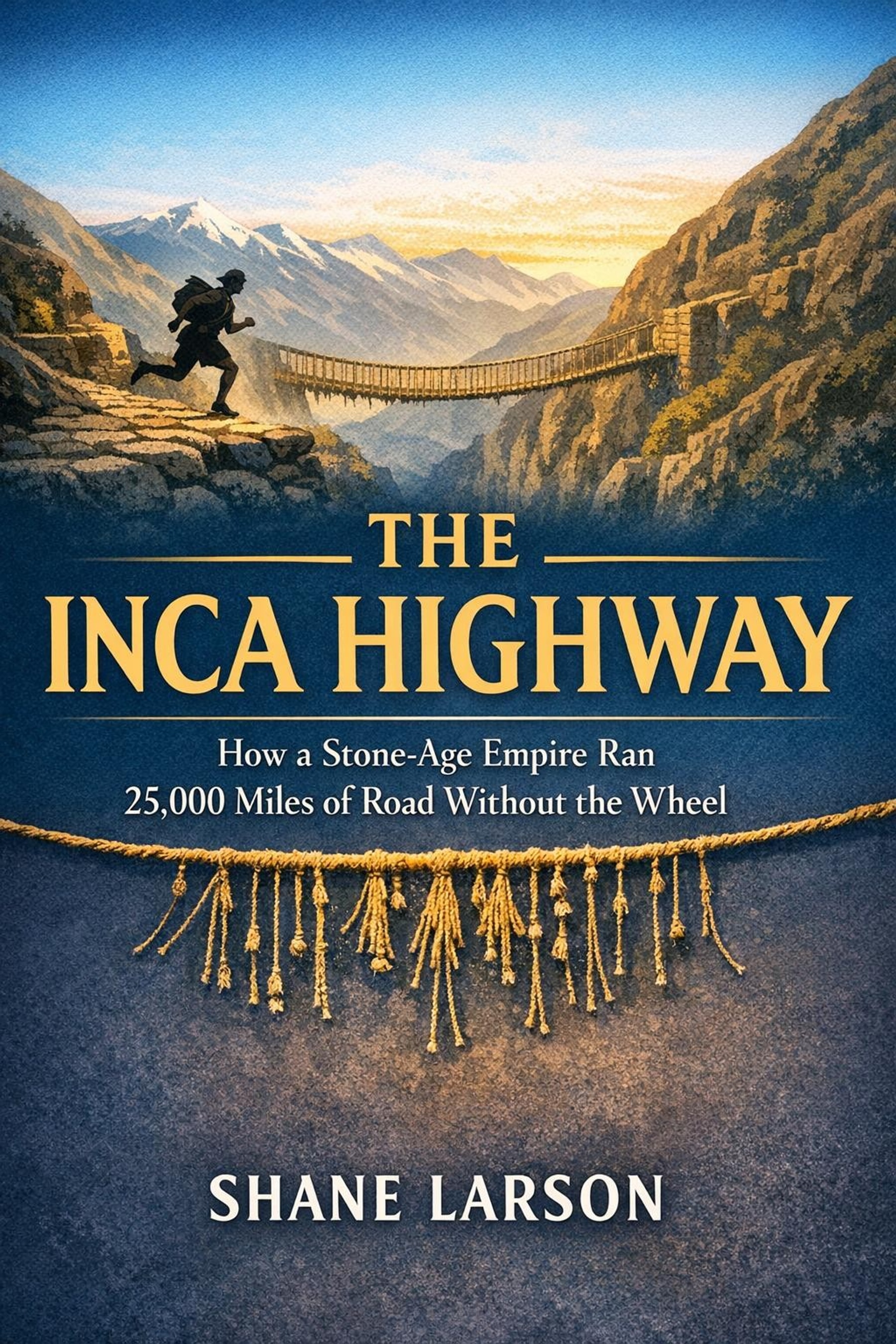
The Inca Highway
How a Stone-Age Empire Ran 25,000 Miles of Road Without the Wheel
By Shane Larson
About This Book
In the spring of 1533, a Spanish soldier named Pedro Sancho stood on a stone-paved highway in the Andes and tried to describe what he was seeing. The road was wider than any in Castile. It cut through mountains by means of steps carved into living rock. It crossed gorges on bridges that swayed but held. Posthouses appeared at regular intervals, stocked with food and runners ready to relay messages. Sancho had served emperors, had walked the roads of Renaissance Europe, and he wrote that nothing in Christendom matched what he was walking on.
The empire that built that road had existed for less than a century. It would not survive the decade.
Tawantinsuyu — the Four Regions Together — was the largest and most populous state in the pre-Columbian Americas. At its height in the early sixteenth century, it stretched twenty-five hundred miles along the spine of the Andes and governed roughly twelve million people across four distinct ecological zones: Pacific desert, high altiplano, montane cloud forest, and the eastern Amazonian fringe. It did this without writing, without money, without the wheel, without iron, and without any draft animal stronger than a llama. By every standard Old World historians once treated as prerequisites for state formation, the Inca empire should have been impossible.
It wasn't. It was extraordinary. And the key to understanding it is the road.
The Argument
This book treats the Qhapaq Ñan — the Great Road — not as the empire's infrastructure but as its operating system. Twenty-five thousand miles of stone-paved and stepped highway, two parallel trunk routes (highland and coastal) connected by hundreds of laterals, served by a network of tambos spaced one day's march apart and staffed by rotating laborers under the mit'a obligation. The road moved armies, redirected populations, redistributed food from imperial storehouses during droughts, and carried the empire's accounting on the knotted cords of the quipu.
Shane Larson follows the road from the highland trunk down to the coastal causeways, into the great storehouses at Huánuco Pampa, through the cyclopean walls of Sacsayhuamán, across woven-grass bridges that Spanish engineers couldn't replicate two centuries later. He traces the quipu from its role in the imperial census to the recent breakthroughs of the Khipu Database Project. And he tells the story of how the system fell — not, as the schoolbook version has it, to Spanish steel and horses, but to smallpox that killed the emperor Huayna Capac before any European set foot in the Andes, and to the civil war between his sons Huáscar and Atahualpa that left the empire shattered on the eve of Pizarro's arrival.
The encounter at Cajamarca in November 1532 is the climax most readers know. The real story is what made that encounter possible — and what the road network looked like in the moment it began to break.
What's Inside
- The geography of impossibility — why an empire stretched across four ecological zones at altitudes that kill outsiders had no business existing, and why it did anyway
- The Qhapaq Ñan in detail — the two trunk routes, the lateral connectors, the engineering tricks that solved problems Roman engineers never faced
- The chasqui relay system, with comparative timing against the Persian Royal Road and the Roman cursus publicus — and why a runner without a horse could beat both
- Quipu decoded — what we know, what's been demonstrated since the Khipu Database Project began, and what may still be encoded in cords no one has read in five centuries
- Mit'a and mitma — how rotating labor obligations and forced resettlement of entire populations let the empire function without coinage or a permanent army
- The storehouse system — why Huánuco Pampa held enough food to feed a province through a multi-year drought
- The suspension bridges — Q'eswachaka and its kin, woven annually from grass, capable of crossing gorges that defeated Pizarro's engineers
- The smallpox pandemic of the 1520s — how a disease moving faster than Spaniards killed Huayna Capac, his designated heir, and a substantial fraction of the imperial bureaucracy
- The Huáscar–Atahualpa civil war — the succession crisis that did more damage than the conquest itself
- Cajamarca, November 16, 1532 — what actually happened, and why the standard account underplays the role of the road network in delivering Atahualpa to Pizarro
Why I Wrote This
I came to the Inca by way of the Romans. I had spent years reading about imperial logistics — how Rome moved grain, how the Persian post relayed news, how Mongol stations supported the yam — and I kept seeing the Qhapaq Ñan mentioned in passing as "impressive for its time" and then dropped. That always struck me as strange, because by every measurable standard the Inca system did more with less than anything in Eurasia. Twenty-five thousand miles of road, no horses, no wheels, and faster news than Rome ever managed.
Most of the popular books on the Inca either fold the road into the conquest narrative or treat it as a curiosity of engineering. I wanted to write the book that takes the road seriously on its own terms — as a piece of state infrastructure that should be sitting next to the Roman cursus publicus and the Persian Royal Road in every general history of how premodern empires worked. And I wanted to be honest about the collapse: about how much of the empire was already broken by disease and civil war before the Spaniards arrived, and how much the conquest narrative has shaped what we think we know about everything that came before it.
Frequently Asked Questions
Do I need to know anything about pre-Columbian history to read this?
No. The book opens with the geography and works outward from there. If you've read general world history at the level of a Charles Mann or a Jared Diamond, you have more than enough background. If you haven't, you'll be fine — the cultural and chronological context is built in as the story unfolds.
How does this compare to John Hemming's The Conquest of the Incas?
Hemming's book is the definitive narrative of the Spanish conquest itself, and it's still the right book if that's what you want. The Road That Was the Empire spends most of its pages on the imperial system before contact — the road, the quipu, the storehouses, the labor obligations — and treats the conquest as the breaking point rather than the main subject. They're complementary rather than competing.
Does this cover Machu Picchu?
Yes, but in context rather than as the centerpiece. Machu Picchu was a royal estate, not the capital, and the book treats it as one node in a much larger network. If you're traveling to the Sacred Valley, this is the background that makes the site legible.
What about the quipu? Has anything actually been decoded?
A great deal, and more every year. The Khipu Database Project at Harvard has identified numerical and categorical patterns across hundreds of surviving cords. Recent work has demonstrated that some quipus almost certainly encoded narrative information, not just numerical accounts, though the full decipherment of narrative quipus remains open. The book covers what's been established, what's been argued, and what's still genuinely unknown.
Is this part of a series?
Not formally. It stands alone. Readers who enjoy it will find natural companions in the Bronze Age books and in the broader catalog of works on premodern state-building.
How long is the book?
It's a focused single-volume history — long enough to do the subject justice, short enough to read in a week. The road itself is the through-line; the book doesn't sprawl.
If You Liked This, You Might Like
- The Ancient World's Greatest Engineers — the Roman aqueducts, the Persian qanats, the Egyptian pyramids, and now the missing Andean chapter alongside them.
- The Bronze Age World — another premodern system that solved enormous logistical problems with tools that look impossible in retrospect.
- Collapse Proof — the patterns of imperial collapse across history, with the Inca case as one of the cleanest examples of disease-plus-civil-war breaking a system that looked permanent.
- Sacred Geography — how premodern states organized landscape, ritual, and political authority into a single integrated system.
The road was the empire. Pull the road out of the story, and the rest doesn't stand. This is the history of an extraordinary state built on a single, continent-spanning piece of engineering — and the decade in which all of it came apart.
Included with Kindle Unlimited — read it free if you're a member.
New Ancient History releases and free chapters — no spam, unsubscribe anytime.