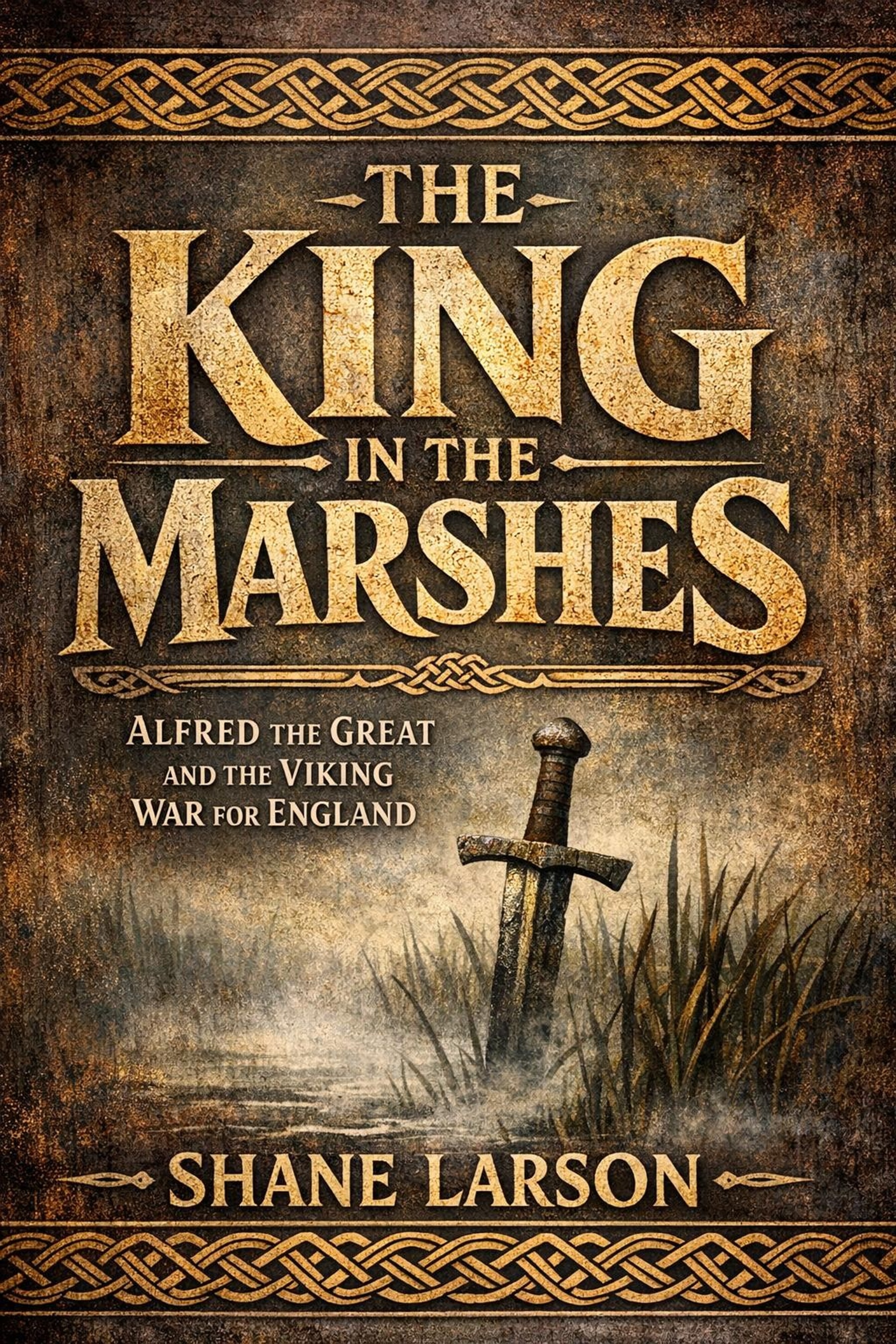
The King in the Marshes
Alfred the Great and the Viking War for England
By Shane Larson
About This Book
On the afternoon of 20 September 1901 a crowd filled the lower end of the Broadway in Winchester to watch a sheet come off a king. The bronze underneath was seventeen feet tall and held a sword by the blade, hilt uppermost, so that what it raised over the city was a cross. The occasion was the thousandth anniversary of the death of Alfred, king of the West Saxons, and over the course of the day he was credited with founding the navy, the common law, trial by jury, the English language and the British Empire.
He had died in October 899. The millennium was two years late, and the arithmetic was the least of what the speeches got wrong. Alfred founded none of those things. What he did was both smaller and harder to summarise, and it is the subject of The King in the Marshes: Alfred the Great and the Viking War for England.
The kingdom that nearly wasn't
When Alfred was born at Wantage in 848 or 849, the fifth son of a king who already had four, the island south of the Forth held four English kingdoms. By the time he was about twenty-two and unexpectedly on the throne, a Danish army had taken York, killed the king of East Anglia and driven the king of Mercia into exile. By January 878 only Wessex was left, and in the days after Twelfth Night a Danish force under Guthrum rode into the royal estate at Chippenham in a season when no one made war.
The Anglo-Saxon Chronicle, probably compiled at Alfred's own court a dozen years later, does not hide what followed. Part of the West Saxon nobility fled overseas. Part made its peace. The king, with a small troop, went into the Somerset Levels, and for four months the only English king still holding a throne was a fugitive in a wetland between two rivers. At Easter he built a fort on the island of Athelney. In the seventh week after Easter he rode east to Egbert's Stone and found the men of three shires waiting. Two days later he beat Guthrum at Edington in a battle that lasted all day, starved the survivors out over a fortnight, and three weeks after that stood godfather at Guthrum's baptism at Aller, a few miles from the marsh.
That is the part of the legend that is true, and the book treats it as the hinge it was. It then spends the larger part of its length on what most popular accounts hurry past: the twenty years Alfred used to make sure the winter of 878 could not happen again. Fortified towns and the Burghal Hidage that records them. An army split into halves that served in turn. Ships. London reoccupied in 886. A reformed coinage, a law code with a prologue that ran from Moses to Wessex, and, from his late thirties, a king learning Latin and setting about a library in English. When two fresh Viking armies crossed from Francia in 892, the system was tested for four years and held without a decisive battle.
Why I Wrote This
I came to Alfred from the other side. I had written about the Viking expansion, the longships going out to Dublin and Francia and the Volga, and in that story Wessex is a place the armies fail to take, a few paragraphs between the fall of York and the Danelaw. I wanted to know what the failure looked like from the shore.
What hooked me was the gap between the two Alfreds. The Victorian founder of everything is a fiction, and so are the cakes, and most books either repeat the legend or enjoy demolishing it. Neither is the interesting part. The interesting part is that the central claim survives: in the spring of 878 the future of any English kingdom came down to one man in a marsh and whether he stayed. Then he spent twenty years on fortifications, law, coinage and books, a stranger thing for a warrior king to do than winning a battle. I wanted the life that gives those years their due and says plainly where the ninth century has left us a maybe.
Frequently Asked Questions
Do I need to read The Viking Expansion first?
No. They are companions, not volumes. The Viking Expansion follows the Scandinavian armies outward across Europe and covers the fall of the northern English kingdoms from the longships' side. This book stays in Wessex and tells the same war from the kingdom that survived it. Read either alone, in either order.
Is this a narrative biography or an academic study?
A narrative biography for a general reader, with the scholarly debates set out rather than buried, no invented dialogue and no interior monologue. Three appendices cover the Asser authenticity debate, a timeline and family tree of the house of Wessex, and every fortified town in the Burghal Hidage with what survives of it.
Did Alfred the Great really unite England?
No. England did not exist in his lifetime. He ruled Wessex and, after 886, a Mercia that had a lord rather than a king; the north and east were Danish. His charters begin to style him king of the Anglo-Saxons in the late 880s, a smaller claim than it sounds. England was built after his death by his son Edward, his daughter Æthelflæd and his grandson Æthelstan, out of what he had kept.
Is Asser's Life of King Alfred a forgery?
Probably not, but the question is real and gets a full appendix. The Life was written in 893 and is the only contemporary biography of any Anglo-Saxon king. Its single manuscript burned in 1731, and twice in the twentieth century serious historians argued the whole text was written a century or more later. The counter-case, resting on Latin usage, Welsh naming habits and details of the 880s no later writer would have known, has persuaded most of the field.
How long is the book?
About 75,000 words: thirteen chapters in four parts, an Introduction, a Conclusion and three appendices, or roughly 240 pages in the paperback.
If You Liked This, You Might Like
- The Viking Expansion — the same armies seen from the longships, from Lindisfarne to Constantinople; this book is what they met when they reached Wessex.
- The Norman Conquest — where the house Alfred saved comes to its end, with the last king of his line and the fleet of 1066.
- Charlemagne — the Frankish court a six-year-old Alfred passed through in 856, and the model for his court school and his programme of books.
Alfred did not make England. He kept a kingdom from disappearing when it had come apart in his hands, and then spent two decades making it harder to break. That is a smaller claim than the one on the statue, and it has the advantage of being true.
What You'll Learn
- The year of nine battles: Ashdown, where Alfred attacked uphill while his brother finished Mass, and how a twenty-two-year-old took the throne over the heads of his brother's sons.
- Twelfth Night, 878: the oaths sworn on a holy ring at Wareham and broken the same night, the midwinter attack on Chippenham, and the ealdorman who lost his lands for deserting king and country.
- Athelney: the marsh before nine centuries of drainage, and the three legends, the cakes, the harper and the vision of St Cuthbert, each introduced with the text that first tells it and that text's date.
- A day's march from safety: the burhs, the archaeology, and the honest debate over how much of the system was Alfred's and how much his son and daughter finished.
- London, law and letters: the idea of a single English people that Alfred's writings began to use, the law book, the translation programme, and the argument over whether the king wrote a word of it himself.
- The bones of a king: Old Minster, New Minster, Hyde Abbey, the 1788 prison builders, and the 2014 announcement about a pelvis fragment that might be Alfred, or his son Edward, and cannot be proved either way.
- Which Alfred? The saint of the monks, the lawgiver of the Tudor printers, the hero of the 1740 masque that gave the world "Rule, Britannia!", the Victorian on the plinth, and what the evidence holds once they are set aside.
New Medieval History releases and free chapters — no spam, unsubscribe anytime.
More in This Genre
View all →