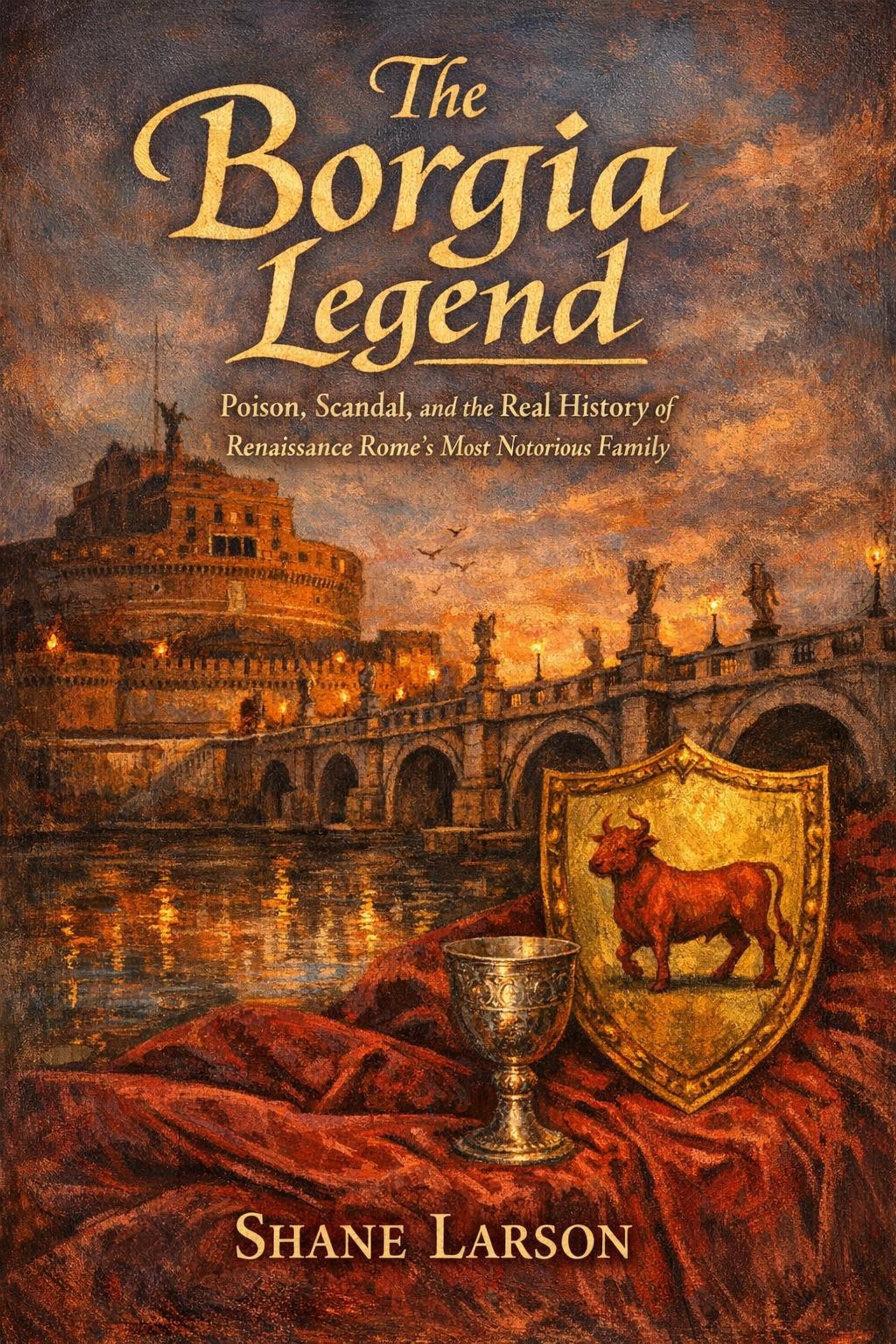
The Borgia Legend
Poison, Scandal, and the Real History of Renaissance Rome's Most Notorious Family
By Shane Larson
About This Book
In the spring of 1497 Giovanni Sforza, lord of Pesaro, rode out of Rome in a hurry and did not come back. He was the husband of the pope's daughter, and the pope no longer wanted him to be. The alliance that had made the marriage useful was dead, and the Borgias had settled on the cleanest way out: an annulment on the ground that, in four years, the marriage had never been consummated. Giovanni would have to say so. In writing, and in effect in public.
He held out for months. While he did, he told the Duke of Milan why, in his opinion, the pope really wanted his daughter back. That remark is the first appearance anywhere of the charge that Lucrezia Borgia slept with her father.
It is worth knowing that, because the charge is still repeated five hundred years later and its origin almost never is. Most of what the world believes about the Borgias works the same way. Somebody said it first, and that somebody usually had a reason.
The Argument
Rodrigo Borgia was a Valencian who spent thirty-five years as vice-chancellor of the Church, and became Pope Alexander VI in 1492 by handing his offices, his palace and a good many abbeys to the cardinals who voted for him. He acknowledged his children and housed them beside the Vatican. He married his daughter three times for political advantage and used the Church's money and the King of France's soldiers to carve his son Cesare a state out of central Italy. Cesare, for his part, had his sister's second husband strangled in his bed, and on the last night of 1502 invited four of his own captains to a meeting at Senigallia and had them arrested and killed. All of that is on the record and none of it is in dispute.
The legend is something else. It says the family poisoned its way through the College of Cardinals with a white powder called cantarella. It says father, son and daughter were lovers. It makes Lucrezia a murderess with a hollow ring. And when you go looking for the evidence, the poison has no recipe, no vial and no contemporary document, and its name turns up for the first time in a writer working decades later. The incest has one interested accuser and a handful of poets. Lucrezia cannot be tied to any death at all. She spent the last seventeen years of her life at Ferrara, fourteen of them as its duchess, governing in her husband's absence, and was mourned there when she died in 1519.
So the book makes two claims and holds both. The Borgias were as ruthless as the documents say. And the things they are most famous for are the things least supported by those documents. What separated them from the Riario, the della Rovere and the Medici was not their conduct but their position: they were foreigners in Rome, they rose faster and more openly than anyone had, and they lost everything in a single week of fever in August 1503. The man who took the papal throne a few weeks later had hated them for a decade, and he and his heirs had the telling of it.
Why I Wrote This
I came to the Borgias the way most people do, already knowing the story, and what stopped me was a date. The poison everyone associates with them has a name, and the name does not appear in anything written while they were alive. Once I had noticed that, I started checking the dates on everything else, and the legend kept moving later and later while the family stayed where it was, in the 1490s, doing things that were bad enough without help.
What I ended up wanting to write was not a defence. I do not think they need one, and they do not deserve one. Cesare's murders are as well documented as anything in the period. What interested me was the gap between a real family that fought dirty and lost, and the monsters that were assembled out of them afterwards by people with a use for monsters. That gap has authors, and you can name most of them. The book is my attempt to do that, one charge at a time.
Frequently Asked Questions
Did the Borgias really poison people?
Nobody can show that they did. There is no contemporary document, recipe or physical evidence for the famous Borgia poison, and its name first appears decades after Alexander VI's death. One case, the death of a Venetian cardinal in 1503, rests on a later confession and is treated in the book as a real possibility. The honest answer is "not proven", which is not the same as "never".
Was Lucrezia Borgia actually a murderer?
No credible source connects her to any killing. The image of Lucrezia as a poisoner comes largely from a play and an opera of 1833. In life she was married three times for her family's purposes, and then lived seventeen years at Ferrara, most of them as its duchess, with a good reputation.
How did Pope Alexander VI die?
He fell ill about a week after a supper in a cardinal's vineyard in August 1503 and died on the eighteenth, aged seventy-two. The story that he drank poisoned wine meant for someone else was written down a generation later. The men reporting from Rome that week described fever in a bad malarial summer, and the book explains why that is much the likelier cause.
Is this book a defence of the Borgias?
No. It states plainly what is documented, including the bought election, the family's use of Church lands, and the killings Cesare ordered. It only declines to repeat charges that have nothing behind them.
If You Liked This, You Might Like
- The Fall of Constantinople — the catastrophe of 1453 that the first Borgia pope spent his reign trying to answer with a crusade.
- Al-Andalus — the Spain the Borja family came from, down to 1492, the year a Valencian became pope and Granada fell.
- The Conquistadors' Smallpox War — what followed from the line Alexander VI drew across the Atlantic in 1493, and another famous story that looks different once the sources are checked.
A family of outsiders took the papacy, nearly made a kingdom out of it, and lost it in a week. The daughter outlived the wreck and governed well. That is the story the documents tell, and it holds up without any of the things the Borgias are famous for.
What You'll Learn
- The conclave of 1492, itemised. Which offices and fortresses changed hands, which of the famous details come from a hostile diarist, and why the same thing happened at the conclaves before and after.
- A body in the Tiber. The pope's son Juan disappeared after a family supper in June 1497 and was found with nine wounds and his purse untouched. The book goes through the suspects named at the time, and notes when Cesare's name was first added to the list.
- The Banquet of Chestnuts. It rests on one diary entry. The book says what the entry claims, briefly, and then asks how far a single entry in a later copy can carry a story.
- The strongest poisoning case. A Venetian cardinal died in April 1503, and a servant later confessed under a hostile regime. The book does not wave it away, and says exactly how much it proves.
- August 1503. The supper in a cardinal's vineyard, the week's delay, the host who also fell ill, and why the envoys writing that week thought it was fever.
- Lucrezia in Ferrara. Half a chapter on the years most accounts treat as an epilogue: the regencies, the court, the wars, the children, and the reputation she actually had when she died.
- How the legend was built. From epigrams and a pamphlet written in the Borgias' lifetime, through Guicciardini, to a French play and an Italian opera of 1833, and then the archives that answered them.
- A charge-by-charge appendix. Every famous accusation with its earliest source, that source's date and allegiance, and a verdict: documented, probable, possible or unsupported.
New Early Modern History releases and free chapters — no spam, unsubscribe anytime.
More in This Genre
View all →