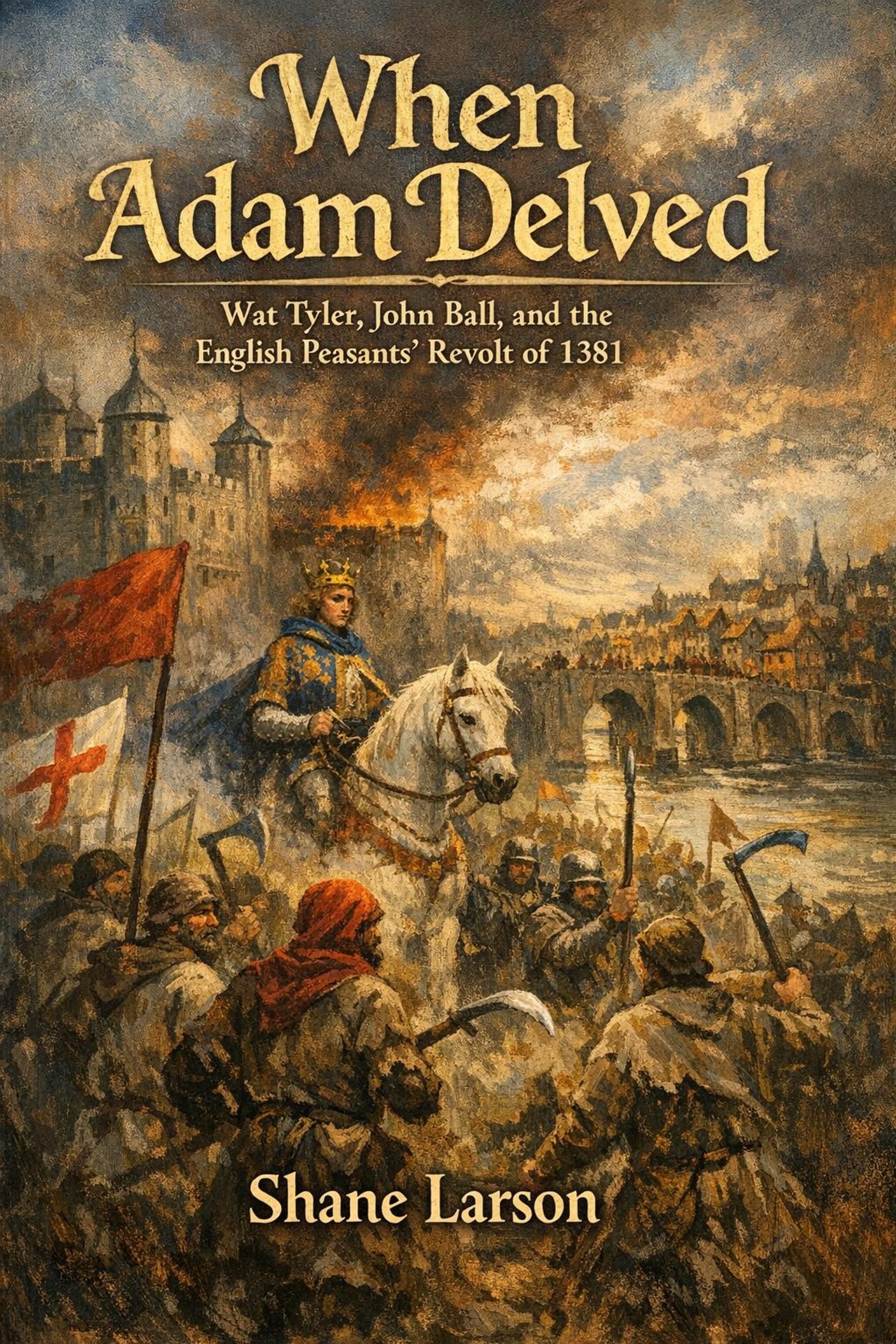
When Adam Delved
Wat Tyler, John Ball, and the English Peasants' Revolt of 1381
By Shane Larson
About This Book
In 1377 the villagers of a string of manors across southern England clubbed together, sent men to the royal chancery at Westminster, and paid for certified copies of their manors' entries in Domesday Book, the survey William the Conqueror's clerks had compiled nearly three centuries earlier. Then they took the copies to court and argued that the labour services their lords demanded had never been owed. They lost. Parliament called it the Great Rumour. Nobody in those villages could have read the Latin on the parchment they had bought. They knew exactly what it was for.
Four years later the same kind of men, from the same part of England, went looking for parchment again. This time they did not buy it. They burned the court rolls in their lords' chests, the sheriff's files at Coggeshall, the archbishop's registers at Lambeth, the lawyers' rolls at the Temple and the university's charters at Cambridge. Then they stood in a field at Mile End while the king's clerks wrote out charters of freedom for them, county by county, because a charter under the great seal outranked anything a lord kept in a chest.
A Rising Aimed at Paperwork
When Adam Delved: Wat Tyler, John Ball, and the English Peasants' Revolt of 1381 tells the rising at three speeds. The first is thirty years of pressure: a plague that killed perhaps half of England and made every surviving pair of hands worth more; a Statute of Labourers that pegged wages to the levels of 1346–47 and prosecuted thousands for taking more; lords leaning harder on the unfree tenants they had left; a losing war in France and a court divided around a child king and his unpopular uncle, John of Gaunt. And then three poll taxes, the last of them a shilling a head on everyone over fifteen, granted at Northampton in November 1380, which a third of the taxpayers of 1377 did not appear for.
The second speed is seventeen days, told one at a time. Brentwood on 30 May, where the men of Fobbing refused a tax commissioner. Maidstone on 7 June, where the Kentish host chose a captain called Wat Tyler whom nobody has been able to place. Blackheath on 12 June, where John Ball, freed from the archbishop's prison, preached on a couplet in English. The bridge opened on 13 June and the Savoy burned that evening. Mile End on 14 June, where Richard II, aged fourteen, granted the end of serfdom in writing while, behind him, the archbishop of Canterbury and the Treasurer of England were beheaded on Tower Hill. And Smithfield on 15 June, where the mayor of London struck Tyler down in front of the king.
The third speed is the long tail: the county risings at St Albans, Bury St Edmunds, Cambridge and Norfolk; the retribution, smaller than the legend says and counted here from the records; the charters revoked at Chelmsford on 2 July; John Ball hanged, drawn and quartered at St Albans on 15 July in the king's presence; and a parliament that put on the roll that villeins were their lords' property. And after that, the book's last question. Serfdom disappeared anyway within a century, and no poll tax of that kind was levied again for generations, so did the rising fail or not?
Why I Wrote This
I had written two books that stop at 1381. The Black Death gets to the Statute of Labourers and points forward; The Hundred Years' War gets to the poll tax and points sideways. Both owed the reader the summer itself, and I assumed I knew it: peasants, a boy king, Wat Tyler, Smithfield. What hooked me when I went into the sources was the paperwork. These people burned court rolls and sheriff's files and lawyers' books with great precision, and then stood in a field and waited for the king's clerks to write them charters. That is not what a mob does. It is what people do who understand exactly how they are governed and where the governing is written down. Once I saw that, I wanted the book that followed the documents.
Frequently Asked Questions
Do I need to read The Black Death or The Hundred Years' War before this book?
No. Both are companions, not prerequisites. The plague and the war are given here in a chapter each, with a pointer to the book that tells each in full. This one begins in a manor court in 1349 and assumes nothing.
Was the Peasants' Revolt really a revolt by peasants?
Mostly not, which is why some historians now call it the Great Rising or the English Rising. The trial records name village officeholders, craftsmen, townspeople and clergy far more often than the destitute, and the rebels' own word for themselves was the commons. The book keeps the familiar name in the subtitle and gives the argument over it a full chapter.
Who killed Wat Tyler, and what did he actually demand?
The mayor of London, William Walworth, struck him, and a king's esquire, Ralph Standish, ran him through, in front of Richard II at Smithfield on 15 June 1381. His demands minutes earlier survive in one source only: no lordship but the king's, the church's wealth shared among the parishes, and every man free. The book gives that list, says where it comes from, and compares every chronicler's account of the killing.
Did the Peasants' Revolt succeed?
In the short term, no: every promise was revoked within three weeks, the leaders were hanged, and parliament refused to free a single villein. In the long term the poll tax was never tried again, lords stopped defending serfdom by force, and villeinage had largely gone within a century. Whether 1381 caused that or merely came first is argued in Chapter Thirteen and not settled.
How long is it, and is it narrative or academic?
About 78,000 words: an introduction, fourteen chapters in four parts, a conclusion and three appendices. Narrative history, told day by day where the record allows, with the witness named in every scene. The German Peasants' War of 1525 is not covered; this is the English rising alone.
If You Liked This, You Might Like
- The Black Death — the plague that emptied the villages and made the labour laws necessary; this book picks up in the manor court the year after.
- The Hundred Years' War — the losing war in France that the shilling a head was raised to pay for.
- The Norman Conquest — where English lordship and Domesday Book came from; the villagers of 1377 bought copies of that survey to argue their freedom.
- The Princes in the Tower — a later English case read the same way, from hostile sources set side by side.
The commons of 1381 knew which documents to burn and which to demand, and lost; what they asked for came anyway, by roads they did not choose.
A standalone on the medieval shelf, between The Black Death and The Hundred Years' War.
What You'll Learn
- **The loyal rebels.** Why an army that killed the king's Chancellor and Treasurer insisted it was for King Richard and the true commons, and why that was a coherent position rather than a contradiction.
- **Who actually rose.** The indictments and trial rolls, read against the chroniclers: reeves, constables, jurors, craftsmen, townsmen and a surprising number of clergy, the people who ran villages in ordinary years.
- **The rebel letters,** short riddling English texts signed Jakke Mylner, Jakke Carter and Jakke Trewman, preserved by two hostile monks, and what they show about how the rising organised itself in a week.
- **Smithfield from five witnesses.** The *Anonimalle Chronicle*, Walsingham, Knighton, Froissart and the Westminster chronicler each tell the killing of Wat Tyler differently, and the book sets the versions side by side.
- **The killing of the Flemings** in the Vintry on 14 June, reported as the atrocity it was, with the one figure that survives.
- **Six centuries of Wat Tyler:** Chaucer's one glance, the Tudor stage villain, Thomas Paine's defence, Robert Southey's embarrassing play and William Morris's dream of John Ball, each described and none applied to the present.
- **Three appendices:** the rising day by day, the chroniclers and where they contradict each other, and a walking gazetteer of 1381 London.
New Medieval History releases and free chapters — no spam, unsubscribe anytime.
More in This Genre
View all →