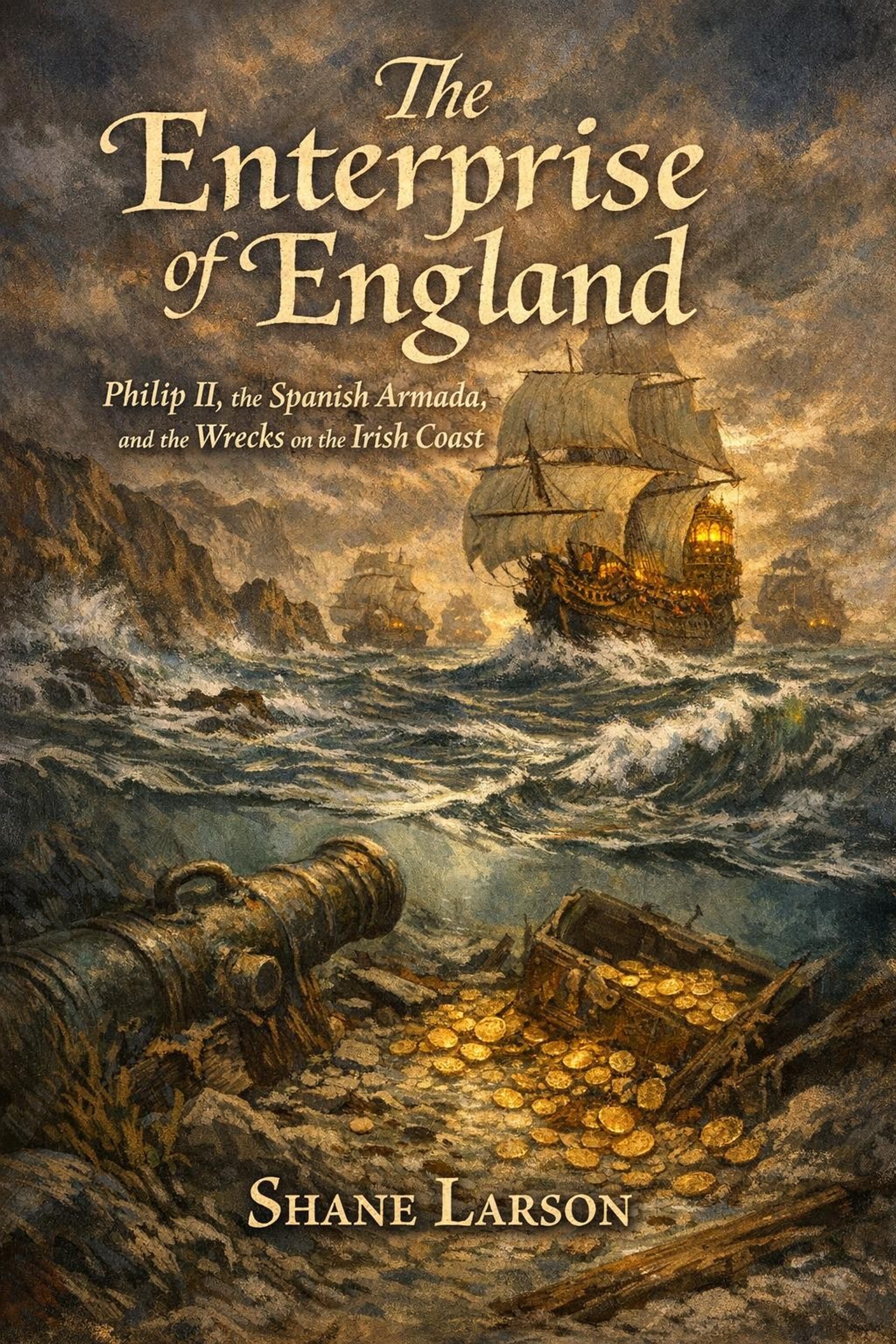
The Enterprise of England
Philip II, the Spanish Armada, and the Wrecks on the Irish Coast
By Shane Larson
About This Book
A little before midnight on 7 August 1588, in the anchorage off Calais, the captains of the Spanish fleet saw eight burning ships coming down on them with the tide. Their orders were sensible: slip the cable, leave the anchor buoyed on the bottom, stand clear, come back for it at first light. Most of them did not slip. They cut, some of them twice, and by dawn the heaviest anchors in the fleet were lying in the sand off a French town.
Six weeks later those anchors were the difference between living and drowning. Ship after ship came in off the Atlantic onto the west coast of Ireland with one anchor left, or none. In Blasket Sound the Santa María de la Rosa let go the single anchor she had, swung onto a rock on the turn of the tide, and sank with every soul aboard but one. At Streedagh Strand in Sligo three ships broke up on the sand in about an hour. By the fleet's own casualty returns, more men died on that one beach than English guns had killed in nine days.
The Spanish Armada was not lost in the Channel. It was lost on the way home, to a plan with a hole in it, to weather, to charts that drew Ireland in the wrong place, and to a garrison with its orders already written.
Two Decks and a Seabed
The Enterprise of England: Philip II, the Spanish Armada, and the Wrecks on the Irish Coast begins where the fleet did, at a desk in the Escorial, with a sixty-year-old king who had once been king of England himself and had proposed to its queen. His plan was coherent in every respect but one: Parma's barges could not leave harbour while Dutch flyboats held the shallows, and there was no deep-water port on that coast for the fleet to meet them in. Parma told him so, more than once.
The man sent to execute it, the Duke of Medina Sidonia, asked in February 1588 to be excused, on the honest grounds that he had never commanded at sea and was ill whenever he was afloat. That letter has been quoted against him for four centuries; Peter Pierson, and Colin Martin and Geoffrey Parker, have argued the other case. The book weighs both, chapter by chapter, and does not pretend to a cleaner verdict than the evidence gives.
The nine days up the Channel are cut between the San Martín and the Ark Royal, from the sighting off the Lizard to Gravelines, the one day on which English gunnery decided anything. Then north about Scotland, the thirst, the navigation error that put ships a degree of longitude east of where their pilots believed, and the Irish coast. The last movement belongs to the divers: Robert Sténuit at the Girona, Sydney Wignall in Blasket Sound, Colin Martin at Kinnagoe Bay, the Irish state's archaeologists at Streedagh after the storms of 2015. What came up was mostly guns, carriages and shot.
Why I Wrote This
I came to the Armada sideways, through Elizabeth I and then Mary, Queen of Scots, and in both of those books 1588 kept arriving as something that happened offstage and ended at Gravelines. When I sat down with the numbers, they did not add up to the story I had been told. The English had sunk one ship outright. The dying happened six weeks later, on beaches whose names I had to look up, and the fullest account of it was written by a Spanish captain in Antwerp a year on. What held me after that was the archaeology. A diver in 1967 worked out from the documents where a galleass had gone down, and found her. The wrecks have been quietly correcting the paper record ever since, and almost none of it has reached the version of 1588 most of us carry around.
Frequently Asked Questions
Did the English actually sink the Spanish Armada?
Not in any meaningful sense. In nine days the Armada lost six ships out of about a hundred and thirty, two of them to accident. Only one, the María Juan, was sunk at sea by English gunfire; two more were shot to pieces at Gravelines and taken by the Dutch. The English achievement was refusing to lose and keeping the fleet from Parma's army.
How many Spanish Armada ships were wrecked in Ireland?
Something like two dozen, from Kerry round to Antrim, most of them in two gales within three weeks of mid-September 1588. The count cannot be exact: some wrecks are known only from English letters, some only from Spanish lists of ships that never returned. The usual estimate of the dead in Ireland, drowned and killed together, is five to six thousand.
What happened to the Spanish survivors who came ashore in Ireland?
Many were killed. The Lord Deputy, Sir William Fitzwilliam, issued a commission at the end of September authorising the death of any Spaniard found in Ireland, and in Connacht Sir Richard Bingham carried it out thoroughly. Modern estimates of those put to death on land run from several hundred to well over a thousand; the book explains why no closer figure is possible. A few hundred escaped, mostly through Ulster to Scotland, with help from Irish lords, priests and households, some of whom paid for it with their lives.
Did Drake really finish his game of bowls before sailing to meet the Armada?
There is no evidence that he did. Nothing written in 1588 mentions bowls. The earliest printed reference usually cited is a political pamphlet of 1624, and the famous remark does not appear in its familiar form until the eighteenth century. The book treats it, with the Tilbury speech text and Philip's line about the winds, as a problem of evidence.
Where can I see finds from the Spanish Armada wrecks?
The Girona collection, with its gold chains, cameos and jewelled salamander, has long been held by the Ulster Museum in Belfast. Part of the Trinidad Valencera material has been shown at the Tower Museum in Derry. The Streedagh guns raised in 2015 went into long conservation. Galleries rotate and objects go into store, so check before travelling; Appendix B gives a pointer for every site.
If You Liked This, You Might Like
- Suleiman the Magnificent — Lepanto in 1571 was where Spain's admirals learned their trade, and what they learned was a boarding battle the English refused to fight.
- The Conquistadors' Smallpox War — the conquest that built the empire whose silver paid for the Enterprise of England, and gave Drake and Hawkins treasure fleets to rob.
- The Hundred Years' War — Calais, where the Armada dropped anchor in August 1588, had been England's last foothold on the Continent until it fell thirty years earlier.
- The Thirty Years' War — the next round of the same Habsburg and Protestant conflict, a generation on, fought on land across Europe.
A fleet that won its battle and could not win its war, a commander who asked not to be sent, and a coastline that did what the enemy could not: 1588 from the Escorial, the two flagships, and the sand underneath.
A standalone military history on the English-history shelf, beside Elizabeth I and Mary, Queen of Scots.
What You'll Learn
- **The arithmetic nobody quotes.** Six ships lost in the Channel and off Gravelines, three or four of them to English gunfire; around two dozen lost on the Irish coast in three weeks. An English fleet that lost about a hundred men to the enemy and several thousand to typhus after it had won.
- **The guns on the seabed.** Siege pieces cast in 1556 for Philip as Mary Tudor's consort, aboard a Venetian cargo ship thirty-two years later; a two-wheeled land carriage set against the English truck carriage; heavy shot still in the lockers, loaded for a boarding fight that never came.
- **Captain Cuéllar's letter.** The wreck at Streedagh, the robbery on the beach, the refuge with O'Rourke and the MacClancy, and the escape through Ulster and Scotland to Flanders.
- **The killing in Ireland, stated plainly.** Fitzwilliam's commission, Bingham in Connacht, the Hovendens at Inishowen, and the Irish households that sheltered men at the cost of their own lives. Estimates labelled as estimates.
- **The legends, named as legends.** The bowls, Drake's drum, Philip's remark about men and winds, and the Spanish blood of western Ireland.
- **Three appendices.** An order of battle with its disagreeing sources, a gazetteer of every identified Armada wreck for anyone who means to stand on those beaches, and a chronology in both calendars.
New Early Modern History releases and free chapters — no spam, unsubscribe anytime.
More in This Genre
View all →