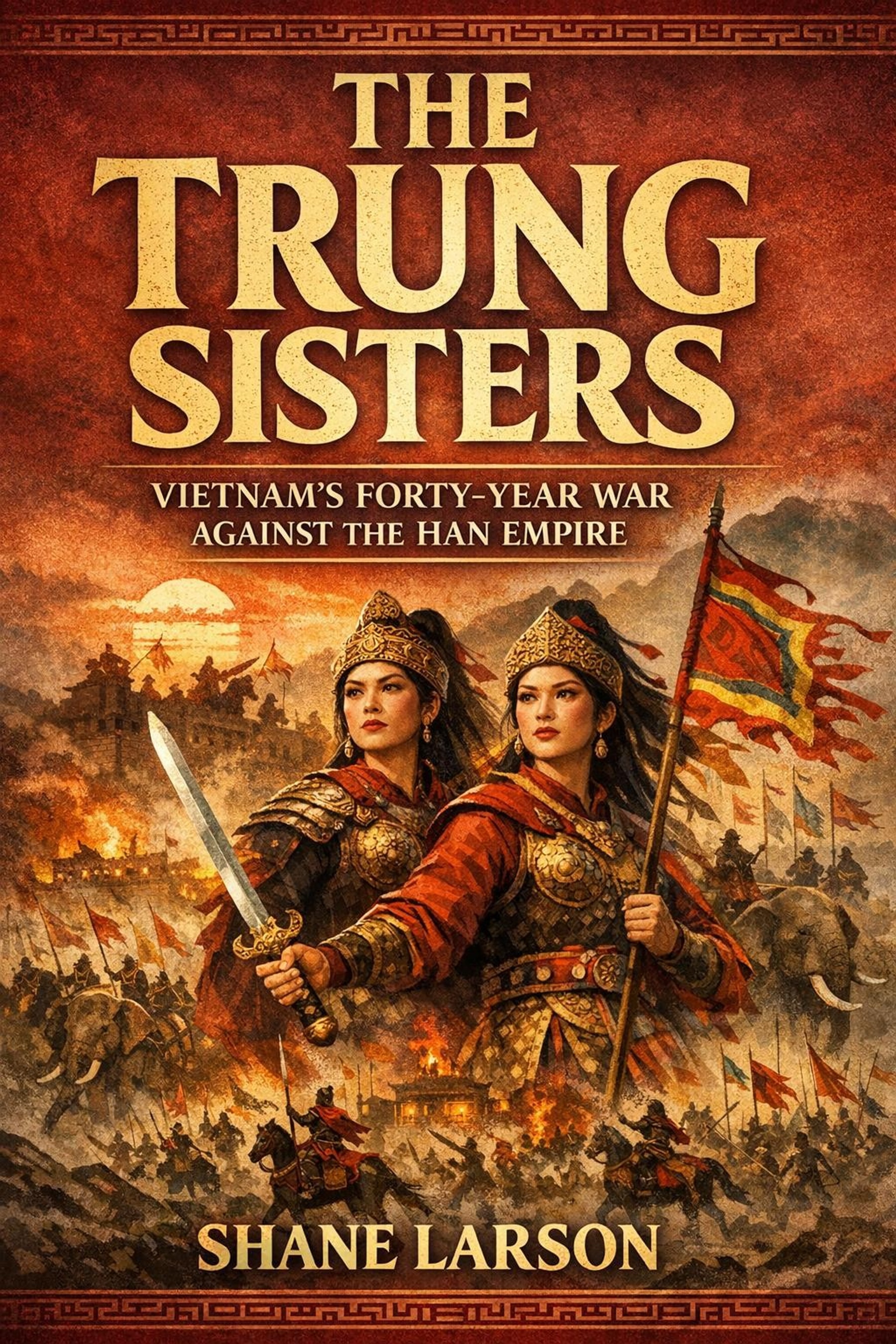
The Trung Sisters
Vietnam's Forty-Year War Against the Han Empire
By Shane Larson
About This Book
In the spring of 43 CE, on the banks of the Hat River, the first queen of an independent Vietnam ran out of options. Behind her, the army she had raised three years earlier was breaking apart against the disciplined ranks of a Han general who had crushed rebellions across half of Asia. Chinese chronicles record that she was captured and beheaded. Vietnamese memory tells it differently: that Trung Trac and her sister Trung Nhi waded into the river rather than kneel to an empire. Two endings, one woman — and a story that nineteen centuries of temples, festivals, and resistance have refused to let die.
It begins in 40 CE, when the Red River delta belonged to the Han Empire, the largest and most powerful state on Earth. The local Lac lords answered to a Chinese governor; their old customs were being filed down to fit an imperial mold. Then two sisters from a noble family did the unthinkable. They gathered the lords behind them, marched on the governor's seat, and took sixty-five fortified citadels. The governor fled north. Trung Trac was proclaimed queen, and for three improbable years a free Vietnamese kingdom held its ground against Rome's only rival in the ancient world.
That kingdom did not last. But its memory outlasted every empire that tried to bury it. The Trung Sisters is the story of how a defeated rebellion became a nation's founding myth — and why, two thousand years later, it still shapes how Vietnam understands itself.
The Story
This is narrative history built from two traditions that rarely agree. The hostile Chinese chronicles recorded the revolt as a provincial nuisance, suppressed and forgotten. The living Vietnamese tradition — passed down through temple inscriptions, folk veneration, and the annual Hai Ba Trung festival — remembered it as the first stand of a people who would spend a thousand years refusing to stay conquered. Reading the sisters' story means reading between those two accounts, weighing what each side had reason to exaggerate or erase.
The book sets the rebellion inside the long arc of Chinese rule over Vietnam, from the first annexation in 111 BCE to the decisive naval victory at Bach Dang in 938 CE that finally ended it. Along the way it follows the rebels who came after the Trungs — Lady Trieu most famous among them — and the Dong Son bronze-drum culture that defined the society the sisters fought to protect. The military campaign gets its full due: how two women built and commanded an army in a world that left no space for them to do so, how they held sixty-five citadels, and how the veteran general Ma Yuan brought the whole experiment to a brutal end.
What emerges is not a tale of triumph but something more durable — the making of a symbol. The Trung Sisters lost their war and won their place at the center of a national identity, honored as Vietnam's first heroes across dynasties, colonizations, and wars that none of their contemporaries could have imagined.
What You'll Discover
- How two sisters raised, led, and supplied a rebel army in 1st-century Southeast Asia, in a society that offered women no precedent for command
- The full shape of the campaign — the sixty-five citadels, Trung Trac's three-year reign as queen, and Ma Yuan's methodical reconquest
- Why the Chinese chronicles and the Vietnamese tradition tell two different stories, and how historians work between hostile records and living memory
- The Dong Son bronze-drum culture and the Lac society the sisters defended against assimilation
- The thousand-year struggle the revolt belongs to, from the annexation of 111 BCE to the triumph at Bach Dang in 938 CE
- How the legend of Hai Ba Trung was reshaped by each era that inherited it, from medieval dynasties to modern Vietnam
- Where the Trung Sisters stand among history's great rebel women — alongside Boudica, Zenobia, and the others who took on empires and lost
Why I Wrote This
Most readers who grew up outside Southeast Asia can name Boudica or Cleopatra but have never heard of the women who founded the Vietnamese national story. That gap bothered me. The ancient world we get handed is overwhelmingly Mediterranean — Greece, Rome, Egypt — as if nothing comparable happened east of Persia. The Trung Sisters are proof of how much that framing leaves out.
What pulled me in was the tension between the two source traditions. You have a Chinese record that treats the revolt as a footnote, and a Vietnamese memory that treats it as the moment a nation was born. Both can't be neutral, and the honest version of the story lives in the space between them. I wanted to write something that respected the legend without surrendering to it — that took the history seriously and let the reader see why a lost war still matters two thousand years later.
Frequently Asked Questions
Is this a narrative history or an academic textbook?
It's narrative history written to read like a story. The research is solid and the sourcing is honest about what we know and don't, but the goal is to carry you through the events the way a good storyteller would, not to bury you in apparatus.
Do I need to know anything about Vietnamese or Chinese history first?
No. The book provides all the context you need, from the Han Empire's reach into the Red River delta to the Dong Son culture the sisters defended. If you've never studied this period, you'll be able to follow it from the first page.
Did the Trung Sisters really exist, or are they legend?
They were real. The rebellion of 40–43 CE is recorded in Chinese sources, which is part of what makes the story so interesting — even the empire that crushed them had to write them down. The legend grew around the documented facts over the centuries, and the book traces both.
Does this cover more than just the rebellion?
Yes. The Trung revolt sits inside a longer story the book tells in full: the thousand-year arc of resistance to Chinese rule, from 111 BCE through Lady Trieu and other rebels to the final victory at Bach Dang in 938 CE.
How does this compare to books about Boudica or other rebel queens?
If you've enjoyed accounts of women who challenged ancient empires, this belongs on the same shelf — but it opens a part of the world those books rarely touch. The closing chapter explicitly places the Trung Sisters among figures like Boudica and Zenobia.
Is this book on Kindle Unlimited?
Yes. It's available to read free with a Kindle Unlimited membership, or to buy outright on Kindle.
If You Liked This, You Might Like
- Boudica — The British queen who burned Roman towns to the ground in another empire's far province; the closest Western parallel to the Trung revolt.
- Zenobia of Palmyra — A desert queen who carved a breakaway empire out of Rome's east, then paid the price for defying it.
- The Khmer Empire — The Southeast Asian power that built Angkor; the deeper history of the region the Trung Sisters helped define.
Meet the women who turned a lost war into a nation's memory — and the thousand-year struggle their rebellion set in motion.
Included with Kindle Unlimited — read it free if you're a member.
New Ancient History releases and free chapters — no spam, unsubscribe anytime.