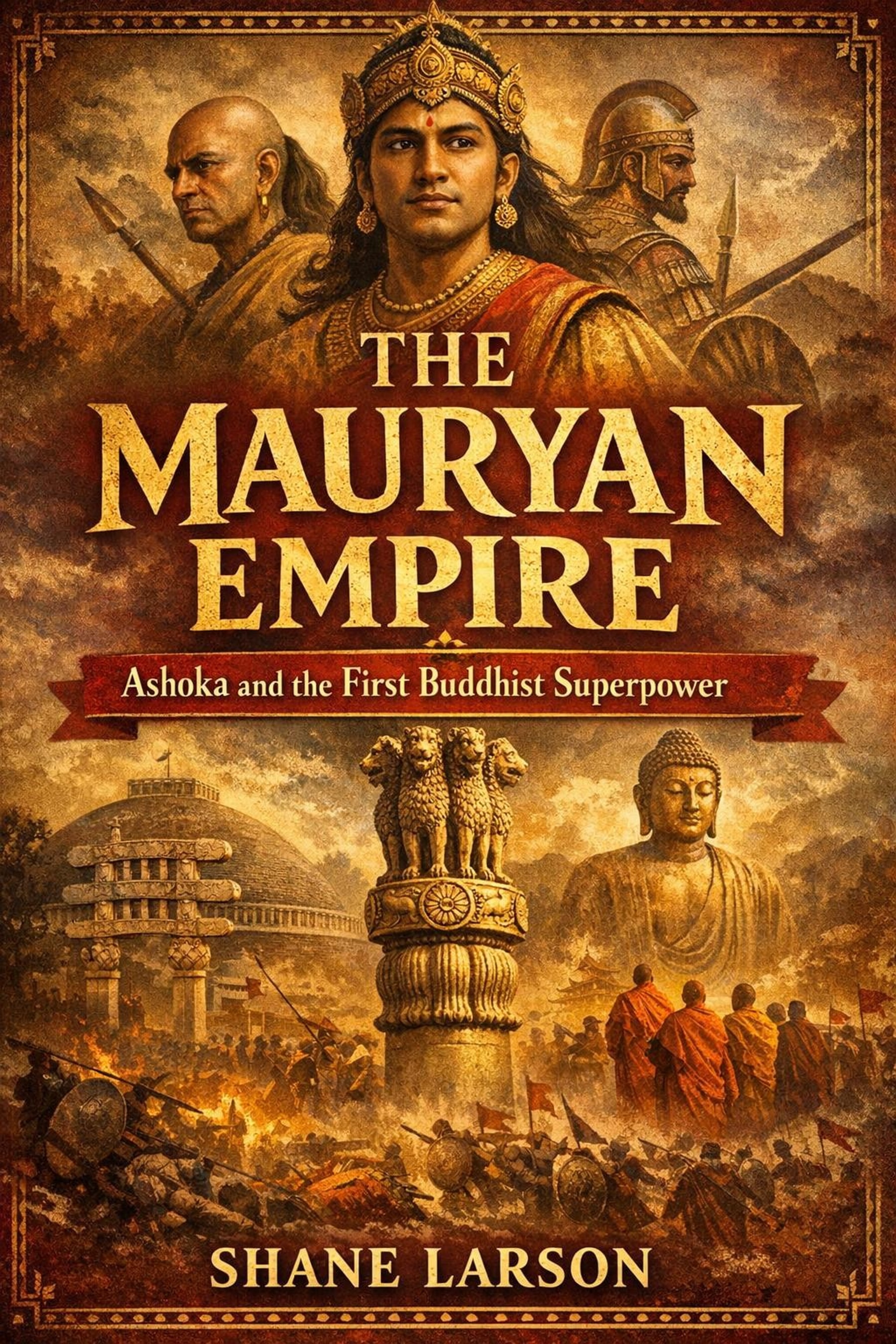
The Mauryan Empire
Ashoka and the First Buddhist Superpower
By Shane Larson
About This Book
Somewhere in the Indian subcontinent, a slab of polished sandstone has stood in the open for more than two thousand years. Wind, monsoon, and empire have all passed over it. The words carved into its face are still legible — and they are not a boast. They are a confession. An emperor admits to a slaughter he ordered, names the number of dead, and says he is sorry. No ruler in the ancient world had ever done anything like it.
That emperor was Ashoka, and the state he inherited was the largest the subcontinent had ever seen. The Mauryan Empire stretched from the mountains of Afghanistan to the Bay of Bengal, knit together by spies, roads, and royal violence. But to understand how a man came to carve his own war crime into stone, you have to start two generations earlier — in the power vacuum a retreating Greek army left behind, and with a low-born adventurer who walked into it and took a throne.
The Story
When Alexander the Great turned his army around at the Indian frontier and marched west to die in Babylon, he left a fractured borderland behind him. Into that chaos stepped Chandragupta Maurya — a man of obscure origins, guided by the most ruthless political mind of the age. His advisor Chanakya authored the Arthashastra, a treatise on statecraft so cold and total that it still reads like an instruction manual for absolute power: taxation, surveillance, assassination, the management of enemies and allies as interchangeable tools.
Together they toppled a dynasty and built an empire from nothing. When Alexander's successor Seleucus marched east to reclaim the Indian provinces, Chandragupta met him and forced a settlement: the eastern reaches of the Persian world changed hands, and the price Seleucus paid for peace was five hundred war elephants. The Mauryan state now reached from Central Asia to the Ganges delta.
The empire's defining moment, though, belongs to Chandragupta's grandson. Ashoka expanded the realm through a war against the kingdom of Kalinga so bloody that, by his own account, it broke something in him. He turned to Buddhism, renounced further conquest, and began inscribing his ethics on rocks and pillars across his territory. He dispatched missions that carried the faith into Sri Lanka and beyond, transforming a regional Indian tradition into one of the world's great religions. This book follows that arc with a clear eye — honest about how thin and contradictory the sources are, and honest about the distance between the iron-fisted ruler who actually governed the Mauryan Empire and the gentle saint that later legend made of him.
What You'll Discover
- How a man of obscure birth seized a throne in the disorder Alexander's retreat created, and what kind of empire he built on top of it
- The chilling political logic of Chanakya's Arthashastra — and how its doctrines of spycraft and control actually shaped Mauryan administration
- Why Seleucus, one of Alexander's most powerful successors, traded the eastern provinces of Persia for a herd of war elephants
- What truly happened at Kalinga, and why a single campaign turned a conquering emperor against conquest
- What the rock and pillar edicts say in their own words — and, just as revealing, what they carefully leave unsaid
- How Buddhist missionaries sent from Ashoka's court reshaped the religious map of half of Asia
- Why the Mauryan Empire, the first to unify the subcontinent, came apart barely fifty years after its greatest ruler died
Why I Wrote This
I kept running into two completely different Ashokas. One is the saint — the gentle, enlightened philosopher-king who laid down his sword and ruled by compassion. The other is the man who actually ran a sprawling ancient state, with all the surveillance, taxation, and force that required. Most popular accounts pick one and quietly drop the other.
The truth is that we know him almost entirely through his own carved propaganda and through Buddhist tradition written down centuries later. That's not a reason to throw up our hands; it's the most interesting part. I wanted to write a narrative that tells the story with real momentum but never pretends the evidence is firmer than it is. Where the sources contradict each other, I say so. Where the legend has overwritten the history, I try to show the seam. Readers don't need to be flattered with false certainty — the honest version is the better story anyway.
Frequently Asked Questions
Do I need to know anything about ancient India before reading this?
No. The book assumes no prior background. It opens in the aftermath of Alexander's campaign — a moment many readers already half-know — and builds the Mauryan world from there, introducing people, places, and terms as they arise.
Is this a scholarly textbook or a narrative history?
It's narrative history written for general readers. The pacing is built around story and stakes, not footnote density. That said, it takes the evidence seriously and is candid throughout about where the sources are thin, late, or contradictory.
How much of the book is about Ashoka versus Chandragupta?
Both get real attention. Chandragupta's rise and Chanakya's statecraft form the foundation, because Ashoka's empire makes no sense without them. But Ashoka, Kalinga, and the edicts are the heart of the book.
What are the edicts, exactly?
They are Ashoka's own proclamations, carved into rocks and freestanding pillars across the empire and still surviving today. The book quotes from them, explains what they reveal about his governance and his Buddhism, and weighs them against the more flattering picture later tradition painted.
Is this book on Kindle Unlimited?
Yes. It's enrolled in Kindle Unlimited, so members can read it at no additional cost.
If You Liked This, You Might Like
- Alexander's Generals — The Successor wars that created the very vacuum Chandragupta exploited, told through the men who carved up Alexander's empire, Seleucus among them.
- Marcus Aurelius — Another ruler measured against the philosopher-king ideal, and another gap between the wise image and the harder realities of governing.
- Sargon — The original story of a man rising from obscurity to forge the world's first empire, half a world and two thousand years earlier.
- The Persian Empire — The vast Achaemenid world whose eastern edge Chandragupta absorbed, and the imperial machinery the Mauryans inherited and rivaled.
The legend of the gentle emperor has had two thousand years to settle over the facts. This is the empire underneath it — the conquest, the bloodshed, the confession in stone, and the man history could never quite agree on.
Included with Kindle Unlimited — read it free if you're a member.
New Ancient History releases and free chapters — no spam, unsubscribe anytime.