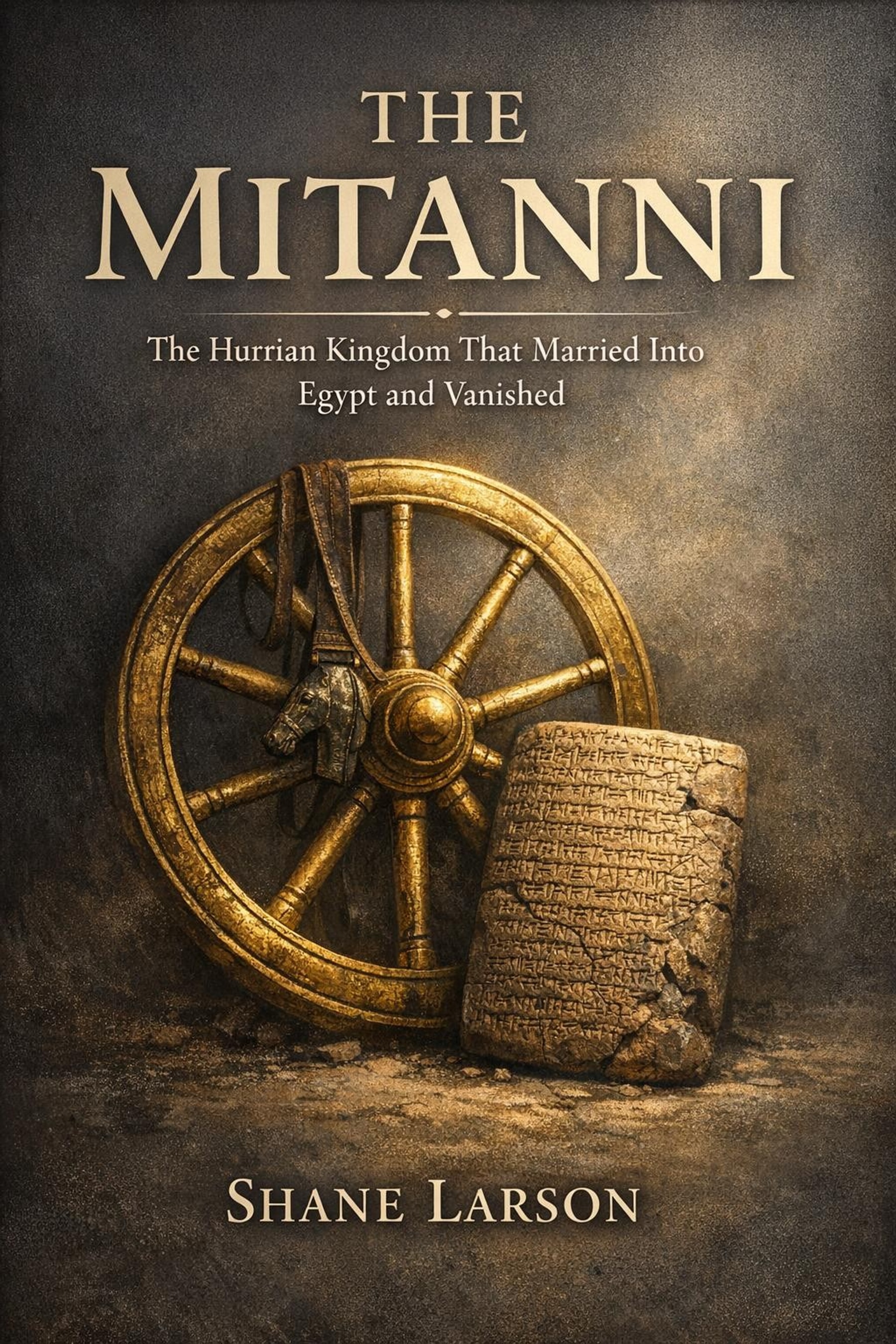
The Mitanni
The Hurrian Kingdom That Married Into Egypt and Vanished
By Shane Larson
About This Book
Somewhere under the plains of northern Syria there is a mound with a royal city inside it. The city had palaces, temples, and — because its kings corresponded with pharaohs as equals — a chancellery holding the working files of a superpower. Archaeologists have a leading candidate for which mound it is. Nobody has proven it. Washukanni, capital of the kingdom of Mitanni, is one of the last great cities of the ancient world that remains genuinely unlocated.
Meanwhile, in a provincial town called Nuzi on the kingdom's eastern edge, the paperwork of ordinary people survived by the thousand. Adoption contracts used to dodge land-sale restrictions. Inheritance fights. The court record of a woman named Tulpun-naya, litigious enough that we can follow her career. History played a strange joke on Mitanni: the lawsuits of a small town came through three and a half millennia intact, and the archive of the empire that governed it vanished without a trace.
That inversion is the whole subject of this book. What can you actually know about a great power when everything it wrote about itself is gone — and everything you have was filed by its rivals, its vassals, and its destroyers?
Quite a lot, it turns out, if you are willing to read the files against the grain. Mitanni was no minor player. For two generations it held the whole northern arc of Mesopotamia and Syria, fought the armies of Thutmose III to a stalemate, and then turned that stalemate into the closest alliance in the Bronze Age world — sealed by three princesses sent south to marry three successive pharaohs. When Amenhotep III fell ill, the king of Mitanni shipped him the statue of Shaushka, the healing goddess of Nineveh; the tablets suggest it was her second trip. The kingdom's horse trainers produced the oldest conditioning manual on earth, a seven-month programme written by a master named Kikkuli — and we have it only because the Hittites judged it valuable enough to copy into their own archives. Empires do not steal the trade secrets of nobodies.
The reconstruction proceeds document by document, because the evidence permits nothing else. Each chapter starts from a specific surviving text — a wounded royal letter about adulterated gold, a treaty whose witness list preserves a lost kingdom's gods, a vassal king's autobiography carved across his own statue — and builds only as far as that document can carry the weight. Every source has an agenda: Egyptian records glorify pharaohs, Hittite treaties justify the winners, Assyrian annals turn every campaign into a triumph. The book shows where accounts written for incompatible purposes agree, and says plainly where the testimony runs out.
It also confronts one of the strangest puzzles in ancient history head-on: this Hurrian-speaking kingdom had kings with names from another language family entirely, and in one treaty a Mitanni prince swears his oath before Mitra, Varuna, and Indra — deities of the Indian Vedas, invoked a thousand miles from where anyone would expect them.
Why I Wrote This
I keep a mental list of subjects where the shelf doesn't match the importance, and Mitanni sat at the top of it for years. Egypt, the Hittites, Babylon, Assyria — I could hand you a stack of good popular histories for each. For the fifth member of their club there was nothing in English between an academic handbook chapter and silence. That alone would have been reason enough, but what actually hooked me was the missing city. We are not talking about a legend; this is a documented capital, named in treaties, seat of kings whose letters we can read, and no one can point to it on a map. Writing a history of a state whose every surviving record was kept by someone else turned out to be the most interesting methodological problem I've taken on — the book had to show its work, because with Mitanni there is no other honest way to do it.
Frequently Asked Questions
Do I need to read The Amarna Letters or any other book first?
No. It stands entirely on its own — the diplomatic world of the letters is set up from scratch in the introduction and Part Three. Readers of the Amarna correspondence will recognize the terrain and see it from the northern side for a change, but nothing is assumed.
Is this narrative history or a textbook?
Narrative history. It moves chronologically through the kingdom's rise, its career among the great powers, and its destruction, and it is written to be read straight through. What it borrows from scholarship is honesty about evidence — you are always told which document a claim rests on.
How much background in ancient history does it assume?
None. Every ruler, kingdom, and technical term is introduced when it first matters. It is built for someone meeting this world for the first time.
Does it cover the Indo-Aryan connection — the Vedic gods in the treaties?
Yes, at length. Chapter 2 is devoted to it: the royal names, the Mitra-Varuna-Indra oath, the horse-training vocabulary, and the competing explanations, from migration to a mercenary chariot elite to a fossilised prestige language. The honest conclusion is that the question is unresolved, and the chapter explains exactly why.
Has Washukanni been found since the book was written?
No. Tell Fekheriye, at the headwaters of the Khabur, remains the leading candidate, but no excavation has produced a tablet naming the city it was written in — the find that would settle the matter. Chapter 13 covers the state of the search and what stands in its way.
How long is the book?
About 75,000 words — roughly 240 pages in print. Fourteen chapters plus an introduction and conclusion, with three appendices: the king list, Mitanni's Amarna letters one by one, and the chariot and training programme.
If You Liked This, You Might Like
- The Amarna Letters: Diplomacy at the End of the World — the archive this book leans on hardest, told from Egypt's side of the correspondence; together the two books let you read the same mail from both ends.
- The Hittite Empire: Forgotten Superpower of the Ancient World — the full story of the power that destroyed Mitanni in a season, and of the archives at Hattusa that preserved so much of what we know about it.
- Akhenaten: The Heretic Pharaoh Who Invented Monotheism — Tushratta's gold letter was addressed to this pharaoh, and his abandoned capital is where it was found; here is what was happening at the other end of that friendship.
Every empire assumes its own records will do the remembering. This is the story of the one that had to be recovered entirely from everyone else's — and of the city that could still, one field season from now, hand it back its voice.
What You'll Learn
- The gold-statue affair in full: what Tushratta's messengers witnessed at the casting in Egypt, what actually arrived after the old pharaoh died, and why the complaint he wrote is among the most human documents of the second millennium BC.
- Who the Hurrians were before Mitanni existed — speakers of a language related to almost nothing else on earth — and why "Hurrian" and "Mitanni" must never be used interchangeably.
- The Indo-Aryan puzzle examined from every side: the royal names, the Vedic gods in the treaty oath, the Sanskrit-adjacent numerals in the horse manual, and a fair hearing for each competing explanation.
- The chariot as a system rather than a vehicle — spoked wheels, composite bows, crew doctrine, and the systematically conditioned horses that made the whole machine work.
- The wars with Egypt, including Thutmose III hauling boats overland to reach the Euphrates, and the strategic logic that converted two generations of fighting into marriage diplomacy.
- How Suppiluliuma of Hatti dismantled a first-rank empire in a single campaigning season, why the kingdom's web-of-vassals structure made the collapse that fast, and how Assyria then absorbed the remnant and erased the name.
- The state of the hunt for Washukanni: what the texts constrain, what Tell Fekheriye offers, and what one baked tablet in the right excavation square would change.
- What outlived the kingdom, from Hurrian gods in the Hittite state pantheon to a hymn from Ugarit carrying the oldest written music in the world.
New Ancient History releases and free chapters — no spam, unsubscribe anytime.