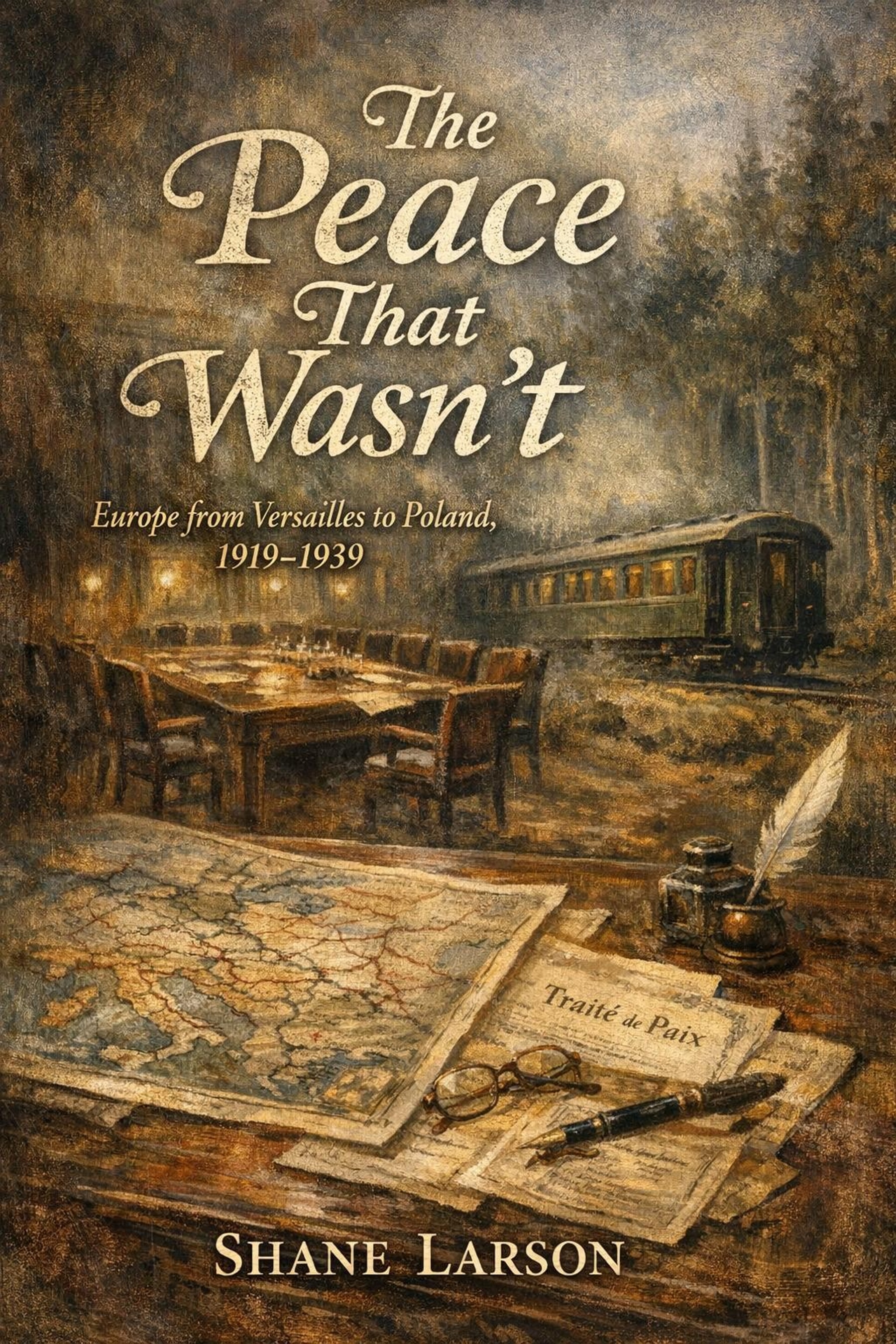
The Peace That Wasn't
Europe from Versailles to Poland, 1919-1939
By Shane Larson
About This Book
In a clearing in the forest of Compiègne, a railway siding leads nowhere in particular. In November 1918 it held a French dining car — an ordinary restaurant car fitted that autumn with a long table — and at that table, before dawn on 11 November, four German delegates signed the armistice that stopped the First World War. The car went into a museum and sat there for thirteen years as a national relic.
In June 1940, with France beaten in six weeks, German army engineers broke open the museum's wall, hauled the carriage back to the exact spot it had occupied in 1918, and arranged the chairs with a set-dresser's care. The French delegation was shown to the seats the Germans had used twenty-two years earlier, and France signed its capitulation at the same table.
The scene is usually offered as proof of one man's vindictiveness, and it is that. But it proves something more useful. No government stages theatre that elaborate unless an entire public can be relied on to read the gesture without a caption — unless the grievance has been doing political work for two decades. The carriage explains why millions of Germans experienced the second war as a reply to the first. It does not explain why the reply was possible. This book is about that gap: the distance between the grievance, which was on display in the clearing, and the mechanism, which was somewhere else entirely.
Ask most readers what caused the Second World War and you get a document: a treaty too harsh, a Germany humiliated into extremism, a dictatorship arriving on schedule. That account was in print by December 1919, and it has a chronology problem. The republic the treaty supposedly doomed outlived the treaty crisis, outlived the Ruhr occupation, outlived hyperinflation, and entered its tenth year stable, solvent, and governed from the centre — while the party of the eventual catastrophe polled 2.6 percent and shed members.
What changed was money. Germany's five good years ran on short-term American credit lent long, with New York financing everything from reparations transfers to municipal swimming pools. Starting in 1928 that money went home — first chasing Wall Street's boom, then destroyed by Wall Street's collapse — and credit that took five years to extend was withdrawn in about eighteen months. Unemployment climbed from 1.4 million past six million; the Nazi vote climbed from 2.6 percent to 37.3 percent; the two curves cover the same three years. The depression did not radicalise a contented country. It detonated a grievance that nationalist politicians and the army's stab-in-the-back legend had kept primed for exactly such an occasion.
Even that only accounts for the regime. The postwar security order existed precisely to contain a rearming Germany, and its texts were adequate to every crisis they met. What failed — four times, in public — was any member government's willingness to bear a specific cost at a specific moment. Manchuria, Abyssinia, the Rhineland, Spain: each test cheaper to pass than the one after it, each declined for reasons that were real, usually true, and fatal. By the time anyone flew to Munich, the pattern was not a suspicion available to the far-sighted. It was the documented record, and the government in Berlin had read it as carefully as anyone.
What's Inside
- The armistice as Germany experienced it: no Allied soldier on German soil, no surrender ceremony, an army marching home under flags and arches — and the room all of that left for a legend nobody had yet invented.
- Article 231 as its two young American drafters wrote it (a legal liability clause) versus as Germany read it (a confession of guilt), and the reparations headline versus the far smaller sum actually owed — and mostly never paid.
- Mussolini's Rome in 1922, told as the invention of a template — the militia, the theatre, the constitutional invitation — with the specific people in Munich who were taking notes.
- The load-bearing chapter: how American credit built Weimar's stability and how its recall dismantled it, followed loan by loan and election by election.
- The four tests of collective security told as one continuous record rather than four unrelated episodes, so the price list each refusal published is visible.
- The Rhineland weekend in detail: nineteen battalions, withdrawal orders in their pockets, a French intelligence estimate wrong by multiples, and a caretaker cabinet five weeks from an election.
- Munich argued fairly, from the folder Chamberlain's cabinet actually held — radar schedules, fighter re-equipment, dominion telegrams, bombing casualty projections — and then the ledger totted for both sides.
- Nine days in August 1939, in which the two regimes founded on the promise of each other's annihilation astonished every professional observer in Europe.
- Three appendices: a seven-power parallel timeline, the reparations question handled with the disagreements named, and the armies of 1939 with every contested figure given as a range.
Why I Wrote This
I write books about how systems fail — how currencies, institutions, and empires come apart while the people inside them explain, reasonably, why this particular test is not worth the cost. The interwar years are that story run at speed: a security architecture built by intelligent, scarred men, dismantled in twenty years by decisions that were individually defensible and collectively fatal. What hooked me was the chronology. I had absorbed the standard story — harsh treaty, doomed republic — and the dates simply do not support it. The republic was stable ten years after Versailles. Then the credit left, and once you lay the unemployment curve over the Nazi vote curve, you cannot unsee it; every tidier explanation starts to look like theatre. I wrote this book to put the receipts in order. It opens a ten-volume series because the causes deserve more than the thirty pages most war histories spare them before the shooting starts.
Frequently Asked Questions
Do I need to know anything about World War II before reading this book?
No. It begins in November 1918 and assumes nothing; every treaty, crisis, and name is explained when it arrives. If anything, this is the right place to start — it is Volume 1 of the series precisely because the causes come first.
Is this book for or against Chamberlain and appeasement?
Neither, and it refuses the choice. It argues the case for the policy as its makers understood it, with the genuine numbers they had in front of them, then says plainly where they were wrong. The verdict on Munich is given, not gestured at, and it will not satisfy either the popular sneer or the popular rehabilitation.
Does this book cover the fighting of the Second World War?
No. It ends on 3 September 1939, with Chamberlain's broadcast. The campaigns begin in Volume 2, which opens inside Poland where this book stops.
Do I have to read the Second World War Chronicles in order?
Each volume stands on its own, but the set is built as a sequence and this book is the designed entry point. Starting here means the fighting, when it comes, arrives already explained.
Does the book blame the Treaty of Versailles for the war?
No — and it does not excuse the treaty either. The grievance was real: territory, disarmament, a liability clause read as an accusation. But the chronology shows the treaty could not have been the mechanism, and the book spends its middle chapters on what was.
If You Liked This, You Might Like
- Economic Collapse Pattern — the 1929 credit withdrawal that detonates this book is the same mechanism that book traces across centuries of financial ruin.
- The Institutional Collapse Pattern — the League of Nations is a trusted system losing its legitimacy in four public acts, and that book explains the pattern it died of.
- The Empire Collapse Pattern — four empires vanish in the first chapter of this book; that one explains why the mightiest powers fall at all.
Twenty-two years separate the two signatures in that railway carriage, and the distance between them was closed one declined cost at a time. This is the account of how — with the sources named and the numbers shown. The Peace That Wasn't is Volume 1 of The Second World War Chronicles.
What You'll Learn
- The armistice as Germany experienced it: no Allied soldier on German soil, no surrender ceremony, an army marching home under flags and arches — and the room all of that left for a legend nobody had yet invented.
- Article 231 as its two young American drafters wrote it (a legal liability clause) versus as Germany read it (a confession of guilt), and the reparations headline versus the far smaller sum actually owed — and mostly never paid.
- Mussolini's Rome in 1922, told as the invention of a template — the militia, the theatre, the constitutional invitation — with the specific people in Munich who were taking notes.
- The load-bearing chapter: how American credit built Weimar's stability and how its recall dismantled it, followed loan by loan and election by election.
- The four tests of collective security told as one continuous record rather than four unrelated episodes, so the price list each refusal published is visible.
- The Rhineland weekend in detail: nineteen battalions, withdrawal orders in their pockets, a French intelligence estimate wrong by multiples, and a caretaker cabinet five weeks from an election.
- Munich argued fairly, from the folder Chamberlain's cabinet actually held — radar schedules, fighter re-equipment, dominion telegrams, bombing casualty projections — and then the ledger totted for both sides.
- Nine days in August 1939, in which the two regimes founded on the promise of each other's annihilation astonished every professional observer in Europe.
- Three appendices: a seven-power parallel timeline, the reparations question handled with the disagreements named, and the armies of 1939 with every contested figure given as a range.
Included with Kindle Unlimited — read it free if you're a member.
New Military History releases and free chapters — no spam, unsubscribe anytime.