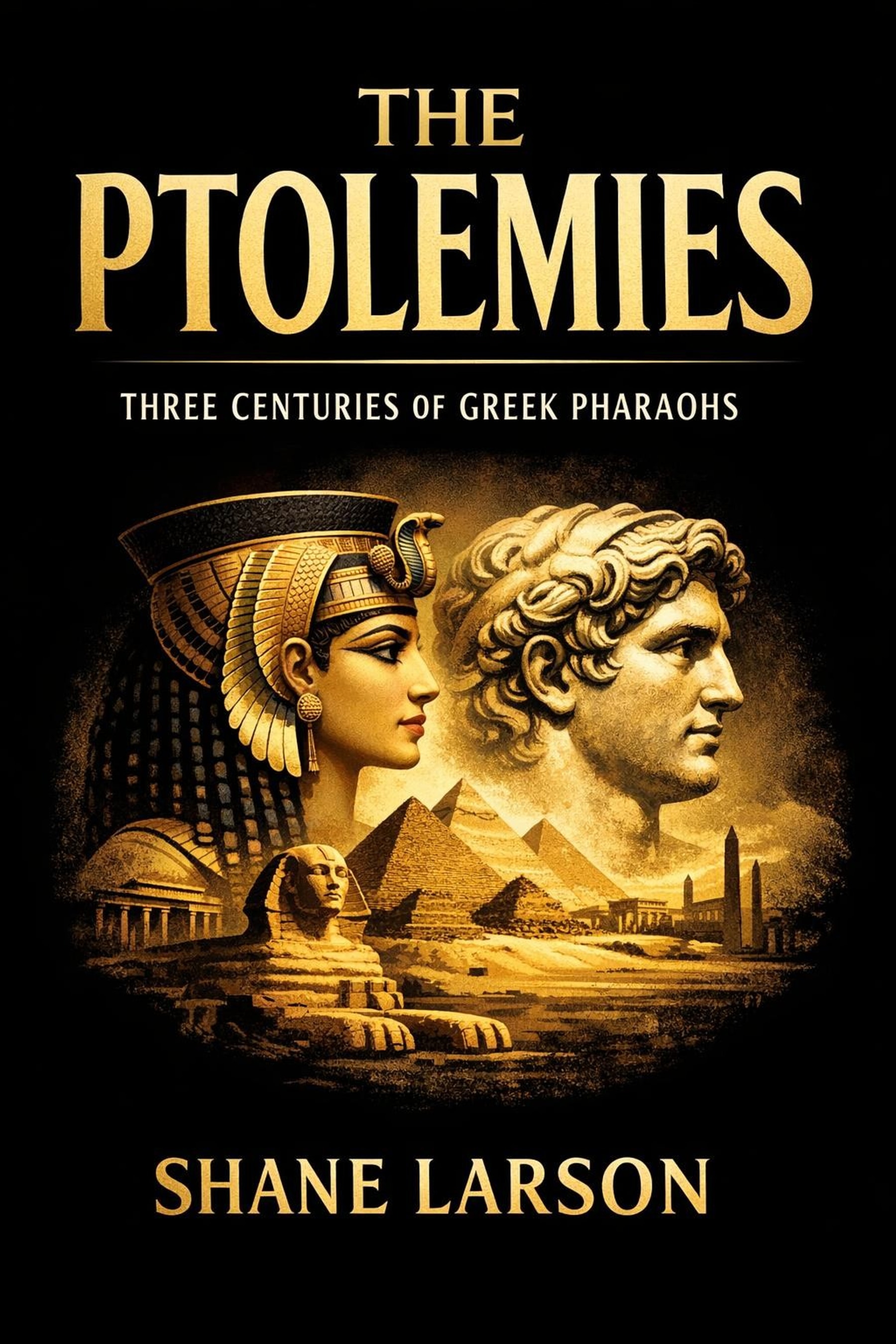
The Ptolemies
Three Centuries of Greek Pharaohs
By Shane Larson
About This Book
Most people who picture the rulers of ancient Egypt imagine pharaohs — dark-lined eyes, golden headdresses, hieroglyphic inscriptions, gods made flesh. The Ptolemies gave them all of that. What they don't tell you is that underneath the pharaonic costume, every single one of them was Greek. For nearly three centuries — longer than the United States has existed — a dynasty of Macedonian Greeks sat on the throne of Egypt, spoke Greek at court, wrote their decrees in Greek, and corresponded with Greek philosophers, Greek poets, and Greek kings. They built one of the ancient world's greatest cities: Alexandria, a metropolis of half a million people that housed the most ambitious library ever assembled, a lighthouse that sailors used to navigate for five hundred years, and a palace quarter so large that a foreign visitor once described it as a city within a city. And they ruled over thirty million Egyptians, most of whom never stopped thinking of their rulers as foreigners. The Ptolemies: Three Centuries of Greek Pharaohs is the story of that dynasty in full — how it started, how it built an empire, how it slowly came apart, and how it ended in the most consequential royal death of the ancient world. The Story It begins with one of antiquity's most audacious acts of political theater. When Alexander the Great died in Babylon in 323 BCE, his generals immediately began tearing his empire apart. Most of them fought over armies, treasuries, and thrones. Ptolemy, son of Lagos — one of Alexander's oldest companions — asked for something smaller. He asked for Egypt. And then, on the road from Babylon to Macedonia, he intercepted Alexander's golden funeral procession and redirected it south. The theft was calculated, not impulsive. Ptolemy understood something his rivals didn't: that Egypt, defended by desert on three sides and sea on the fourth, was the one piece of Alexander's empire that could actually be held. He also understood that whoever possessed Alexander's body possessed Alexander's legitimacy — and that Egypt was the one place in the ancient world where a foreign conqueror could be transformed, through the machinery of the pharaonic state, into a god. From that founding act, The Ptolemies traces three centuries of Greek rule over Egypt: the golden age under Ptolemy II and III, when Alexandria became the intellectual capital of the Mediterranean and Ptolemaic fleets dominated the eastern seas; the long erosion of the middle period, when fratricidal wars, native revolts, and Roman interference slowly hollowed out the dynasty's power; and the desperate final generation, when Cleopatra VII — brilliant, ruthless, the first Ptolemy to actually learn Egyptian — tried to use Rome's warring generals to preserve what was left of her kingdom, and came within a single naval battle of pulling it off. The book covers the full sweep: generals who built the most sophisticated bureaucracy in the ancient world, queens who commanded armies and commissioned temples, brother-kings who murdered each other with a regularity that shocked even their contemporaries, and a city — Alexandria — that stood for everything the Hellenistic world believed civilization could be. What's Inside
The founding theft — how Ptolemy I hijacked Alexander's funeral procession, what he gained by it, and why it worked as a political strategy for three hundred years The machinery of the pharaonic state — how a dynasty of Greeks inherited the world's oldest bureaucracy, kept it largely intact, and used it to extract more revenue than any previous ruler of Egypt The Library of Alexandria — its actual origins, what it really contained, who funded it, how it worked as an institution, and why the question of "who burned it" has a complicated answer The Ptolemaic queens — Arsinoe II, Berenice II, Cleopatra III, and others who held real political and military power across the dynasty's history, not just decorative roles The Syrian Wars — six conflicts with the Seleucid empire that dominated the dynasty's middle centuries and slowly drained its resources and territory Greeks and Egyptians — how two cultures coexisted, blended, resented each other, and occasionally produced something entirely new, from the hybrid god Serapis to the bilingual bureaucrats who ran the countryside The civil wars — the fratricidal conflicts of the later dynasty that made Rome's interference not just possible but inevitable Cleopatra VII — her actual career, her relationship with Caesar and Antony, her strategy for preserving Egyptian independence, and what her death meant for the ancient world The end of the ancient world's wealthiest kingdom — how Augustus turned Egypt into Rome's personal property and why it mattered for the next four centuries of imperial history
Why I Wrote This The Ptolemies kept showing up in every ancient history book I read — as background, as context, as the dynasty that happened to be ruling Egypt when something more famous occurred nearby. Caesar visits Alexandria. The Library burns (or doesn't). Cleopatra falls. Egypt becomes a Roman province. The Ptolemies themselves were treated as scenery. That bothered me. Three centuries is a long time. The dynasty that built Alexandria, assembled the greatest library of antiquity, produced Cleopatra VII, and turned Egypt into the Roman Empire's grain supply deserves to be the main story, not the backdrop. Once I started looking at them on their own terms — not as a footnote to Alexander, not as the setup to Caesar — I found one of the most fascinating ruling families in ancient history: brilliant and murderous, visionary and dysfunctional, Greek in their ambitions and Egyptian in their rituals, and ultimately unable to survive the one force they had successfully managed for three hundred years: the ambitions of a single man from the west. The Ptolemies is the book I went looking for and couldn't find. Frequently Asked Questions Do I need to know ancient Greek history to read this? No prior knowledge required. The book opens with Alexander the Great's death in 323 BCE and explains the political situation from the ground up. If you know who Cleopatra is, you have enough context to start reading. Readers who are deep into ancient history will find new material here; readers who are entirely new to the Hellenistic period will have no trouble following the narrative. Is this a textbook or a narrative history? It's a narrative history — written for general readers, not for classicists. The approach is chronological and character-driven, built around the major rulers and turning points of the dynasty rather than around scholarly debates. Source notes and an appendix address the historical evidence for readers who want to go deeper. What makes this different from other books about Cleopatra? Cleopatra VII gets a full treatment in the book's final section, but she's the end of the story, not the whole story. The Ptolemaic dynasty ran for nearly three centuries before Cleopatra was born. This book covers that full arc — the founding generation, the golden age, the long decline — so by the time you reach Cleopatra, you understand exactly what she was trying to save and why it mattered. Is this book available on Kindle Unlimited? Yes. The Ptolemies: Three Centuries of Greek Pharaohs is available in Kindle Unlimited as well as in paperback and Kindle formats. Does the book cover the Library of Alexandria? Yes, in depth. There's a full chapter on the Library — its founding, how it actually functioned as an institution, what it contained, and the question of how and when it was destroyed. The short answer to the last question is: it's complicated, and the book explains why. How long is the book? The main narrative runs fourteen chapters plus three appendices, covering the full dynasty from 323 BCE to 30 BCE. It's designed to be read in sequence but the appendices — a dynasty timeline, a guide to the historical sources, and a further-reading section — work as standalone reference material. If You Liked This, You Might Like
Canaan to Carthage — the Phoenicians who built the Mediterranean trade network the Ptolemies later dominated; essential background for understanding how Alexandria became the commercial capital it did. Last Days of Carthage — Rome's destruction of its greatest rival, happening during the same decades that Rome began squeezing the Ptolemaic kingdom; read together, the two books show how Rome dismantled the entire Hellenistic world. The Bronze Age World — the deep history of Egypt and the Near East before the Greeks arrived; understanding what the Ptolemies inherited requires understanding what Egypt had been for two thousand years before Alexander showed up.
The Ptolemies built a civilization that lasted longer than the Roman Empire in the west — and they built it, against all odds, in a country that wasn't theirs, in a language its people didn't speak, by becoming, slowly and deliberately, something the ancient world had never quite seen before: rulers who were simultaneously foreign and native, Greek and Egyptian, mortal kings and living gods. The Ptolemies: Three Centuries of Greek Pharaohs tells that story in full.
Included with Kindle Unlimited — read it free if you're a member.
New Ancient History releases and free chapters — no spam, unsubscribe anytime.