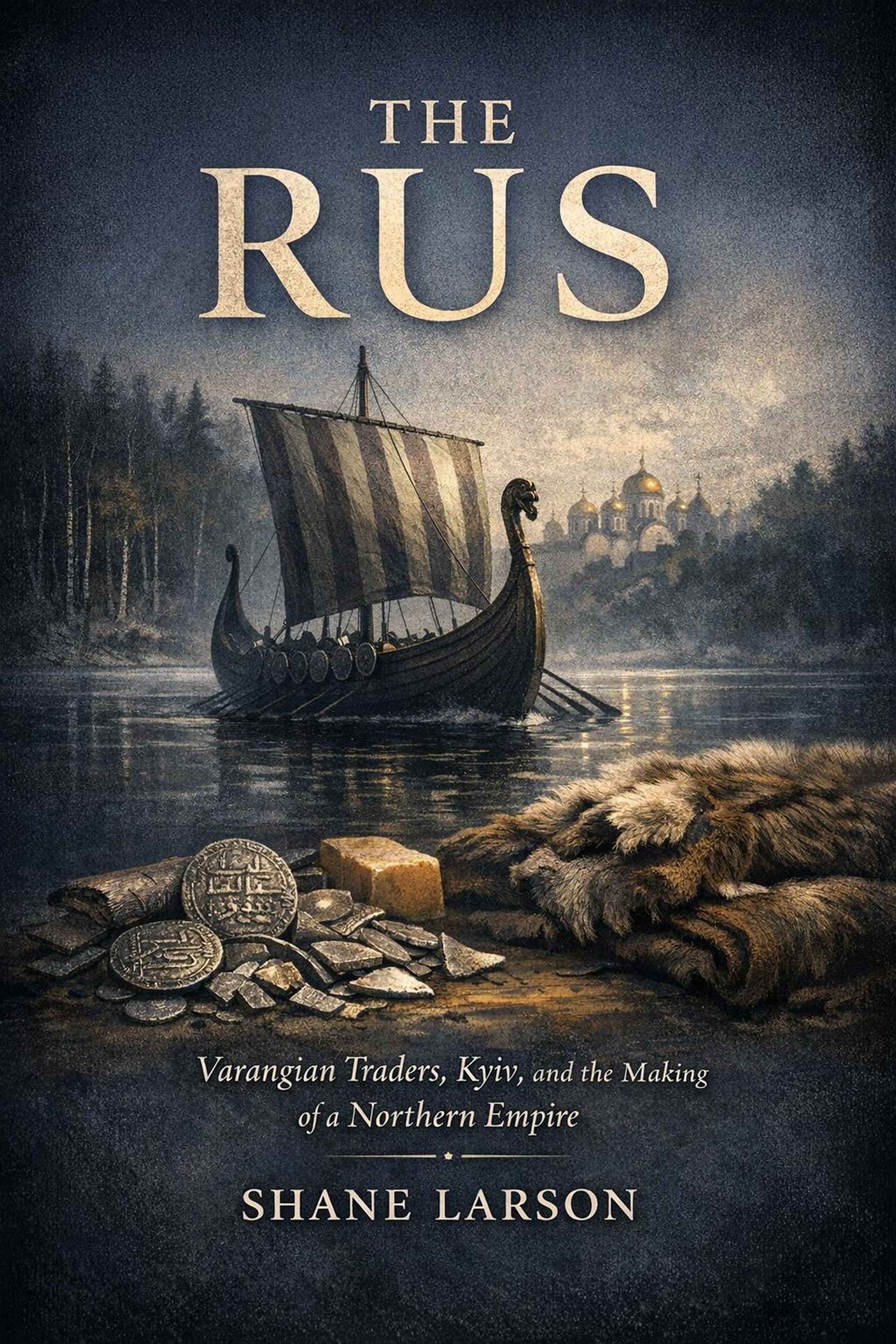
The Rus
Varangian Traders, Kyiv, and the Making of a Northern Empire
By Shane Larson
About This Book
Somewhere in the south gallery of Hagia Sophia, on a marble parapet where a bored man could rest his elbow through a long service, someone scratched his name into the stone in runes. Enough of it survives to read the first part: Halfdan. He was almost certainly a northerner in the emperor's guard, standing a watch he did not need to pay attention to, in the largest building he had ever entered, several thousand kilometers from wherever he was born.
Nobody knows anything else about him. That single graffito is the whole record. But the fact of him — a Scandinavian with a Norse name and a Norse alphabet, idle in the great church of the Byzantine empire, in a job that guaranteed him gold — is one of the strangest facts in medieval Europe, and it did not happen by accident. There was a road that brought him there, and the road had been running for two hundred years before he arrived.
The road was made of rivers, and what moved down it was silver, fur, wax, and people.
The Trade That Built a State
Start at the other end, in the ground of a Baltic island. Scandinavian soil has produced several hundred thousand Islamic silver coins — dirhams struck in Baghdad, Samarkand, Merv, and the mints of Central Asia, in quantities that on Gotland alone exceed what survives in most provinces of the caliphate that made them. They are not treasure hoards in the storybook sense. The coins are cut into fragments, nicked and bent where someone tested the metal with a knife, and buried alongside standard weights and folding balances. This is working capital: money valued by weight rather than counted, chopped to make change.
No caliph's fleet ever entered the Baltic. The silver came north as payment, and something had to be going south in enough volume to pull coin out of the wealthiest economy on earth. What went south was the produce of the northern forest — sable and marten and beaver, wax for the candles of a Christendom that burned them by the ton, honey, amber, walrus ivory — and, in very large volume, human beings, taken along the river systems and sold in the markets of the Islamic east and of Constantinople.
That trade is the engine of everything else in this book, and it explains the odd shape of what grew out of it. Moving bulk cargo two thousand kilometers down rivers means dragging boats overland between watersheds and past rapids, and every portage is a place where a loaded, slow-moving convoy is helpless. So the traders fortified the choke points. The fortified points needed garrisons. Garrisons need feeding, which means tribute from the surrounding country, which means the men holding the stations became the men ruling the district. Staraya Ladoga, Gnezdovo, Novgorod, Smolensk, Chernigov, Kyiv: river stations that hardened into towns, and towns whose captains hardened into princes.
The state was a by-product of protecting a trade route. That is the argument of the book, and it is also the explanation for how the thing ended — because when the eastern silver failed and the Mediterranean reopened, the political structure was left standing on an economic foundation that had quietly gone away.
What's Inside
- The geography, taken seriously and made navigable. The Baltic to Lake Ladoga, the Volkhov and the Lovat, the watershed portages, and the two great through-routes: the Volga running southeast to the Caspian, the Dnieper running south to the Black Sea. Rivers freeze, then flood, then run — and that calendar set the rhythm of every voyage, contract, and tribute circuit in the book.
- Seven cataracts, named twice. A Byzantine emperor wrote an administrative memorandum for his son explaining exactly how the Rus convoy reached his city, including the name of each Dnieper cataract in both Slavic and Norse. It is an extraordinary document, and it makes it possible to narrate a single voyage in real detail — which is what Chapter 7 does.
- An eyewitness with a hostile eye. In 922 an envoy from Baghdad met a Rus trading company camped on the Volga and recorded what he saw with fastidious disgust, including a ship burial he watched from a few paces away. His revulsion is itself evidence, and the book explains how to read a witness like that.
- The treaties. Agreements from 907, 911 and 944 that survive clause by clause: where Rus merchants could lodge, how many could enter the city at a time and through which gate, unarmed; their rations and their free baths; the procedure when someone was killed; the return of runaway slaves and of wrecked property. A trade treaty records what both sides thought needed regulating, which is something no chronicle will ever tell you.
- The Varangian Guard, from the bargain that created it in 988 to the Norwegian king who served in it before he was a king — and Halfdan's runes on the parapet.
- The conversion of 988, told as what it was: a famous and delightful story about envoys comparing four faiths, composed long afterward as a literary set piece, sitting on top of a political transaction involving an emperor in desperate need of troops and a marriage without precedent.
- Birchbark. Hundreds of ordinary letters preserved in waterlogged Novgorod soil — debts, lists, a complaint about a stolen woman, a marriage proposal, and a boy named Onfim doing his writing homework and drawing in the margins. The best evidence anywhere in medieval Europe for ordinary people who could read and write.
- The coming apart, argued from archaeology rather than from the chronicles' laments: a succession system that guaranteed fragmentation, a capital sacked in 1169 by a prince who then declined to move into it, silver that had stopped arriving a century before the Mongols did, and what building programs and pottery sequences show about what was actually destroyed in 1240 and what simply carried on.
Why I Wrote This
I wrote a book about the Viking expansion a while back, and it ends with Scandinavians reaching Constantinople. Then it stops, because that is where the familiar story stops. Everything popular in English about the Viking age goes west — Lindisfarne, Dublin, Iceland, Greenland, the brief embarrassment in Newfoundland. I finished that book knowing I had left the more interesting half unwritten.
Because the western expansion produced raids and farms and eventually assimilation. The eastern one produced a state — the only durable one the Viking world ever made — and it did it almost as a side effect of running a trade route. That is a better story, and it is told in English by roughly one excellent academic survey from thirty years ago and almost nothing else.
The thing that finally made me start was the silver. Hundreds of thousands of coins from Baghdad and Samarkand, sitting in the dirt of Swedish farms, cut up for small change. You cannot look at that and not want to know what was going the other way.
Frequently Asked Questions
Do I need to have read anything else first?
No. The book assumes no prior knowledge — not of the Viking age, not of Byzantium, not of the geography, which is explained from the ground up because most readers have never had reason to learn it. It works as a continuation of a Viking-age narrative if you want one, and as a standalone if you don't.
Is this a Viking book or a Byzantine book?
Both, and that is the point. The Rus are the hinge between the two worlds, and the book spends four chapters in and around Constantinople because that is where the trade went and where the best documents survive.
How does it handle the slave trade?
Directly, repeatedly, and without softening. A very large share of what the Rus carried south was captives, and the book says where they came from, how they were moved, where they were sold, and what the records support about scale. It is reported factually — no euphemism, and equally no dwelling on cruelty for effect. Most popular accounts of the eastern Vikings mention this once and move on, which misrepresents the economy that produced the state.
Does the book take a position on where the Rus came from?
It presents the question and then answers it from the material rather than the argument. The origin of the name and the elite has been debated for close to three centuries, and for much of that time the debate was not really about evidence. The book notes that, declines to relitigate it, and goes to the graves, the brooches, the weights, and the personal names in the treaties — which point to a mixed Scandinavian, Slavic, and Finnic elite that was substantially Slavic within a few generations.
Where does the narrative end?
In the thirteenth century, with the Mongol campaign of 1237–40 and the archaeological evidence for what it did. The book does not carry the story forward past that, by design.
How long is it?
Around 82,000 words: an introduction, fourteen chapters in four parts, a conclusion, and three appendices — the river roads segment by segment, the Byzantine treaties clause by clause, and an honest account of what each body of evidence can and cannot support. The paperback runs 257 pages.
If You Liked This, You Might Like
- The Viking Expansion — The western half of the same phenomenon, and the book this one is the continuation of. That one ends with Scandinavians arriving at Constantinople; this one is what they were doing there.
- The Mongol Storm — Picks up almost exactly where this book stops. Chapter 14 here is the view from inside the cities; that book is the view from the steppe.
- Justinian and Theodora — Constantinople four centuries before the Rus arrived at its walls, which is useful for understanding what they were looking at.
- The Purple Merchants — The same structural story in a warmer sea: a trading network whose politics were shaped entirely by the shape of its routes.
A road made of rivers, a cargo that included people, and a state that appeared because somebody had to guard the portages.
What You'll Learn
- Why a portage is exactly where a town appears — the river geography that determined everything
- The annual convoy to Constantinople, narrated end to end from the emperor's own account
- The treaties of 907, 911, and 944 — what a trade agreement reveals that a chronicle cannot
- Ibn Fadlan's eyewitness report of the Rus on the Volga, and how to read a hostile witness
- Olga, Svyatoslav, Vladimir's baptism in 988, and Yaroslav's daughters married to three kings
- Why it came apart: a succession system that multiplied princes, silver that dried up, and the Mongol campaign of 1237–40
Included with Kindle Unlimited — read it free if you're a member.
New Medieval History releases and free chapters — no spam, unsubscribe anytime.
More in This Genre
View all →