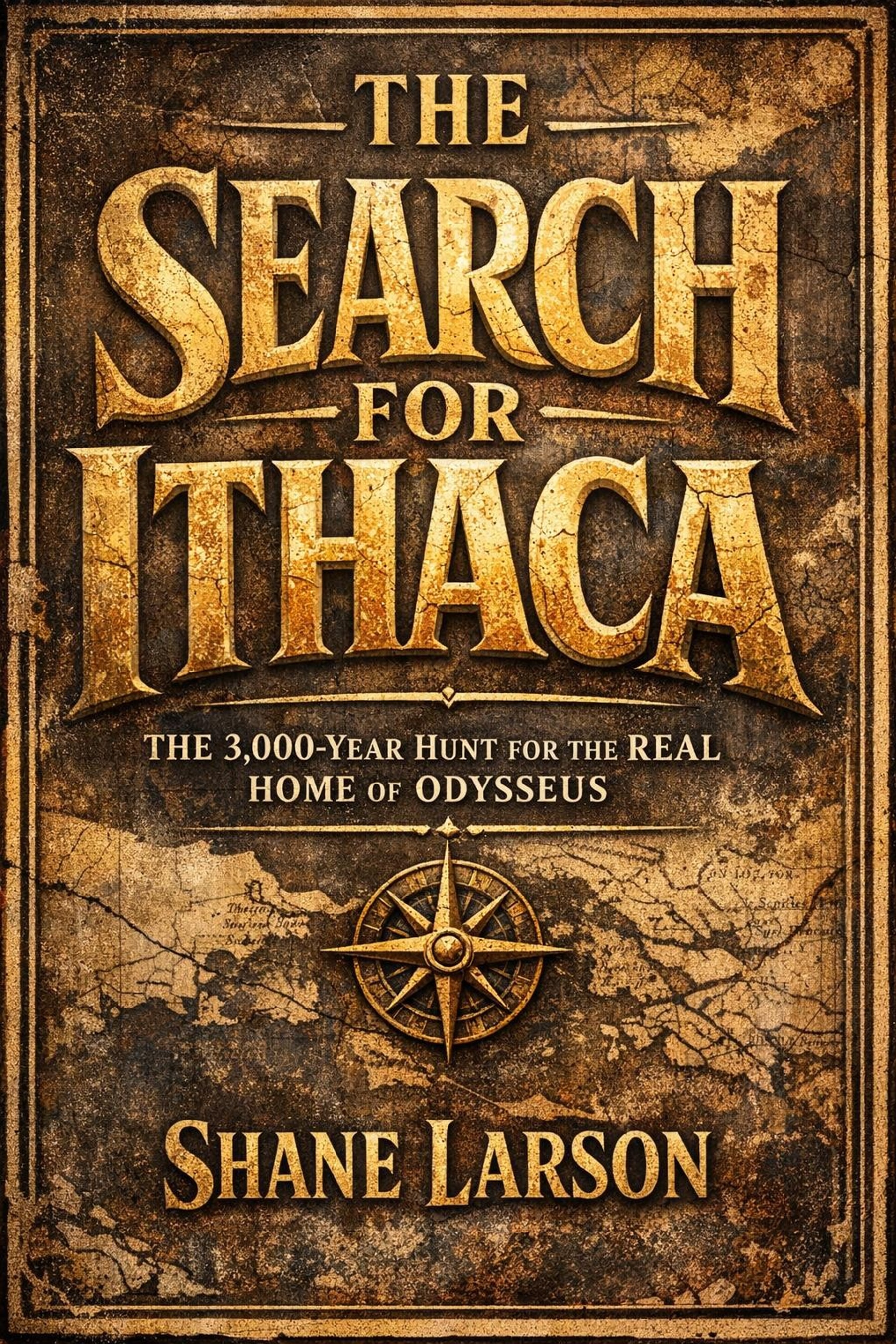
The Search for Ithaca
The 3,000-Year Hunt for the Real Home of Odysseus
By Shane Larson
About This Book
In 1953, an earthquake flattened nearly every town on the Greek island of Kefalonia. Roads split, hillsides let go, and along stretches of the coast the land itself rose out of the sea. For most of the world it was a tragedy and then a footnote. For one question — a question that had been argued since antiquity — it was something else entirely: a live demonstration that the ground in this corner of the Ionian does not stay put. Landscapes here are witnesses with a habit of changing their testimony.
That matters because of a poem. The Odyssey gives its hero a home address and describes it in oddly specific terms — a low place, farthest out in the water toward the sunset, its sister islands lying back toward the dawn. Sail the Ionian today with those lines in your head and you run into trouble immediately. The island that has worn the name Ithaca for thousands of years is tall, rugged, and tucked inshore of its bigger neighbor. It is, by the poem's own coordinates, the wrong island.
Somebody is mistaken: the poet, the map, or three millennia of tradition. Working out which one is a genuine cold case — the oldest in Western literature — and it is still open.
The Story
This book runs that case from the beginning. Ancient readers spotted the discrepancy first: Eratosthenes rolled his eyes at anyone mapping a poem, while Strabo squinted at the geography and left behind a stray, tantalizing remark about a low neck of land on Kefalonia that the sea sometimes crossed. Nineteenth-century travelers arrived with survey instruments and rival theories. Wilhelm Dörpfeld — Schliemann's right hand at Troy — spent his last decades and his reputation insisting the real Ithaca was Lefkada, and died unconvincing.
Then, in 2005, a British management consultant named Robert Bittlestone looked at satellite images of Kefalonia and asked a question the professionals had stopped asking. What if the low western peninsula called Paliki — which matches the poem's description almost line for line — had once been a separate island? What if the channel that severed it had been buried by two and a half thousand years of earthquake-driven rockfall, in one of the most seismically violent places in Europe? It was an outrageous idea with one great virtue: it could be tested. Bittlestone recruited a Cambridge classicist and a professional geologist, published the theory with a university press, and the team began putting instruments — and eventually drill rigs — into the Thinia valley to see what was down there.
What the boreholes found, what they didn't, and what a 2026 paper by those same two scholars did to the entire framing of the question — Homer, they argue, never strictly called Ithaca an island at all — is the spine of the book's second half. Alongside it runs a quieter thread: on modern Ithaki, in a collapsed cave above Polis Bay, archaeologists found bronze tripods and a dedication proving that ancient Greeks worshipped Odysseus there as a real hero for a thousand years. Belief has an archaeology too.
What's Inside
- The poem cross-examined as a witness: the handful of Greek words — chthamalē, panypertatē, pros zophon — on which the whole dispute turns, unpacked in plain language
- A suspect-by-suspect tour of the Ionian lineup: Ithaki, Lefkada, Kefalonia, Zakynthos, and why every candidate has an alibi problem
- Dörpfeld's doomed Lefkada campaign, told as the cautionary tale of marrying a hypothesis
- The full Paliki theory and the geology behind it — how earthquakes, rockfall, and coastal uplift could erase a sea channel from the map
- The fieldwork itself: gravity surveys, seismic lines, and boreholes through the Thinia isthmus, with an honest accounting of what the cores did and did not show
- The strongest case against Paliki, given its full day in court — infill volumes, timelines, sea levels, and the skeptics' view that an oral poet never needed a real map
- The 2026 re-reading that dissolves the "island" assumption and lowers the bar the geology has to clear
- The Polis Bay cave, Sylvia Benton's excavation, thirteen bronze tripods, and the eerie echo of the poem's thirteen Phaeacian gifts
- A final weighing of all four lines of evidence, a scorecard for the candidates, and the specific discoveries that would actually close the case
Why I Wrote This
I came to this story from the eastern end of the Bronze Age. I had written about the palace civilizations, the Sea Peoples, and the collapse around 1200 BC, and Homer kept standing at the western edge of that world like a signpost I hadn't followed. What finally pulled me in wasn't the poetry — it was the boreholes. Somewhere in the 2010s I learned that real geologists had drilled real holes through a Greek isthmus to test a reading of a three-thousand-year-old poem, and I couldn't let that go. It is the purest collision of text and ground I know of. I wanted to write the version of this story that takes every side seriously, keeps score honestly, and admits out loud what nobody has proven yet.
Frequently Asked Questions
Do I need to have read the Odyssey to follow this book?
No. Every passage that matters is retold in plain modern language right where you need it, and the poem's plot is summarized in the two minutes it takes to set up the problem. If you have read it, you'll catch a few extra resonances, but nothing depends on prior homework.
Does the book finally answer where Ithaca really was?
It gives you a verdict, but not a conviction. The honest state of the evidence is that the Paliki theory fits the poem's words best, the geology is suggestive but unproven, and the archaeology of worship points at modern Ithaki. The book says exactly that, shows how each conclusion was reached, and names the specific future discoveries that would settle things. If you want a book that declares the mystery solved, this isn't it — because nobody has solved it.
Is this about the Nolan film?
No. The film is why a lot of people are suddenly asking the question again, and the book acknowledges that moment, but there is nothing about the production in these pages. This is the history and science behind the question the film will leave you asking.
How technical does the geology get?
Boreholes, gravity surveys, and seismic lines are all explained the moment they appear, in ordinary words, usually in a sentence or two. If you can follow a true-crime documentary, you can follow this.
Is this part of a series?
Yes — it's the first book in Homer's World, a series about the real history behind the Odyssey. Companion volumes on the Bronze Age world behind the poem and on the ancient hero-cult of Odysseus are in the works, and the book points you to them where the threads connect.
If You Liked This, You Might Like
- The Mycenaeans — The palace civilization Odysseus supposedly ruled a corner of; the world the Odyssey half-remembers, told from the archaeology up.
- Ancient Apocalypse: The Fall of the Bronze Age — The catastrophe that ended that world and opened the dark centuries the poem had to survive.
- Sea Peoples: Raiders of the Bronze Age — The maritime chaos at the era's end, and the eastern half of the story this book tells from the west.
- The Collapse Pattern — A wider-angle look at how great civilizations come apart, including the Bronze Age system whose wreckage Homer inherited.
Three thousand years of readers have tried to sail home with Odysseus and found the harbor missing. This is the whole case file — the words, the islands, the rock, and the ruins — laid out so you can weigh it yourself.
The Search for Ithaca is Book 1 of the Homer's World series.
Included with Kindle Unlimited — read it free if you're a member.
New Ancient History releases and free chapters — no spam, unsubscribe anytime.