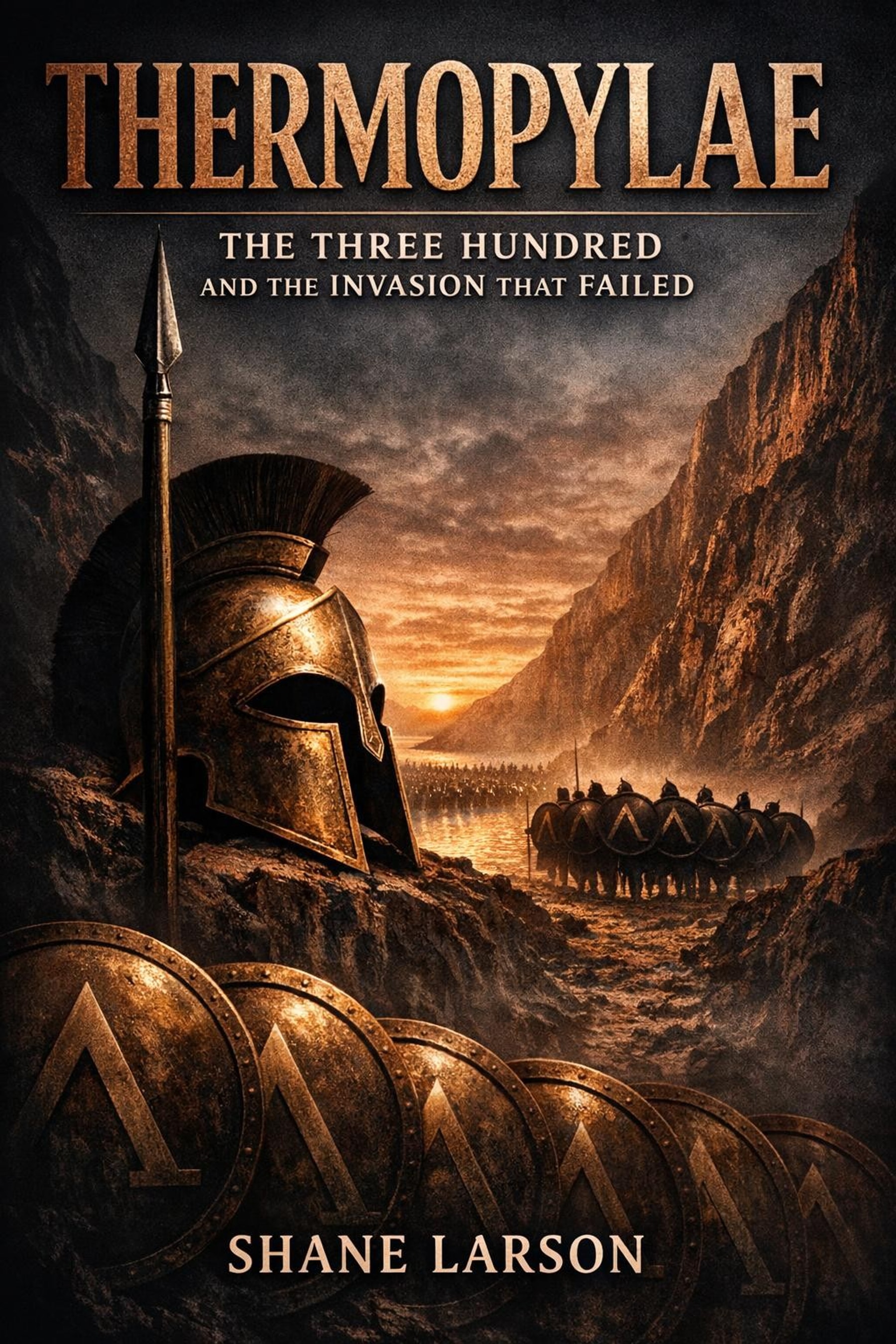
Thermopylae
The Three Hundred and the Invasion That Failed
By Shane Larson
About This Book
On the last night of the battle, a local man named Ephialtes walked into the Persian camp and offered to sell his neighbors. He knew a goat track over the mountains — a path that curled around the narrow coastal pass where the Greeks had held for two days — and for a price he would lead the enemy along it in the dark. By dawn the Persians were behind the Greek line, and the defense that had held the greatest army in the world was suddenly a trap with the jaws closing from two sides.
That betrayal is where the famous story usually locks in: the doomed few, the noble sacrifice, the three hundred choosing death in the pass. It is a magnificent image and it is largely wrong. There were not three hundred Greeks at the pass. There were something closer to seven thousand. The stand at Thermopylae was not a suicide mission but one half of a coordinated plan, fought in deliberate lockstep with a naval battle the legend forgot to mention. And the whole operation failed — the pass fell, the strategy collapsed, and Athens was burned to the ground a few weeks later.
The real story is harder, stranger, and better than the movie, and it starts by taking seriously the thing the legend cannot afford to admit: that Thermopylae was a defeat.
The argument
In 480 BC the Persian king Xerxes brought west the largest military force the ancient world had ever assembled — not the millions Herodotus reported, but a genuinely enormous army supported by a fleet, a bridged sea, and a canal cut through a mountain peninsula so his ships would not have to round it. Against that machine a coalition of quarrelsome Greek city-states improvised a defense at the one place the terrain gave them a chance: a coastal bottleneck in central Greece where numbers stopped mattering and the fighting narrowed to a front only a few dozen men wide.
The plan had two halves, and they were meant to work together. While the land force plugged the pass at Thermopylae, the Greek fleet fought to hold the adjacent strait at Artemisium, so the Persian navy could not simply sail around the defenders and land troops in their rear. For three days it worked. The pass neutralized every Persian advantage — cavalry, archery, sheer weight of numbers — and the invasion stalled against a few thousand men. Then Ephialtes sold the mountain path, and the arithmetic reversed.
What the legend does with the ending is where this book gets most interested. The Spartan king Leonidas sent most of the army away and stayed with a rear guard to buy time — a hard command decision, not scripted martyrdom. The Thespians who chose to die alongside the Spartans, a whole town's worth of volunteers, were nearly written out of the story within a generation. The helots — enslaved men who fought and died at the pass — were left out entirely. And the war itself was not decided here at all. It was won later, at sea off Salamis and on land at Plataea, by the fleets and armies that the "alone against the horde" myth has no room for.
This book tells both stories and refuses to let them blur: the documented campaign, reconstructed hour by hour, and then the two-and-a-half-thousand-year manufacture of the legend on top of it. It also teaches you to read Herodotus — our nearly sole witness — as you go, because knowing where he can be trusted and where he cannot is the whole game.
What's Inside
- The real roster at the pass — closer to seven thousand men than three hundred, including the allied contingents and the enslaved helots that the standard version quietly deletes.
- Xerxes' invasion machine in working detail: the canal through the Athos peninsula, the pontoon bridges across the Hellespont, and how historians actually estimate the size of an ancient army instead of repeating Herodotus.
- Artemisium, the naval battle fought in the same days as the land stand and designed to work with it — the missing half of the operation, put back where it belongs.
- Three days at the pass, hour by hour, showing exactly how the terrain converted a hopeless numerical mismatch into a stalemate the Persians could not break by force.
- Ephialtes and the mountain path, treated as the turning point it was, and Leonidas' final dispositions read as battlefield command rather than prophecy fulfilled.
- Salamis and Plataea, the engagements that actually ended the invasion, restored to their place as the decisive events the famous story crowds out.
- The making of the myth, from the first carved epitaphs to modern film — and a clear-eyed look at what "the three hundred" has been used to sell across twenty-five centuries.
Why I Wrote This
I came to Thermopylae the way most people do — through the myth, and a little suspicious of it. The more I read the primary evidence, the more I felt the legend was actually cheating the people who were there. Turning seven thousand men into three hundred erases the Thespians who volunteered to die and the helots who had no choice, and it hides the fact that these were competent commanders making brutal calculations, not extras in a martyrdom.
What kept me writing was the discovery that the true version is more impressive, not less. A defeat that buys time, executed by a fragile coalition against the best-organized state on earth, is a harder and more interesting thing than a glorious suicide. I wanted to give the real seven thousand back their battle, and to give Xerxes' Persia its due as the sophisticated superpower it actually was rather than the faceless horde the story needs it to be.
Frequently Asked Questions
Is this the story from the movie 300?
It is the history the movie is loosely built on, told straight. If you loved the film and want to know what genuinely happened at the pass — who was really there, how the fight actually unfolded, and how the legend grew — this is written for exactly that curiosity.
Were there really only three hundred Spartans?
No. Around seven thousand Greeks from many cities held the pass, with the three hundred Spartans forming the elite core. The book explains how the larger force worked, why the smaller number stuck in memory, and who got written out along the way.
Do I need to have read Sparta or The Persian Empire first?
Not at all. This stands on its own and introduces both worlds from scratch. If you have read those books, this is the collision point where the Spartan and Persian stories meet head-on.
Does it quote Herodotus directly?
It paraphrases Herodotus and every other ancient source in plain modern English, with no copyrighted translation reproduced. A running thread teaches you how to weigh his testimony — where he is reliable and where he is clearly exaggerating.
Does it cover Salamis and Plataea, or just the pass?
Both. The pass is the centerpiece, but the book follows the war to its actual conclusion at Salamis and Plataea, because leaving those out is precisely how the legend distorts the story.
If You Liked This, You Might Like
- Sparta — the warrior society that produced Leonidas and his three hundred, examined from the inside rather than through the myth.
- The Persian Empire — Xerxes' superstate on its own terms, the most advanced organization on earth and the force this book treats as a real power rather than a horde.
- The Golden Age of Athens — the city that burned during this invasion and rose from it to build the classical world.
- The Empire Collapse Pattern — why enormous, seemingly unstoppable powers like Xerxes' Persia fail against smaller and more determined opponents.
Seven thousand men held that pass, and history remembered three hundred. This is what the other six thousand seven hundred were doing there, and why the truth outlasts the legend.
Part of Shane Larson's narrative histories of the ancient Greek and Persian worlds.
Included with Kindle Unlimited — read it free if you're a member.
New Ancient History releases and free chapters — no spam, unsubscribe anytime.