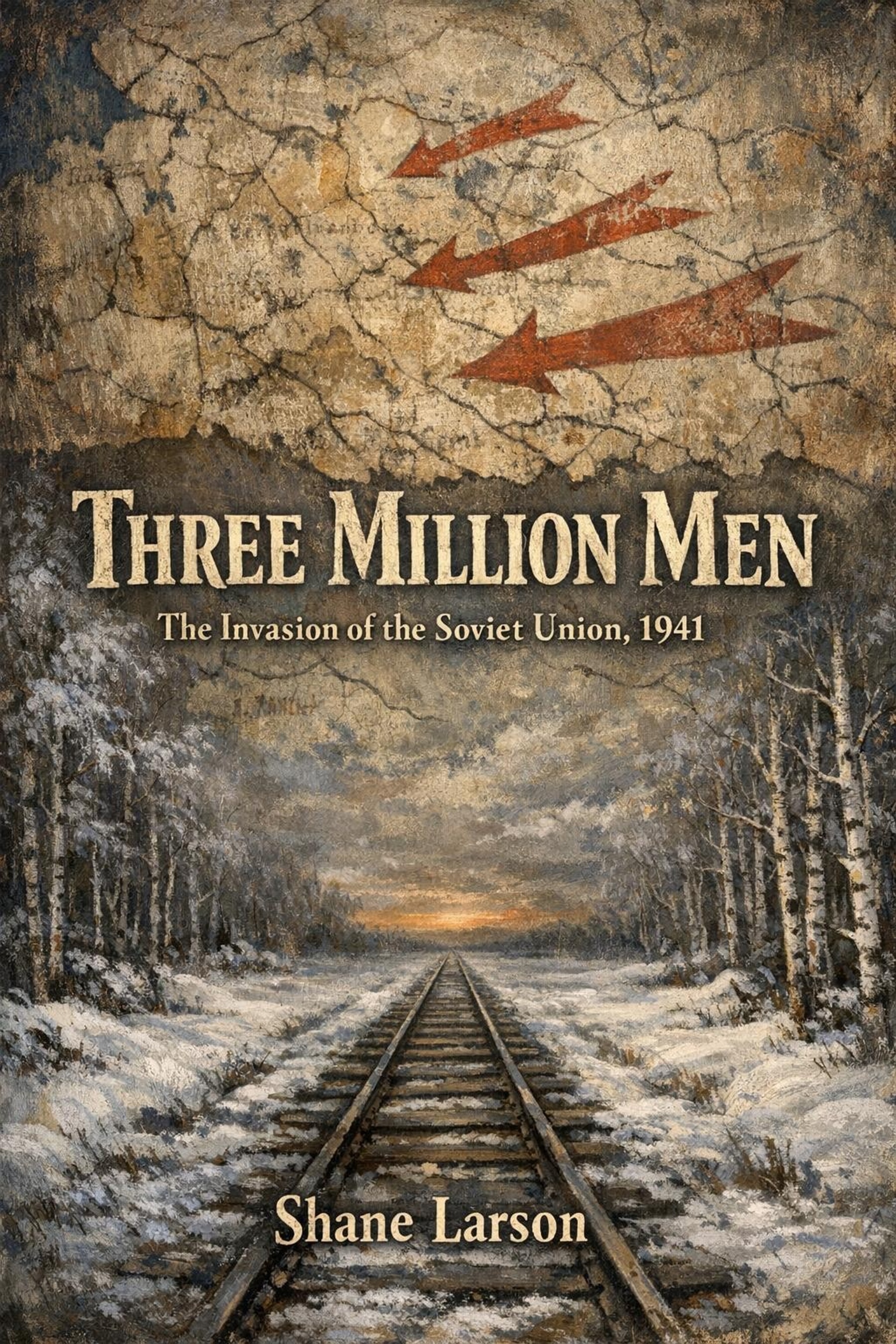
Three Million Men
The Invasion of the Soviet Union, 1941
By Shane Larson
About This Book
Soviet railways were built on a broader gauge than Germany's. That single engineering fact meant that behind every German tank driving east in the summer of 1941, a crew had to pull up the rails, move them inward, and spike them down again, mile after mile, before one supply train could follow. The railway engineers converted track at a rate that impressed everyone who measured it. It was never enough. By the middle of July the spearheads were roughly two hundred miles beyond any railhead that could sustain them, and everything they burned, fired, and ate was coming forward by truck and by horse.
On 11 August 1941, the chief of the German general staff, Franz Halder, confided to his war diary that the Soviet colossus had been consistently underestimated — that a planning count of some two hundred divisions had become an identified count past three hundred and sixty, and that a dozen divisions destroyed were simply replaced by another dozen. He wrote it six weeks before the autumn mud and four months before serious snow, while the panzer divisions were still ahead of schedule.
Those two facts — a railhead that could not keep up and an enemy twice the size of the one that had been counted — are where the largest military operation ever mounted actually failed. The weather that has carried the blame for eighty years arrived months later.
The Argument
Three Million Men argues that the German campaign against the Soviet Union was lost in August 1941, in fine weather, and that "General Winter" is an alibi with an identifiable date of manufacture: the postwar memoirs and staff studies of the surviving German commanders, written for a Western audience with its own reasons to accept them. The winter was real and severe, which is the property every durable alibi shares — but the army met it without winter equipment because the plan had assumed the war would be over first, and the plan assumed that because of an intelligence estimate wrong by nearly half.
Underneath the campaign sit two intelligence catastrophes in the same few weeks, opposite in kind and identical in effect. Stalin was warned of the attack dozens of times, by sources that did not know of one another's existence, and dismissed every warning inside a theory that made the warnings themselves evidence of a British provocation — in a state where the officers who might have insisted had seen what became of men who insisted. Germany's failure was the mirror image: nothing punished bad news, but nothing forced a revision either, and the two-hundred-division estimate of 1940 was never re-tested as the evidence against it piled up. One machine could not move the truth upward; the other never demanded it.
And beneath the strategy sits the quartermaster's arithmetic that gives the book its spine: the gauge conversion, a motor pool requisitioned from half of occupied Europe in dozens of incompatible types, six hundred thousand horses each needing fodder daily, and a culminating point passed near Smolensk in the middle of July. Set against it stands the fact no German estimate contained: the state being invaded dismantled its own industrial economy, railed it beyond the Urals under air attack, and had it out-producing Germany in tanks before the year ended.
What's Inside
- The warnings in full — Sorge in Tokyo, the ring in Switzerland, Churchill's message drawn from Ultra, the deserters shot for spreading panic — and the theory that swallowed every one of them
- Directive 21, the ten-week timetable, and how the two-hundred-division estimate was built once, from thin sources, and never re-tested
- The summer encirclements from Białystok to Kiev, the largest in the history of warfare, and why each pocket cost more time than the map suggested it won
- The two-month fight at Smolensk that had been budgeted at two weeks, and the 11 August diary entry that wrote off the premise of the whole operation
- The quartermaster's war: gauge-conversion rates, the incompatible truck pool, the fodder arithmetic of six hundred thousand horses, and the culminating point located in place and time
- The Einsatzgruppen and the beginning of the Holocaust by shooting, the Hunger Plan, the fate of the Soviet prisoners of war, and the deliberate starvation of Leningrad — covered directly, in the weeks where they happened, and treated as crimes rather than as factors in a campaign
- The other side of the hill: more than fifteen hundred major factories dismantled, hauled east, and restarted while the defensive battles were still being fought
- Operation Typhoon, the mud, the Moscow panic of 16 October, and the fifth of December, when reserve armies Germany had not known existed came out of the snow
- The eleven days that made the war global — the counter-offensive, Pearl Harbor, and a German declaration of war on the United States that no treaty required
Why I Wrote This
The winter explanation is the most successful alibi in modern military history. It was built by the men who made the decisions, and it got a forty-year head start on the archives that took it apart. I wanted to see what the logistics actually said — to sit with the gauge-conversion rates, the fodder tonnage, and the railhead distances, and find the point where the campaign stopped being winnable. The answer has a date on it, and the date is in the summer.
One more thing mattered more the longer I worked. A book about this campaign that keeps the crimes in a separate chapter at the back is telling the story wrong — the quarantine is itself a quiet descendant of the alibi-making. So this book doesn't. The shootings, the Hunger Plan, the prisoners, and Leningrad sit in the narrative in the weeks where they happened.
Frequently Asked Questions
Do I need to read the earlier volumes first?
No. The book opens with a compressed account of 1919–1941 — the settlement, the fall of France, Britain's year alone — so a new reader has everything needed within a few pages. Readers coming straight from Volume 3 can go directly to Chapter 1.
Did the Russian winter really not defeat the German army?
The winter was real and severe, and the army genuinely met it unequipped. But the equipment sat in depots in Poland because the supply system had already collapsed, and that system collapsed because the plan assumed there would be no winter campaign at all. The winter made a defeat already underway more terrible; it did not cause it.
How does the book handle the Holocaust and the other crimes of the campaign?
Directly, without euphemism, and inside the campaign narrative in the weeks where the events happened — not in an annexe at the end. They are treated as crimes first, with no more detail than establishing what happened requires; where a crime also carried a military consequence, the consequence is stated afterwards and separately.
Why are Soviet casualty figures from 1941 so uncertain?
The archives were sealed for roughly forty years, counting the missing and the militia formations is genuinely hard, and the standard Russian reference compiled under Krivosheev is itself disputed — recent archival work treats its totals as a floor. This book gives every contested figure as a range with the disagreement named.
Does this book cover Stalingrad?
No. This volume ends in December 1941, in the same fortnight as Pearl Harbor and Germany's declaration of war on the United States. Volume 5, The Oil Was a Clock, picks up there; Stalingrad belongs to Volume 6.
If You Liked This, You Might Like
- The Empire Collapse Pattern — the same question, asked across two thousand years: why the strongest force in the field is so often the one that fails.
- The Institutional Collapse Pattern — Stalin's machinery punished the carrying of true warnings; this book maps what happens when trusted systems do exactly that.
- Collapse Proof — the Soviet state in 1941 absorbed a blow no other state could have survived; this book asks what that resilience is made of.
The campaign in these pages was decided in the summer and explained in the winter, and the explanation has outlived nearly everyone it protected. Three Million Men is Volume 4 of The Second World War Chronicles, a ten-volume history of the Second World War.
Included with Kindle Unlimited — read it free if you're a member.
New Military History releases and free chapters — no spam, unsubscribe anytime.