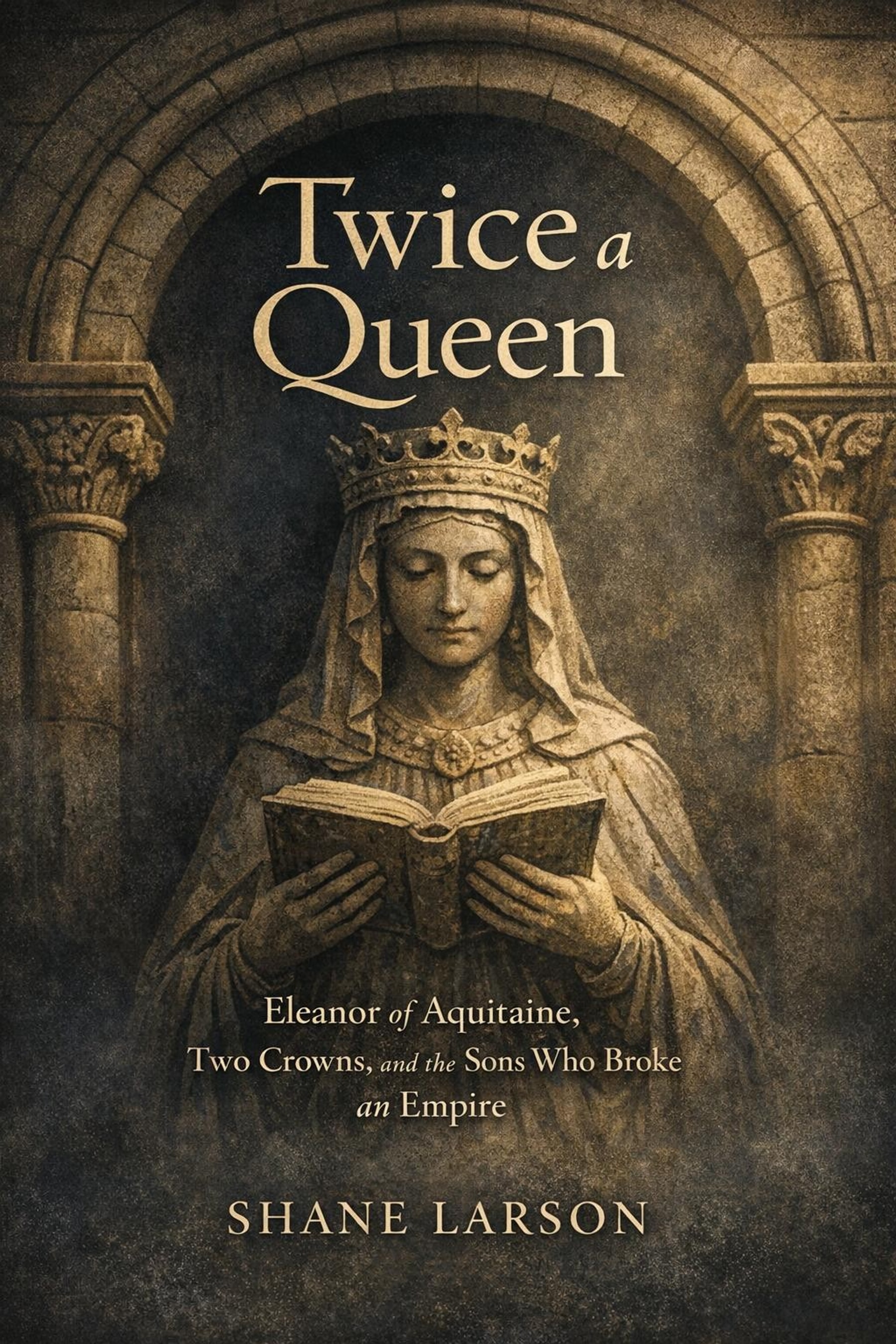
Twice a Queen
Eleanor of Aquitaine, Two Crowns, and the Sons Who Broke an Empire
By Shane Larson
About This Book
In the 1860s the British government asked France for her body. The abbey of Fontevraud had been a prison since the Revolution, and the four painted tomb figures that lay there had been stacked in a side room. Westminster Abbey had room. Napoleon III was willing to make Queen Victoria a present of the lot, and the figures came within a signature of crossing the Channel before the local authorities objected. France had not thought about Eleanor of Aquitaine very much in six hundred years. It was not going to let the English have her.
That episode is a fair model of everything that has happened to her since she died in that abbey in 1204. Every century has found in a thin record exactly the woman it needed: the adulteress who slept with her uncle on crusade, the queen who sat in judgement on the etiquette of love, the she-wolf who taught her sons to hate their father, the modern icon who did as she pleased. All four rest on a handful of Latin sentences by monks and clerks, written long after the fact and none of them hers. There is no letter, no charter phrase, no recorded remark that is certainly Eleanor's own. Her tomb figure holds an open book, the only royal effigy of its age shown reading, and the pages are blank stone.
A Duchy, Two Crowns, and Sixteen Years in Custody
Twice a Queen: Eleanor of Aquitaine, Two Crowns, and the Sons Who Broke an Empire is a narrative life that runs from the duchy she inherited at about thirteen in 1137 to the fall of Normandy three months after her death. The land was hers, not her husbands', and larger than the royal domain of the French king whose son she married that summer. Fifteen years as queen of France brought a crusade, an open quarrel with Louis in her uncle's city of Antioch, and an annulment at Beaugency in March 1152. Within eight weeks she had married Henry Plantagenet, duke of Normandy and heir to England, and the duchy went with her.
The middle of the book is the Angevin marriage from the inside: the writs issued in her name while Henry was across the Channel, ten children in thirteen years, the court she kept at Poitiers with the young Richard, and the revolt of 1173, when three of her sons rose against their father and she was arrested on the road to join them. Henry kept her in custody, comfortable and not free, for the rest of his reign, while her sons fought him without her.
Then the part almost nobody tells. Released in 1189 at about sixty-five, she rode through England taking oaths for Richard and emptying the gaols, held the kingdom against John while Richard was on crusade, and when Richard was captured on the way home she organised a ransom of 150,000 marks and went to Germany in winter to collect him. After Richard's death she chose John over her grandson and crossed the Pyrenees to pick a granddaughter as the next queen of France. In 1202 she was besieged at Mirebeau and relieved by the son who would lose it all. These are the best-documented years of her life, and the ones where she was most formidable.
Why I Wrote This
I came to Eleanor the way Henry Plantagenet did, from the Anarchy. Nineteen Winters ends with a twenty-year-old duke riding to Poitiers to marry a woman the chroniclers could not stop talking about, and I wanted to know who was waiting for him there. The woman they talked about and the woman in the documents barely overlap. The chroniclers are loudest where the record is thinnest and fall nearly silent in the 1190s, when a widow with no office of her own was running England by calling councils and letting the barons deliver her threats. That inversion is the book. I also could not get past the effigy. A carver gave a dead queen an open book and a face that is reading it, and eight centuries of writers have been filling in the pages. I wanted to leave them blank and show the reader where the silence actually is.
Frequently Asked Questions
Do I need to read Nineteen Winters before this book?
No. The Introduction gives the war that made Henry Plantagenet in a single paragraph, so a reader starting here loses nothing. The two books share one scene, the marriage at Poitiers in May 1152.
Did Eleanor of Aquitaine really have an affair with her uncle at Antioch?
Nobody can know, and the book says so. The one witness close to the events reports a strategic quarrel, a queen who threatened to stay, and a husband who removed her by force; he does not say she was unfaithful. The explicit charge comes from a writer three decades on who needed someone to blame for a failed crusade.
Were the courts of love at Poitiers real?
No. They come from a treatise on love written in Champagne in the 1180s, and from a 1950 biography that took its judgements for the minutes of an actual tribunal. A scholar demolished the idea in 1961 and no one has rebuilt it. Eleanor did keep a court at Poitiers; her daughter Marie did more for literature than she did.
Does this book cover Richard I's crusade and King John's reign?
Only as far as Eleanor could see them. The Third Crusade gets about a page, because she was in England holding the kingdom while it happened. John's reign is covered to her death in 1204 and the loss of Normandy that summer; the barons and Magna Carta belong to another book.
Is this a scholarly biography or a narrative one?
Narrative, in thirteen chapters and four parts, at about 75,000 words, with the chronicles paraphrased and the writer named at every use. There are no footnotes, but there is no sentence about Eleanor whose source the reader cannot identify, and the contested points are left contested.
If You Liked This, You Might Like
- The Norman Conquest — the England Eleanor was crowned queen of in 1154 was the one made at Hastings; this is where the dynasty she married into begins.
- The Crusades — the Second Crusade from the army's side, Edessa to the failure at Damascus; this book tells the same campaign from inside the royal household.
- The Hundred Years' War — Gascony and the wine ports, the part of Eleanor's duchy that survived 1204, were the inheritance Edward III carried into France in 1337.
- Catherine of Aragon — another foreign-born queen of England whose marriage became a question of canon law, and who refused to take the veil when it would have suited the king.
The legends live where the record is thin; the woman lives where it is thick, and this book goes where the documents are.
A standalone on the English-history shelf, following Nineteen Winters.
What You'll Learn
- **The grandfather's songs.** William IX, twice excommunicated and the first troubadour whose verses survive, and the family reputation Eleanor inherited with the duchy.
- **Antioch, 1148.** The uncle who wanted the French army to fight for him, and the two witnesses to the quarrel: one cautious and nearly present, one hostile and thirty years late.
- **How Rosamund got her maze.** The near-nothing the twelfth century recorded about Henry's mistress, and the later ballad that gave the queen a labyrinth, a thread, a dagger and a cup of poison.
- **The letter that is the whole case.** The archbishop of Rouen's warning to Eleanor in 1173, set against the hedged chronicle lines that built the she-wolf.
- **Twenty-four million pennies.** What 150,000 marks meant in silver and in years of crown revenue, and whose Latin is in the three letters that told the pope, by the wrath of God, what he had failed to do.
- **A lawyer's trick at Tours.** Why a widow of about seventy-five knelt to Philip II for Poitou in 1199, and how that homage kept Aquitaine out of the judgement that stripped John of Normandy.
- **Three appendices.** All ten children and the thrones their marriages reached; every chronicler who mentions her, ranked by distance and bias; and an itinerary from Bordeaux to Fontevraud.
New Medieval History releases and free chapters — no spam, unsubscribe anytime.
More in This Genre
View all →