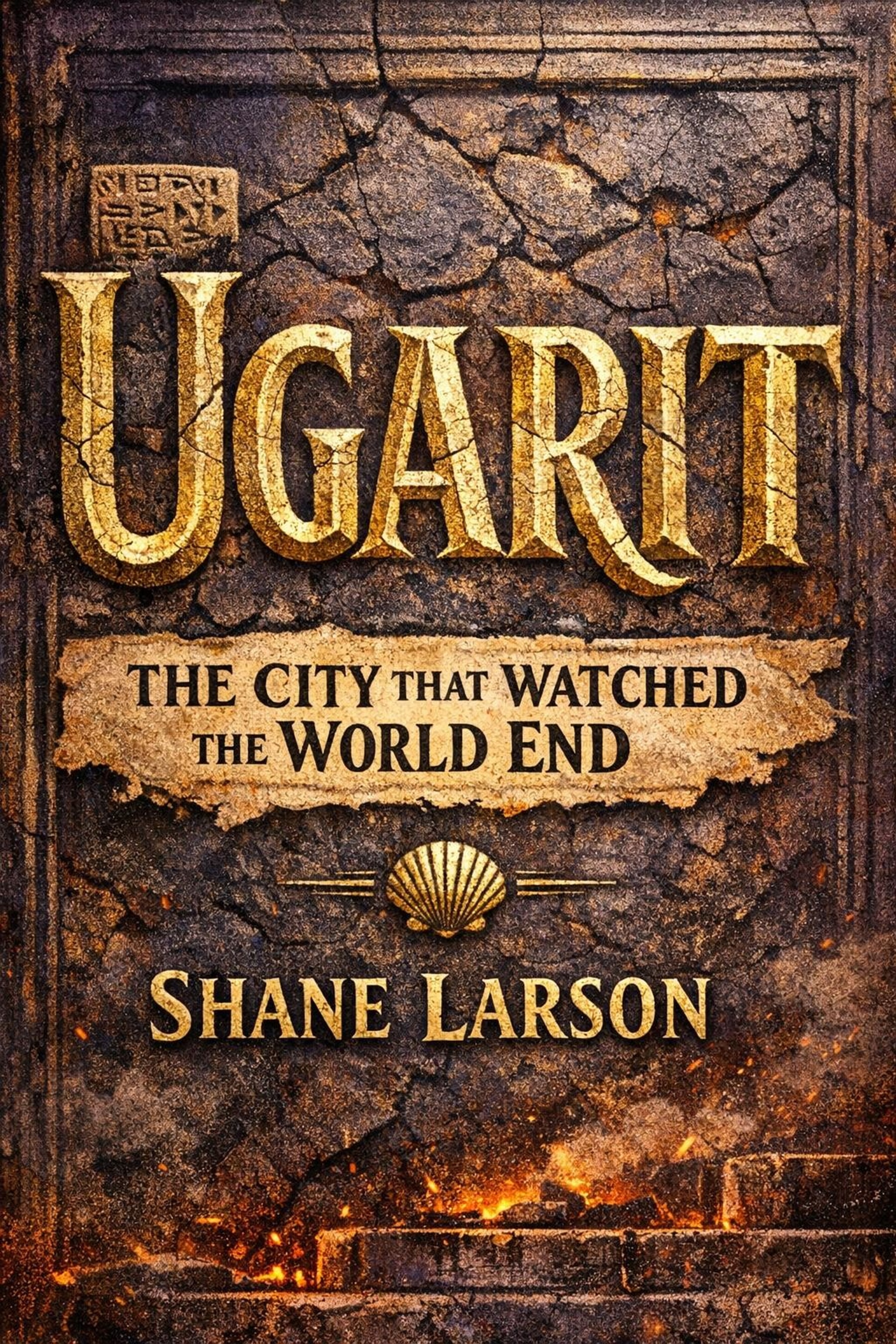
Ugarit
The City That Watched the World End
By Shane Larson
About This Book
In the spring of 1928, a farmer working a field near the Syrian coast felt his plow catch on stone. When he cleared the soil away, he found a slab, and beneath the slab a vaulted tomb. He had no way of knowing it, but his blade had just struck the roof of a civilization that had been missing from human memory for more than three thousand years — a kingdom so completely erased that its very name had been forgotten, unmentioned by the Greeks and Romans, absent from every later history.
Within two years, French archaeologists digging at the mound a kilometer inland were pulling clay tablets out of the ground written in a script no one had ever seen. Within a year of that, three scholars working half in competition and half in collaboration had cracked it. And out of the decipherment came a voice: the voice of Ugarit, the greatest merchant port of the Late Bronze Age, speaking again after thirty-two centuries of silence.
What the tablets said, in their final layer, was terrifying. The ships had come. The towns were burning. The army was gone. And the letters that recorded it had never been sent.
The Only City That Left a Record of Its Own Death
The collapse of the Late Bronze Age is one of the largest catastrophes in human history. Around 1200 BC, over the span of a single generation, the interlocking civilizations of the eastern Mediterranean — the Hittite Empire, Mycenaean Greece, the great cities of the Levant — fell almost simultaneously. It is a story usually told from the outside, reconstructed from burn layers and abandoned palaces, because the people who lived through it left almost nothing in their own words.
Ugarit is the one exception, and that is why it deserves a book of its own. This small, spectacularly wealthy kingdom sat at the exact point where the Egyptian, Hittite, Mesopotamian, and Aegean worlds met by sea and by road. It grew rich not through conquest but through position — the indispensable middleman, taking its cut as copper, tin, grain, timber, wine, and its own famous purple dye moved through its harbor. Its merchant families kept archives. Its scribes worked in as many as eight languages and invented a radically simplified alphabet of about thirty signs, the oldest one whose letter-order we can still read. Its poets wrote down the myths of Baal and El that would reshape how scholars understand the religious world behind the Hebrew Bible.
And then it was destroyed, thoroughly and permanently, and never rebuilt. The fire that ended the city baked its clay archives hard and sealed them underground, which is the grim irony at the center of this story: the catastrophe that killed Ugarit is the same event that preserved its final words for us to read. Everywhere else across the collapsed world, historians work from silence. At Ugarit, they work from the correspondence of people who watched the disaster arrive.
What's Inside
- How a kingdom the size of a modern county became one of the richest places on earth without an army or an empire — purely by being useful to everyone
- The merchant dynasties of Ugarit, reconstructed from their own contracts, loans, lawsuits, and tax exemptions — named individuals whose business files survived the fall
- The invention of the alphabet: why writing had been a guarded elite craft for millennia, and how Ugarit's thirty-sign shortcut hinted at one of history's quietest revolutions
- The gods of Canaan — El, Baal, Anat, Asherah, Mot — in their own literature, handled as documented comparative history rather than theology
- The diplomatic tightrope a small state walked to survive among giants: tribute, flattery, calculated delay, and playing protectors against threats
- The drought, famine, and grain crises that cracked the Bronze Age system from within, felt first in Ugarit's ledgers
- The last letters, tablet by tablet — the king's plea to the ruler of Cyprus, the enemy ships, the army away in Hittite service, the fleet stationed off the coast of Lycia
- The archaeology of the end: the burn layer, the arrowheads, the gold hoards buried by people who never came back to reclaim them
- The 1928 rediscovery and the astonishing race to decipher an unknown script in barely a year
Why I Wrote This
I have spent years writing about the Bronze Age collapse — the Sea Peoples, the fall of the whole interconnected system, the dark age that followed. In every one of those books, I kept arriving at the same place: Ugarit. Its final tablets are the single most quoted, most cinematic primary source in the entire subject, the moment every collapse narrative reaches for when it wants the reader to feel the catastrophe rather than just diagram it. And every time, I had to move on after a few pages, because the larger story needed telling.
This book is me finally staying. Ugarit haunted me because it is the collapse with a human face — not civilizations in the abstract, but a specific harbor, specific merchants, a specific king writing a specific letter that was never sent. I wanted to give the best source in the story its own stage, and to walk the whole arc: the golden age, the warning signs, the fire, and the plow that brought it all back.
Frequently Asked Questions
What actually happened to Ugarit?
Around 1185 BC the city was violently destroyed — sacked and burned during the wider Bronze Age collapse — and, unlike almost every other casualty of that era, it was never reoccupied. The book examines the evidence for who did it (the Sea Peoples are the leading suspects), weighing what we know against what we can only infer, and explains why its permanent death is exactly what preserved its archives so completely.
Do I need to have read your other Bronze Age books first?
No. Ugarit stands entirely on its own. If you have read The Sea Peoples or Ancient Apocalypse, this book gives you the view from inside the collapse — the city those books circle around — but it assumes no prior reading and explains the whole world from the ground up.
Is this a religious book because it covers the Baal myths and the Bible?
No. The chapter on Ugarit's gods treats the Baal Cycle and its connections to the biblical world as documented literary history — evidence, not doctrine. There is no preaching and no debunking, just an honest account of what the tablets reveal about the religious landscape the Hebrew Bible later emerged from.
Does the book quote the ancient tablets directly?
The ancient texts are conveyed through careful paraphrase in my own voice rather than reproduced from modern copyrighted translations. You get the content, the urgency, and the meaning of the letters and myths without a wall of bracketed scholarly translation between you and the story.
How long is it, and what reading level?
It runs about fifty thousand words across thirteen chapters plus appendices — a timeline, a reader's guide to the tablets, and further reading. It is written for the general reader, not the specialist: narrative, accessible, and paced like a story, while staying honest about the evidence.
If You Liked This, You Might Like
- The Sea Peoples — The raiders whose sails appeared off Ugarit's coast, told from the side of the destroyers. The most direct companion to this book.
- Ancient Apocalypse — The systemic account of the whole collapse; Ugarit is its most vivid single case, expanded here to full length.
- The Bronze Age World — The interconnected system in panorama, the world Ugarit sat at the center of.
- The Hittite Empire — Ugarit's overlords and the northern power whose demands stripped the city of its army at the worst possible moment.
The fire that destroyed Ugarit is the reason we can still read it. This is the story of a city that watched the world end — and, alone among the casualties, left the letters to prove it.
Part of the Bronze Age Collapse cluster, alongside The Bronze Age World*,* The Hittite Empire*,* The Sea Peoples*,* Ancient Apocalypse*, and* The First Dark Age*.*
Included with Kindle Unlimited — read it free if you're a member.
New Ancient History releases and free chapters — no spam, unsubscribe anytime.