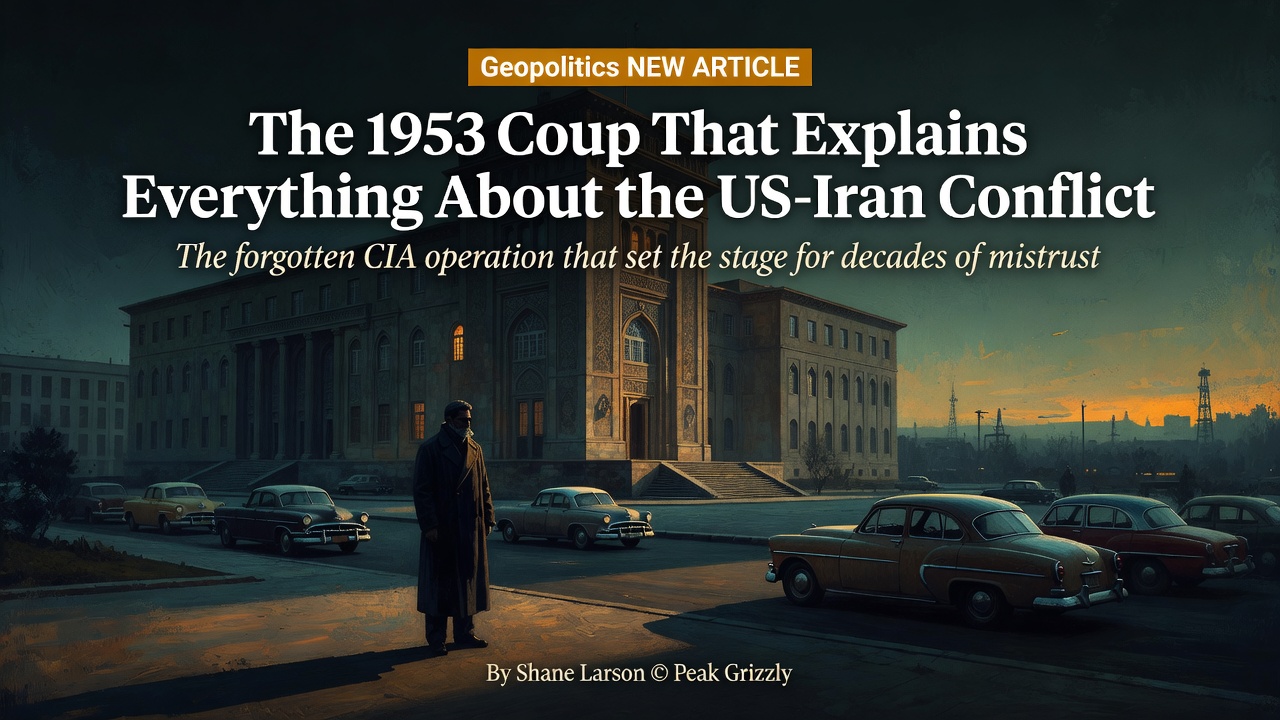
The 1953 Coup That Explains Everything About the US-Iran Conflict
March 19, 2026 · 5 min read
If there is a single event that explains why the United States and Iran have been locked in conflict for nearly half a century, it is what happened in Tehran during four days in August 1953.
Americans, by and large, have never heard of it. It is not taught in most US history classes. It rarely appears in the standard Cold War narrative. When Americans think about the origins of conflict with Iran, they typically start with the 1979 hostage crisis — as if Iranian hostility materialized from nowhere, driven by religious fanaticism rather than by any concrete historical grievance.
Iranians remember it the way Americans remember Pearl Harbor: as a definitive act of aggression that shapes their understanding of who they are and who their enemies are.
This asymmetry of memory — Americans experiencing each confrontation as if it were the first one, Iranians experiencing each as the latest chapter in a story that began in 1953 — is one of the defining features of the entire relationship. It is why the two sides consistently talk past each other. They are not arguing about the same history, because one side does not know the history exists.
A Suitcase Full of Cash and a Plan Built on Chaos
In 1951, Iran's democratically elected Prime Minister Mohammad Mosaddegh nationalized the Anglo-Iranian Oil Company — Britain's single most valuable overseas asset. Britain wanted its oil revenues back. The Eisenhower administration, viewing the world through rigid Cold War logic, feared that Mosaddegh's government might tilt toward the Soviet Union. Neither motivation required the other to be true. Together, they provided the political cover for what the CIA called Operation Ajax.
The operational architect was Kermit Roosevelt Jr. — grandson of Theodore Roosevelt — who arrived in Tehran in July 1953 with a suitcase full of cash and a plan that relied more on bribery, propaganda, and manufactured chaos than on military force.
The CIA funded Iranian journalists, editors, and religious leaders to conduct a propaganda campaign accusing Mosaddegh of being a communist, an atheist, and a threat to Islam. They cultivated military officers unhappy with Mosaddegh's civilian oversight. They recruited leaders of traditional gymnasiums to organize street gangs. And they pressured the young, insecure Shah — cautious to the point of cowardice — to sign a decree dismissing the Prime Minister.
The first attempt failed. On August 15, Mosaddegh's intelligence service was waiting. The Shah's emissary was arrested on the spot. The Shah panicked and fled to Rome. Washington was ready to call it off.
Roosevelt refused to give up. Over the next three days, he activated his networks. CIA-funded mobs took to the streets creating the appearance of popular opposition. Some groups posed as Mosaddegh supporters, deliberately committing violence to discredit him. Others posed as communists, attacking mosques to inflame the clergy. On August 19, a massive crowd — paid agents, opportunistic looters, genuinely disaffected citizens, and turned military units — converged on Mosaddegh's house with tanks. After a battle that killed roughly 300 people, it was over.
Mosaddegh surrendered the next day. He was tried, imprisoned, and spent the rest of his life under house arrest. The Shah returned from Rome to find CIA-organized crowds cheering his arrival. He would rule Iran for twenty-six years.
The Eagle and the Ayatollah
What America Got — and What America Forgot
The economic aftermath revealed the coup's true purpose. In 1954, Iran signed a new agreement that nominally maintained the fiction of nationalization but gave operational control to a consortium of Western oil companies. British Petroleum got 40 percent. American oil companies got another 40 percent. Iran received a 50-50 profit split — the same deal Saudi Arabia had gotten years earlier without anyone overthrowing its government.
The message to the developing world was blunt: nationalize your resources, and the West will overthrow your government.
The coup was not a secret. The New York Times reported on it. Kermit Roosevelt later wrote a memoir about it. But America did not look. The operation was absorbed into the broader narrative of Cold War containment — just another footnote. High school textbooks did not mention it. The average American in 1979, watching Iranian students storm the US Embassy, had no idea that the United States had overthrown Iran's democratically elected government twenty-six years earlier.
In 2000, Secretary of State Madeleine Albright came closer to an apology than any previous American official: "The coup was clearly a setback for Iran's political development. And it is easy to see now why many Iranians continue to resent this intervention by America in their internal affairs." The acknowledgment came forty-seven years too late and without any change in policy. The reformist opening it was meant to support was closed two years later by the "Axis of Evil" speech.
The Chain Reaction
The coup did not just install a dictator. It set in motion a chain of consequences that leads directly to the present.
The Shah, restored to power by foreign intelligence services, built a modernizing authoritarian state backed by a brutal secret police — SAVAK — trained by the CIA and Israel's Mossad. He crushed all secular political opposition, leaving the mosques as the only space for organized dissent. When the revolution came in 1979, it was led by clerics — not because Iran was uniquely susceptible to theocracy, but because the Shah had systematically destroyed every other form of political organization.
The hostage crisis of 1979 cemented American hatred of Iran. The Iran-Iraq War of the 1980s — in which the US backed Saddam Hussein against Iran, a million-casualty conflict that Iranians remember and Americans prefer to forget — deepened Iranian hatred of America. The nuclear standoff, the proxy wars, the sanctions, the assassinations — each chapter makes sense only as a continuation of a story that began when the CIA decided that Iranian democracy was less important than Western access to Iranian oil.
This is not a pro-Iran argument. The Islamic Republic is a repressive theocracy that brutalizes its own people. But understanding how it came to power — and why ordinary Iranians have complicated feelings about both their own government and the country that overthrew their democracy — is essential for understanding anything about the conflict.
The gap between what Americans know and what Iranians know about their shared history is not just an academic curiosity. It is the structural reason why every attempt at diplomacy has failed. You cannot negotiate with someone whose grievances you do not understand, and you cannot understand their grievances if you do not know the history that produced them.
The Eagle and the Ayatollah
New posts and releases, straight to your inbox. No spam, unsubscribe anytime.