Caligula Never Made His Horse a Consul — So Why Does Everyone Know That He Did?
August 14, 2026 · 6 min read
Ask anyone what they know about Caligula and you will get the horse. The emperor who made his horse a consul — the four-legged proof that absolute power drives men insane. It is one of the most successful stories ever told about anybody.
Here is what the source actually says. Suetonius, writing about eighty years after the events, reports that Caligula gave his racehorse Incitatus a marble stall, an ivory manger, and household slaves — and then adds that it was said he intended to make the animal consul. Intended. Said. Even our most gossip-friendly source, a biographer who never met a rumor he wouldn't file, does not claim it happened. It didn't. No horse held the consulship of Rome. The fasti — the consular lists, which survive — have no gap where Incitatus would go.
That distance, between what everyone knows and what anyone can show, is not a quirk of one anecdote. It is the central problem of Caligula's entire reign, and working through it honestly is one of the best exercises in historical thinking that the ancient world offers. Because the question "was Caligula mad?" turns out to be less interesting than the question underneath it: how would we know?
Every surviving source is the prosecution
Start with who is talking. Gaius Caesar Augustus Germanicus — "Caligula," a childhood nickname meaning "little boots," which he reportedly hated — ruled for three years and ten months, from AD 37 to January 41, when officers of his own guard cornered him in a palace corridor and cut him down. He was twenty-eight.
Then consider who wrote his history. Tacitus, the greatest historian of the dynasty, covered the reign in his Annals — and those are precisely the books that did not survive. The account we would trust most is a hole in the manuscript tradition. Suetonius wrote his biography around AD 121, under a later dynasty, organizing material by rubric rather than chronology, so that a verifiable building project and an unverifiable palace whisper sit in adjacent sentences carrying identical confidence. Cassius Dio wrote a hundred and fifty years after the assassination. The two contemporaries whose accounts survive, Seneca and Philo of Alexandria, both had reasons to want the dead man remembered as a monster: Seneca was a courtier the emperor had humiliated and nearly killed; Philo led a Jewish embassy that Caligula toyed with and dismissed.
And behind all of them stands the assassination itself. Caligula was murdered by his own officers, and the regime that followed — his uncle Claudius, found trembling behind a palace curtain and made emperor by the guard — needed the killing to be justified. Every courtier who survived January 41 had participated in, acquiesced to, or profited from the murder of a sitting emperor. A dead tyrant excused all of them. A dead madman excused them completely. The stories that made the dead man a monster were not merely tolerated by the new government; they were useful to it. No defense of Caligula was written, or if written, none was copied. The copyists kept the version the winners wanted kept.
None of this proves the tradition false. Hostile witnesses can tell the truth. But it means every famous Caligula story arrives in court with the same disclosure: told by his enemies, after his death, to an audience that benefited from believing it.
The seashells, the bridge, and the things that check out
So take the stories one at a time, which is what the tradition rarely gets.
The seashells: Caligula marched an army to the Channel coast for an invasion of Britain that never sailed, and — the sources say — ordered the soldiers to gather seashells as plunder from the conquered Ocean. Madness, as told. But the Latin word in play, musculi, meant both "little shellfish" and a type of military siege shelter, and the order comes to us at third hand through writers who wanted it to be lunacy. An aborted campaign, a furious commander, an army given makework or a sardonic punishment detail — several sane readings fit the same reported facts. We cannot recover which. That is the honest answer, and it is different from "he collected seashells because he was insane."
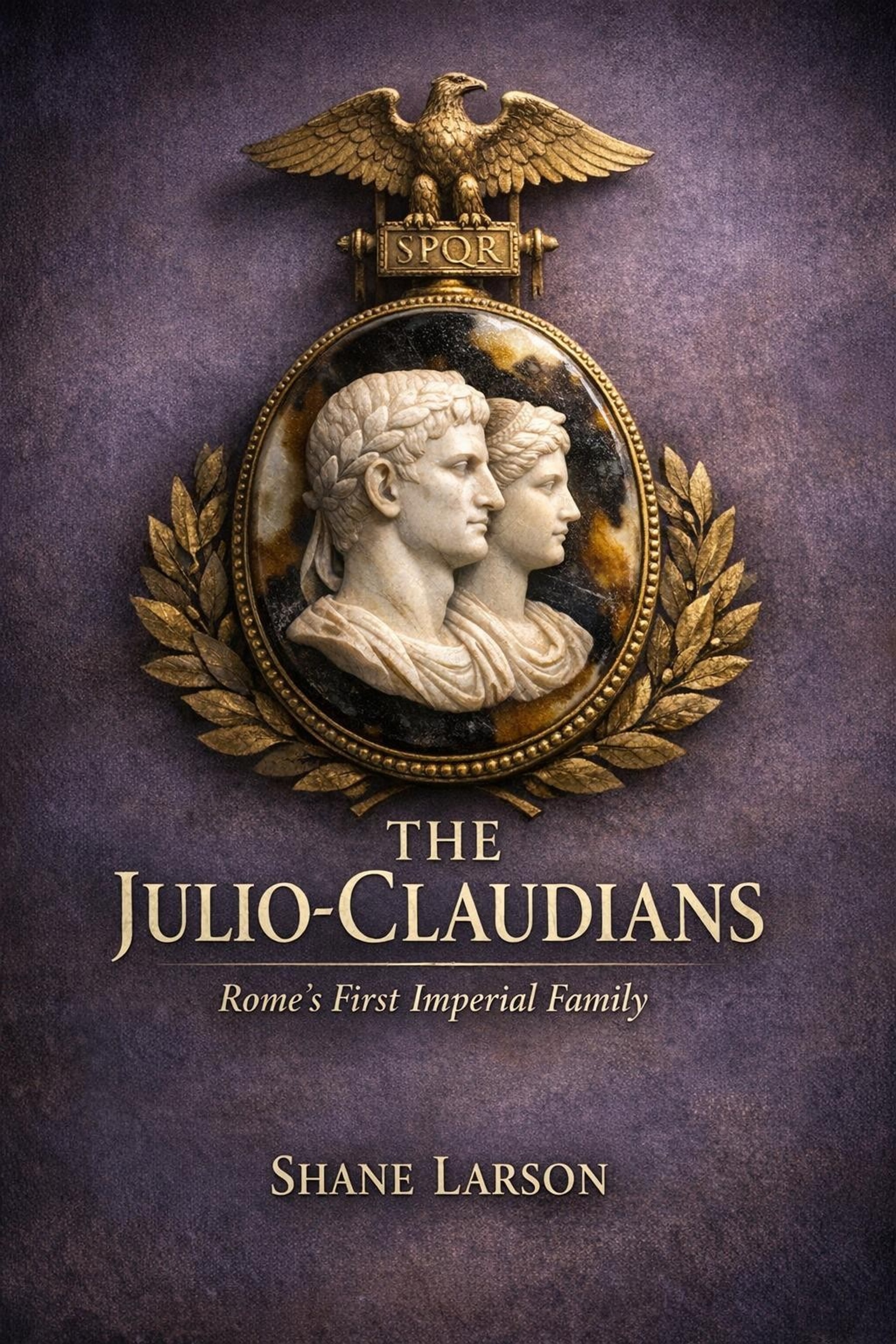
The Julio-Claudians
The bridge at Baiae checks out, more or less: Caligula really does seem to have lashed together a miles-long pontoon of merchant ships across the bay and ridden across it in ceremony. It was extravagant, theatrical, expensive — and it was also precisely the kind of spectacle Roman power had always staged, scaled up. A triumph on water is not a diagnosis.
The famous line — oderint dum metuant, let them hate so long as they fear — was reportedly a favorite saying. It was also a quotation, a line from Accius, a tragic poet dead more than a century, which every educated Roman knew. An emperor quoting theater at his court is a different data point than an emperor coining a personal creed, and the tradition flattened one into the other.
Meanwhile the documents and the ground show a government functioning. The coinage of the reign is competent and conventional, advertising family piety — his mother, his dead brothers, his sisters — exactly as dynastic messaging required. Two of the aqueducts that made imperial Rome possible, later finished by Claudius, were begun under Caligula. So were harbor works, and the transport of the great obelisk from Egypt that stands today in St. Peter's Square in Rome. Grain fleets sailed; provinces were governed; the empire did not notice its ruler was supposedly a lunatic. Short reigns leave shallow records, but what this one left is administration, not chaos.
And then there is Philo — the one man who stood in the room and wrote it down. His embassy of Alexandrian Jews trailed Caligula through a villa's gardens while the emperor inspected renovations, tossed them mocking questions, and wondered aloud why Jews refused to eat pork, to laughter from the entourage. It is a hostile account; Philo despised him. But notice what the eyewitness monster looks like: not a drooling lunatic, but a quick, cruel, easily bored young autocrat amusing himself at petitioners' expense because nothing on earth could make him stop. That portrait is worse than madness in one way, and much more believable.
The verdict the evidence will actually support
Strip the reign back to what can be verified and a stranger figure emerges than either the monster or any rehabilitation. A young man handed absolute power at twenty-four, gravely ill within months of his accession, who emerged from the illness — the sources agree on this sequencing — harder and more dangerous. Confiscations that were real, because the money had to come from somewhere. A theater of humiliation aimed above all at senators, which is exactly why senatorial writers made his memory pay for it. And an ending that is the hardest evidence in the file: the men closest to him, the officers whose job was keeping him alive, decided instead to kill him — and the empire's response was relief.
Caligula does not need the horse story. What can be established is damning enough. But the boundary between the man and the myth — drawn honestly, item by item, with the verdict "we can't know" allowed onto the page — says as much about how history gets written as about how Rome was ruled. Every tyrant since has been described by the survivors. Caligula is simply the case where we can watch it happen.
This article draws on material from my book "The Julio-Claudians: Rome's First Imperial Family" — Book Eight of the Rome: From Village to Empire series — which follows the four emperors after Augustus, and the family that produced and consumed them, from the stage-managed accession of Tiberius in AD 14 to the night the last of the line died in a freedman's villa outside Rome.
The Julio-Claudians
New posts and releases, straight to your inbox. No spam, unsubscribe anytime.