A Viking Carved His Name into the Marble of Hagia Sophia
September 4, 2026 · 7 min read
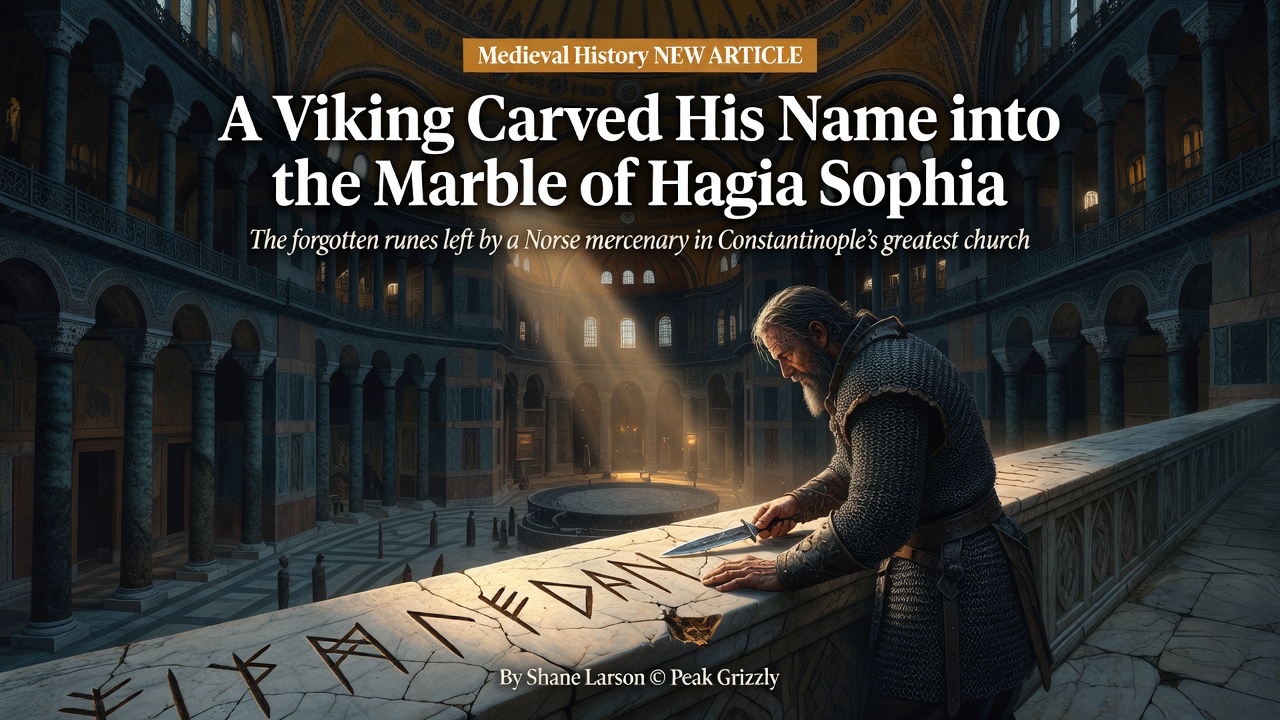
In the south gallery of Hagia Sophia — the vast domed church that was, for most of a thousand years, the largest enclosed space human beings had ever built — there is a stretch of marble balustrade with graffiti on it. Not paint. Runes, cut into the stone with a knife point, in the writing of medieval Scandinavia. Centuries of hands resting on the parapet have worn the inscription almost smooth, and only part of it can still be read with confidence. The legible part is a name: Halfdan.
The conventional reconstruction of the whole line is "Halfdan carved these runes," which is the formula runic inscriptions use everywhere from Scandinavian churchyards to the plundered chambers of ancient tombs. In other words, it says what graffiti has always said. Halfdan was here.
The runes cannot be dated precisely, and at least one more Norse inscription has been found nearby on the same gallery, so Halfdan was not alone. But the most likely dating puts them in a period when we know exactly what a man named Halfdan would have been doing in that building: leaning on the rail through a Greek liturgy he did not understand, in the gallery reserved for the imperial household, wearing the emperor's colors. He was at work. He was almost certainly a Varangian — a member of the Byzantine emperor's Norse bodyguard — and the story of how a Scandinavian came to be bored in the most sacred building in Christendom is the story of the Viking Age that almost nobody tells.
The guard on the balcony
The Varangian Guard was founded on a straightforward transaction. In 988 the emperor Basil II was facing a rebellion he could not put down with the troops he had. The prince of Kyiv, Vladimir, had six thousand Norse warriors he was happy to be rid of — they had helped him win a succession war and were now an expensive nuisance. Basil got the warriors. Vladimir got something no barbarian ruler had ever been granted: the emperor's own sister in marriage, at the price of his baptism and his realm's conversion.
The six thousand broke the rebellion, and the emperor, having noticed that foreign axmen with no stake in palace politics were considerably more trustworthy than Greek guardsmen with cousins in the bureaucracy, kept them. For the next two centuries a corps of Norse-speaking mercenaries stood closest of all troops to the imperial person. The service was famous across the northern world because the pay was famous: regular wages in silver, a share of campaign plunder, and — the sagas insist — customary rights of pillage in the palace when an emperor died. Men went south poor and came home rich enough to buy their way into power. The most spectacular example was Harald Sigurdsson, who spent roughly a decade in imperial service, fought on multiple frontiers, and shipped his fortune north in chests — and then used it to make himself king of Norway.
For a Norseman of the eleventh century, the road to Constantinople was a career. Which raises the real question: what road?
The rivers
Halfdan did not sail to Constantinople around the coasts of Europe. Almost no one did. The route ran the other way — inland, and downhill.
From the Baltic, river systems reach deep into the great plain of eastern Europe, and their headwaters interlace: streams draining north toward the Baltic rise within a few days' portage of streams draining south to the Black Sea and southeast to the Caspian. In the ninth century, Scandinavian crews in shallow boats worked out what that geography meant. You could load cargo at the Baltic shore and, by rowing, sailing, and dragging your boat overland at the watersheds, deliver it to the richest markets on earth.
The evidence for what happened next is buried in Scandinavian farm fields, and there is an astonishing amount of it. Gotland alone — one Baltic island — has yielded roughly seven hundred silver hoards, and the coins in them were not struck anywhere in Europe. They are dirhams: Islamic silver, minted in Baghdad, Samarkand, Merv, and the cities of Central Asia, carried three thousand kilometers north as payment. The largest single find, unearthed under a rotted barn floor in 1999, held sixty-seven kilograms of silver — more than fourteen thousand coins, many of them cut into halves and slivers and nicked by knife points testing the metal. That is not treasure. That is a cash box, chopped small for making change, and the counting across the whole Baltic runs to several hundred thousand recorded coins.
The Rus
What went south to earn all that silver can be listed honestly. Furs — sable, marten, beaver — from the best cold-weather forests in the known world. Wax and honey, in an age when every church and mosque burned candles. Amber. Walrus ivory. And people: a very large share of what these traders sold, on some routes probably the largest share by value, was captives, taken from the villages along the river systems and sold in the markets of the Islamic world and Constantinople. An envoy from Baghdad named Ibn Fadlan met a company of these traders on the Volga in 922 and wrote down what he watched, at a few paces' distance, including the funeral of one of their chiefs. His account is the closest thing to documentary footage the tenth century produced.
An emperor writes an operations manual
The men who ran this traffic were called the Rus, and we know how their southern route worked in almost absurd detail, because a Byzantine emperor wrote it down. Around 950, Constantine VII compiled a confidential handbook of statecraft for his son, and one chapter describes the Rus trading operation the way an intelligence officer would: the boats hollowed from single tree trunks upriver in winter, the fleet assembling at Kyiv in June, the convoy running down the Dnieper toward the sea.
The heart of the chapter is the rapids. The lower Dnieper dropped through a series of granite cataracts, and the emperor names seven of them — each one twice, once in a Scandinavian language and once in a Slavic one. "Ever-fierce." "The islet of the rapid." At the worst of them, everything came out of the boats: cargo carried for miles along the bank, boats dragged or shouldered past the white water, armed men screening the whole procession against the horse-archers who knew exactly where a convoy became a column of porters. Two vocabularies for one river — a Norse trading elite and a Slavic countryside fused into a single operation — which is the entire history of the Rus compressed into a list of place names.
Constantinople knew all this because the Rus kept arriving, and not always to trade. Rus fleets attacked the city in 860, and again in 907 and 941. What they extracted was stranger and more revealing than plunder: trade treaties, concluded in 907, 911, and 944, whose texts survive. The clauses specify which gate Rus merchants could use, in groups of no more than fifty, unarmed, escorted by an imperial officer; where they lodged; the free provisions and baths they were owed; how disputes and thefts and runaways were to be handled. A chronicle tells you what one side wanted remembered. A treaty tells you what both sides actually worried about — and by 944, the empire was regulating the Rus as a permanent fact of life.
What the road built
Here is the part that makes the eastern Viking story different in kind from the western one. To run two thousand kilometers of river, you need fortified stations — places to overwinter, repair boats, store cargo, and hold the portages where a small armed force can tax or destroy anyone passing. Stations became towns. Towns like Novgorod and Kyiv became cities. The armed men who held them became princes, the princes became a dynasty, and by the late tenth century the dynasty ruled the largest realm in Europe, took an emperor's sister in marriage, and married its daughters to the kings of France, Hungary, and Norway. The Vikings everyone knows — the ones who went west, to Lindisfarne and Iceland — left raids and settlements. The ones who went east left a state, the only durable one the Viking world ever built.
Halfdan, at the gallery rail, was standing inside the finished machine: a mercenary from the far end of a trade route, guarding the emperor at the near end of it, in a church whose forms his employer's in-laws in Kyiv were at that moment copying stone for stone.
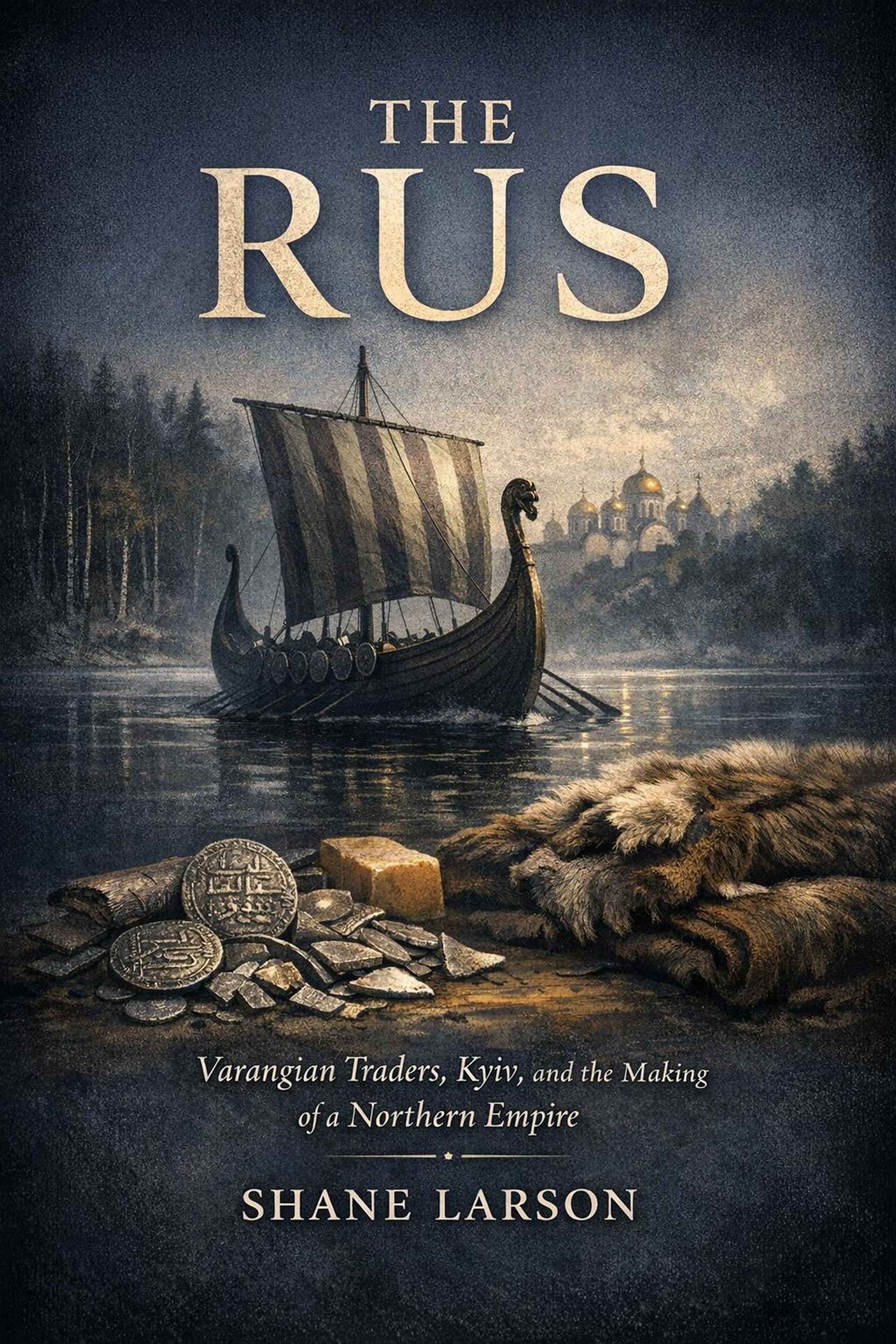
The whole story — the silver, the rivers, the slave trade, the treaties, the convoy over the cataracts, and the state it all accidentally built — is the subject of my book The Rus: Varangian Traders, Kyiv, and the Making of a Northern Empire. It follows the river road end to end, from the hoards under the Gotland farm fields to the fall of Kyiv in 1240, told from the treaties, the archaeology, the Arabic eyewitnesses, and the hundreds of letters on birchbark that Novgorod's ordinary townspeople left behind. If you have ever wondered what the Vikings were doing while they weren't in the west — this is what they were doing.
The Rus
New posts and releases, straight to your inbox. No spam, unsubscribe anytime.