The Ancient Superpower That History Erased: How a Forgotten Empire Rivaled Egypt
March 28, 2026 · 6 min read
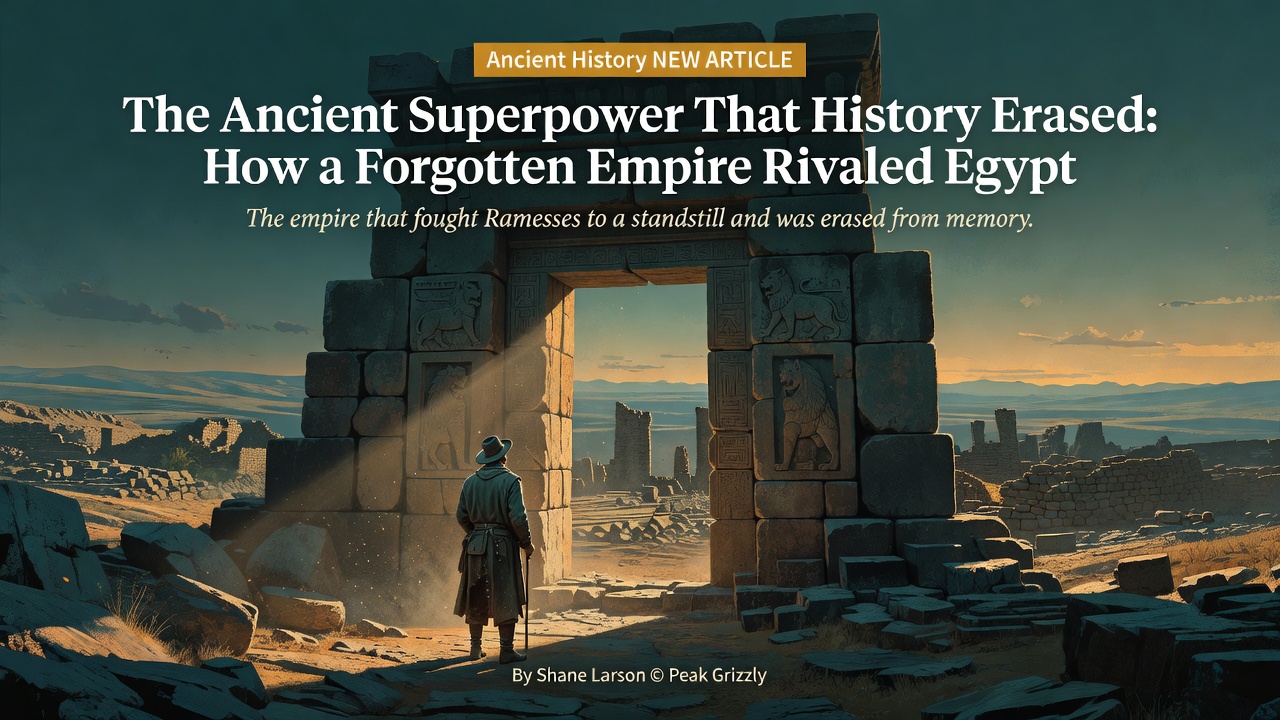
In 1834, a French explorer named Charles Texier rode into the central Anatolian highlands looking for a Roman city. What he found instead was something nobody could explain: massive stone ruins, cyclopean walls, and carved gateways that belonged to no civilization any European scholar could identify. He sketched the walls, noted the strange carved reliefs of warriors and gods, and reported his findings back to France.
Nobody knew what to make of them.
It would take another seventy years, 30,000 clay tablets pulled from a Turkish hillside, and a Czech linguist with an ear for ancient grammar before the world learned the truth: an entire superpower had been hiding in the archaeological record. The Hittites had ruled an empire stretching from the Aegean to Mesopotamia, fought Egypt to a standstill, and signed the first peace treaty in recorded history. Then they vanished so completely that for three thousand years, the only traces of their existence were a few puzzling references in the Hebrew Bible.
The story of how they were found is one of archaeology's great detective stories. The story of what they built is something else entirely.
The Battle That Exposed History's Greatest Propaganda Campaign
In the spring of 1274 BC, roughly 20,000 Egyptian soldiers marched north under Ramesses II to seize the fortress city of Kadesh in western Syria. Waiting for them was Muwatalli II, Great King of the Hittites, commanding an army of comparable size that included perhaps 3,500 chariots -- the largest chariot force ever deployed in a single battle.
What followed was one of history's most spectacular intelligence operations. As Ramesses approached Kadesh with his four divisions strung out over miles of road, he encountered two Bedouin tribesmen who told him exactly what he wanted to hear: the Hittite army was far away, near Aleppo, and Muwatalli was afraid to fight.
Ramesses believed them. The Bedouin were Hittite agents, planted to deliver false intelligence. It worked spectacularly. The pharaoh pressed ahead with only his leading division, set up camp near Kadesh, and left the rest of his army hours behind on the march road. His army was dangerously dispersed -- and the entire Hittite force was concealed less than a mile away.
The Egyptians discovered the truth only when they captured two actual Hittite scouts and beat the information out of them. By then Muwatalli had already launched his attack.
Hittite chariots smashed into the Egyptian Division of Re as it marched in column formation, scattering it completely. Survivors fleeing toward Ramesses' camp spread panic and chaos. The organized Egyptian military position collapsed into a mob. What saved Ramesses was not divine intervention -- despite what he would later claim -- but the timely arrival of an elite Egyptian force traveling separately along the coastal route, which struck the Hittite chariot force in the flank while its crews were busy looting the Egyptian camp.
The battle ended in a stalemate. Neither side could destroy the other. Ramesses marched his battered army back to Egypt. Muwatalli retained control of Kadesh.
Then the propaganda war began. Ramesses II conducted one of the most extensive public relations campaigns in ancient history, carving enormous battle reliefs into the walls of Abu Simbel, Karnak, Luxor, and the Ramesseum. The message was simple: the pharaoh had faced overwhelming odds, demonstrated superhuman courage, and won a great victory. The fact that he had been ambushed due to a catastrophic intelligence failure, that an entire division had been destroyed, and that his strategic objectives had not been achieved -- none of this appeared in the official record.
The Hittite version, recovered from the Hattusa archives three thousand years later, told a different story: we held our ground, they went home.
Ramesses' version went unchallenged for three millennia. It was not until the discovery of the Hittite archives that scholars could even question his account. The most successful propaganda campaign in history worked not because it was believable, but because nobody was left to contradict it.
The Hittite Empire
How an Entire Civilization Disappeared from Memory
The Hittites did not fade gradually. Around 1180 BC, Hattusa was abandoned and burned. The empire fragmented. Within a few centuries, the Hittites had been almost entirely forgotten -- their language unread, their cities buried, their history absorbed into the stories of other peoples.
How does a civilization that rivaled Egypt simply vanish from human memory?
The answer reveals something uncomfortable about how historical memory works. The Hittites wrote on clay tablets and stored them in archive rooms. When Hattusa fell, those archives were buried. Unlike Egypt, with its stone monuments and desert preservation, the Hittites left their records in a material and a climate that hid them from casual discovery. The Egyptians built for eternity in stone. The Hittites governed on clay, and clay crumbles when no one maintains the archives.
There is also the matter of successors. Egypt had a continuous cultural tradition that, even after decline, preserved memory of its past. The Greeks encountered Egyptian monuments and were fascinated by them. The Romans incorporated Egyptian culture. The chain of memory never fully broke. The Hittites had no such luck. The peoples who occupied Anatolia after the empire's collapse had no connection to Hittite culture and no reason to preserve its memory. The Neo-Hittite successor states in Syria preserved fragments for a few centuries before being swallowed by Assyria.
The Bible mentioned "Hittites" as a local Canaanite people -- a description so at odds with the reality of a major Bronze Age superpower that scholars initially assumed they were a different group entirely. For three thousand years, one of the most powerful empires in human history existed only as a minor footnote in someone else's scripture.
The rediscovery changed everything. The tablets at Hattusa showed that the Late Bronze Age was not a collection of isolated civilizations. It was an international system -- great powers that traded, fought, negotiated, and married into each other's royal families. The Hittites corresponded with Egypt, Babylon, Assyria, and the Mycenaean Greeks. They negotiated treaties, exchanged ambassadors, and conducted espionage. The diplomatic archives revealed a world that, in its complexity, looked far more like the modern international system than the popular image of primitive ancient kingdoms.
Their legal system operated on restitution rather than retribution -- more humane than Hammurabi's code. Their religious practice was, by ancient standards, remarkably tolerant: the "thousand gods" of the Hittites absorbed the deities of conquered peoples rather than suppressing them. Their queens held genuine political authority. And their language -- the oldest attested Indo-European language -- forced linguists to completely rethink the family tree of the world's most widely spoken language group.
A Czech scholar named Bedrich Hrozny cracked the language in 1915 with an elegant piece of reasoning. He found a passage that read: nu NINDA-an ezzatteni watar-ma ekutteni. The Sumerian word NINDA meant "bread." If people were eating bread, ezzatteni must mean "you eat" -- and it sounded like the Latin edere and Old High German ezzan. The next word, watar, looked like the English "water." They were eating bread and drinking water. A three-thousand-year silence was broken by recognizing that an ancient Anatolian empire spoke a distant cousin of English.
The Hittites built an empire that shaped the ancient world. They fought the greatest powers of the Bronze Age to a draw, invented diplomatic tools we still use today, and governed with sophistication that challenges our assumptions about "ancient" civilizations. Then they were forgotten. Their story is a reminder that historical memory is not a record of what happened. It is a record of what survived.
The Hittite Empire
New posts and releases, straight to your inbox. No spam, unsubscribe anytime.