Attila the Hun Died on His Wedding Night — And That Is Only the Second Strangest Thing About Him
April 25, 2026 · 13 min read
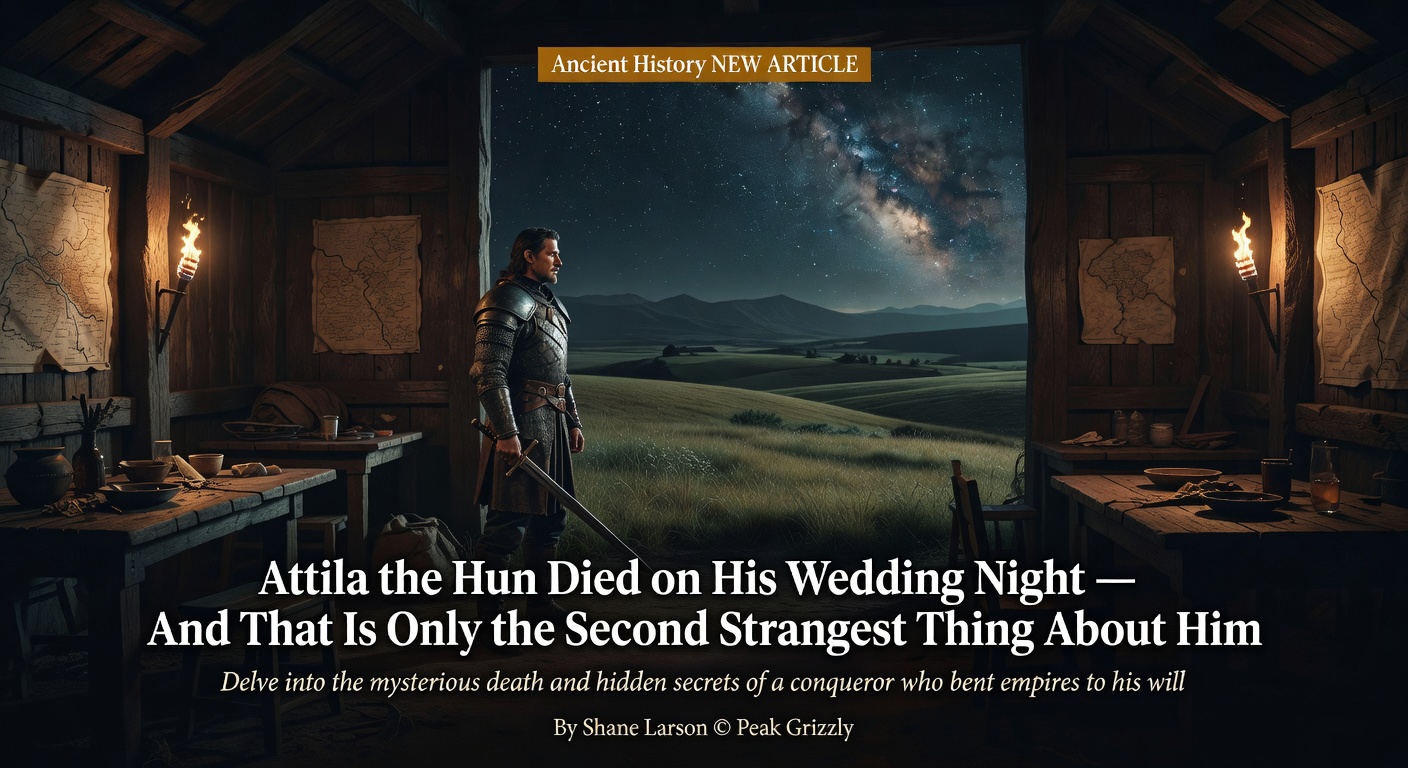
In the early spring of 453, Attila the Hun took a new wife. Her name was Ildico. She was reportedly young and, by the standards of the sources, beautiful, with descriptions from later chroniclers painting her as a figure of quiet grace amid the rugged Hunnic court. The wedding was held on the great Hungarian plain where Attila kept his compound — a stockaded cluster of wooden halls and bathhouses and storehouses that was, by that point in his reign, the unofficial capital of a confederation of peoples stretching from the lower Danube to the Rhine, a vast network that included Huns, Goths, and various subject tribes bound by alliances and tribute. This plain, often swept by winds from the steppes, had become a hub of power, where diplomatic envoys from Rome and beyond arrived to negotiate under the shadow of Attila's rule. There was a great feast, filled with the roar of warriors, the clatter of cups, and meats roasted over open fires, reflecting the Huns' nomadic traditions of hospitality even in victory. Attila, who by the testimony of the one Roman who ever dined with him normally drank less than his retainers — perhaps as a deliberate show of discipline amid his followers' excesses — drank heavily that night, a departure that might have stemmed from the pressures of his aging leadership or the celebrations' demands. He withdrew to his chamber with the bride. And in the morning, when the silence past the usual waking hour grew too strange to ignore, his retainers broke in the door and found him on his back, dead, with the blood still pooled from a hemorrhage at his nose and mouth, a grim scene that suggested a burst blood vessel, possibly exacerbated by overindulgence or underlying health issues common among hard-riding warriors. Ildico was sitting on the edge of the bed, weeping under her veil, her presence adding a layer of mystery to the event, as later tales speculated on her role, from innocent bystander to unwitting participant.
That is the story as it comes down to us. It comes down to us through a chain of hands: the Greek historian Priscus of Panium wrote it a year or two after it happened, drawing on his own experiences and interviews with survivors; his account was quoted by the sixth-century Gothic bishop Jordanes, who adapted it for his broader history of the Goths; Jordanes's summary was copied by later medieval scribes, ensuring its survival amid the era's manuscript culture. It may be broadly true, as cross-references in other sources like the works of Cassiodorus align with key details. It may also be wrong in ways we cannot reconstruct, given the biases of ancient historians who often shaped narratives to fit moral or political agendas — for instance, portraying barbarian leaders as either monstrous or tragic figures. Some Germanic poets, reworking the story five centuries later in Old Norse sagas like the Völsunga Saga, decided that Ildico had killed him, transforming her into a vengeful heroine in a pattern seen in other epics where women drive pivotal plot twists. Some modern historians have wondered whether Marcian, the Eastern Roman emperor who had just refused to pay Attila's tribute — a payment that had been escalating for years, straining the empire's coffers — might have reached a hand into that chamber with silver, perhaps through spies or bribes, as a way to eliminate the threat without open war. None of this can be confirmed, as the lack of contemporary Hunnic records leaves us with fragments and speculation. What is certain is that Attila died that night, and that the timing of his death was, for the surviving Roman world, the greatest piece of good luck the fifth century was going to provide, halting the Huns' advances at a moment when the empire teetered on collapse.
The Scourge of God
Attila had been the pre-eminent threat to the Roman Mediterranean for roughly eighteen years, a period marked by relentless raids and diplomatic maneuvering that reshaped the continent's power dynamics. He came to joint rule with his brother Bleda around 434, inheriting a confederation built on the Huns' mastery of horse archery and rapid mobility, which allowed them to strike deep into enemy territory before vanishing. He eliminated Bleda and consolidated sole power around 445, likely through assassination or battlefield betrayal, a move that mirrored the brutal internal politics of other nomadic empires, such as the earlier Xiongnu in China, where leadership disputes often led to violent purges. From then until his death, he ran a campaign of tribute extraction against the Eastern Roman Empire so systematic that it bled Constantinople of more gold in a decade than any voluntary Roman payment in the empire's history — for example, annual tributes that started at around 700 pounds of gold and escalated to over 2,100 pounds by the 440s, forcing the empire to melt down statues and strip provincial revenues. When Constantinople tried to stop paying, he devastated the Balkans, burning cities like Serdica and Philippopolis in campaigns that displaced thousands and created refugee crises, weakening Rome's border defenses and exposing the fragility of its supply lines. In 451, he invaded Gaul, clashing with a coalition army at the Catalaunian Plains in a battle that involved tens of thousands of fighters, where the Huns' feigned retreats and archery volleys nearly overwhelmed the Roman-Visigothic lines before weather and exhaustion turned the tide. In 452, he invaded Italy, marching through the Po Valley and sacking cities like Aquileia, leaving behind scorched earth that contributed to the region's long-term depopulation.
All of this happened in front of a Roman world whose Western half was already dying, its infrastructure crumbling under the weight of invasions, economic stagnation, and internal strife. Italy, Gaul, Spain, and North Africa were stitched together by a single Roman general named Aetius, who held the ragged fabric in place through a network of alliances with the Visigoths at Toulouse, the Franks on the Rhine, the Burgundians on the Rhône, and a shifting cast of smaller peoples — a strategy that echoed earlier Roman pacts with auxiliaries but was strained by mutual distrust and competing ambitions. The Western emperor, Valentinian III, was a vicious mediocrity, more focused on palace intrigues than governance, his rule marked by executions and exiles that alienated potential allies; his mother Galla Placidia ran the court until she died in 450, acting as a stabilizing force through her diplomatic savvy and connections to barbarian leaders. His sister Honoria was locked up for sleeping with a servant, an scandal that highlighted the court's moral decay, and she smuggled her ring to Attila asking to be rescued, accidentally handing Attila a pretext for invading the West by framing it as a marital claim, a tactic that exploited Rome's internal divisions. If you want to understand how fragile all of this was, consider that Aetius himself — the man who had pulled together the coalition that stopped Attila at the Catalaunian Plains in 451, drawing on years of experience fighting Huns and other foes — was murdered by the emperor Valentinian with his own hand a year after Attila's death, a act of paranoia that unraveled the West's defenses; Valentinian himself was murdered by Aetius's supporters six months later in retaliation, and within two decades there was no Western emperor at all, as local warlords and kings filled the void.
Attila is the hinge on which late antiquity turns, a figure whose campaigns accelerated the transition from a unified empire to a patchwork of successor states. And his death on a wedding night, of a nosebleed or an assassination or a combination of drink and bad anatomy — perhaps linked to the Huns' high rates of injury from horseback falls or the physical toll of constant warfare — is where the hinge finally gives way, allowing the medieval world to emerge from the ruins.
The Priscus embassy is the book's spine
The strangest thing about Attila is not how he died. The strangest thing is what we do and do not know about him, a gap that stems from the Huns' oral traditions and the loss of their records over time.
We have no Hunnic sources. None. Not a letter, not a chronicle, not a coin inscription, which stands in stark contrast to the voluminous archives of Rome or even the runic carvings of the Germanic tribes; the Huns were literate enough to issue administrative documents when they needed to — Priscus mentions secretaries at Attila's court, some of them Roman defectors who brought their bureaucratic skills — but nothing survives, likely due to the nomadic lifestyle that prioritized mobility over archives. Everything we know about the Huns comes from their enemies: Roman officials who viewed them as chaotic barbarians, Gothic historians who incorporated them into migration myths, Christian bishops who saw them as divine punishments, and later medieval legend that romanticized them for epic poetry. This one-sided view often reduces Attila to a caricature, overlooking the complexities of his leadership.
With one enormous exception that offers a rare glimpse behind the veil.
In 449, the Eastern Roman court at Constantinople sent an embassy to Attila, a mission that reflected the empire's desperate diplomacy amid ongoing raids; the public purpose was to negotiate over certain Hunnic fugitives whose return Attila was demanding, a common point of contention that involved escaped slaves and deserters disrupting border stability. The private purpose was an assassination: the grand chamberlain Chrysaphius had bribed the Hunnic ambassador Edeco with promises of wealth, hoping to eliminate Attila and end the tribute drain, a plot that highlighted Rome's willingness to use intrigue when military options failed. Attached to the embassy as a secretary was a Thracian Greek named Priscus of Panium — a literate, sharp-eyed, ambitious man who intended to write about what he saw, drawing on his background as a historian trained in the rhetorical traditions of Athens and Alexandria. Priscus rode north with the embassy for weeks, traversing rugged terrains from the fortified Danube crossings to the open steppes, where the group faced challenges like provisioning for horses and navigating unfamiliar rivers, experiences that gave him a firsthand sense of the Huns' environmental advantages.
Priscus crossed the Danube, entering lands that had been Roman provinces just decades earlier but were now Hunnic domains, dotted with abandoned forts and new settlements. He rode through landscapes no Roman civilian had seen in generations, vast grasslands teeming with herds of horses and flocks of sheep that sustained the Huns' mobile economy, camping in villages of log and thatch where families lived in round yurts reinforced with hides, a setup that allowed for quick disassembly during migrations. He ate goat stew with tribal chieftains, sharing meals that included fermented mare's milk and grilled meats, which offered him insights into Hunnic social customs, such as the emphasis on storytelling and toasts that bonded warriors. He was admitted to Attila's compound — a large stockade that blended Hunnic simplicity with captured Roman engineering, featuring halls of polished wood for feasts and a bathhouse built by a Roman captive from Sirmium who adapted Mediterranean designs to local materials. He sat through dinners with Attila's nobles and watched the ceremonial drinking rounds, where status was displayed through the quality of cups and the restraint of leaders, noting how these rituals reinforced loyalty in a confederation held together by personal ties rather than laws. He watched Attila himself — a short, broad-chested, dark-complexioned man in a plain tunic, sitting on a plain wooden couch, eating plain food from a plain wooden cup while his retainers ate from silver and gold, a deliberate choice that projected humility and authority, countering Roman stereotypes of barbaric excess. He watched Attila's young son Ernak come into the hall, a shy boy perhaps around ten years old, and saw Attila stroke his son's face with an affection Priscus did not expect, a moment that humanized the warlord and revealed the personal stakes in his rule, especially as he groomed heirs amid rivalries. He had a long conversation with a former Greek prisoner of war who had been captured during a Balkan raid, enslaved, fought beside his Hunnic master in several campaigns, earned his freedom through valor, married a Hunnic wife, and had decided he preferred Hunnic life to Roman life, citing the freedom of the steppes over the taxes and corruption of the cities; Priscus tried to argue him out of it, appealing to the cultural superiority of Roman civilization, but the man was not persuaded, offering a counterpoint that challenged Priscus's assumptions about barbarism versus civilization. Priscus, honest enough to record the conversation verbatim in his notes, reported the whole thing, providing a balanced view that acknowledged the appeal of Hunnic society.
The Priscus narrative does not survive whole, fragmented by the passage of time and selective copying; it survives in fragments — long quotations preserved in a tenth-century Byzantine compilation commissioned by Constantine VII, the Excerpta de Legationibus, which collected diplomatic histories for imperial education. But what survives is extraordinary, offering details unmatched in ancient literature, such as descriptions of Hunnic weaponry or daily routines, making it the single most detailed ancient account we have of any steppe court, anywhere, in any century, and a vital counterpoint to the biased summaries in sources like Ammianus Marcellinus. It is the only place where Attila the Hun stops being a propaganda cartoon and becomes a person: a middle-aged warlord with a shy son and a favorite dwarf who served as a court jester, and a reputation for drinking less than his men as a form of self-control, and a habit of watching everything, his eyes missing no detail in negotiations or feasts.
Every popular book ever written about Attila summarizes Priscus in a few paragraphs and moves on, often glossing over the narrative's richness to focus on battles, but this approach misses the depth it adds to understanding Hunnic culture. My book makes the Priscus embassy the spine of the story, weaving it through the chapters to anchor the broader history. The chapter that covers those weeks in 449 is the longest in the book, expanding on these encounters to bring readers closer to the man himself, as if walking alongside Priscus through the gates of the compound. It is the closest any of us will get to the man himself.
Why the story matters
Attila is one of the most famous names in ancient history, and part of the reason is a trick of afterlife, where cultural memory transformed him into enduring symbols across Europe.
When his confederation collapsed in 454, the Germanic peoples who had lived under it remembered him, incorporating his legacy into their oral traditions and later written epics; Norse poets turned him into Atli, a treacherous king murdered by his wife in tales like the Poetic Edda, drawing parallels to other betrayed leaders in mythology, such as Siegfried in the Nibelungenlied. German poets turned him into Etzel, a courteous widowed host whose great hall becomes the scene of a Burgundian massacre not of his making, a figure of tragic hospitality in epics that reflected medieval chivalric ideals. The Christian tradition called him flagellum Dei, the Scourge of God — a man sent by providence to punish Roman sin, as seen in sermons and chronicles that linked his invasions to moral decline, much like how later historians viewed figures like Genghis Khan. Raphael painted him at the Vatican in scenes of papal triumph, Verdi wrote an opera about him that dramatized his Italian campaign, and the British, in the First World War, called the Germans "Huns" after him, borrowing the term from Kaiser Wilhelm II's 1900 speech urging troops to emulate Attila's ruthlessness, a rhetorical choice that fueled wartime propaganda by evoking ancient fears.
But that is not why he matters. He matters because he is the clearest single demonstration, in the pre-gunpowder age, of what a mobile confederation of horse archers could do to a sedentary empire — and what it could not, as seen in comparisons to the Mongol invasions centuries later, which shared tactics of feigned retreats and psychological terror. The Huns could extort tribute through annual demands that disrupted trade routes, devastate regions by burning crops and driving off livestock, and force the most powerful state in the Mediterranean to pay them for two decades, with records showing that the gold inflows funded Hunnic expansions and alliances. They could fight a pitched battle against the combined Roman-Germanic coalition of the West at the Catalaunian Plains and withdraw in good order, using their superior mobility to avoid encirclement despite heavy losses. They could not, it turned out, survive the death of the one man who held their confederation together through personal charisma and strategic marriages, as the lack of institutional structures led to immediate fragmentation, a vulnerability also evident in other tribal unions like the Avars or Bulgars. The Hunnic state was not an institution; it was a mouth, devouring resources without building lasting governance, which underscores why such empires often dissolved quickly without a central figure.
If you want to understand why the Western Roman Empire fell when it did, you have to understand Attila, whose pressures exposed weaknesses in the empire's economy, such as the overreliance on slave labor and the strain of defending distant frontiers. If you want to understand the world the Huns left behind — the medieval European order of kingdoms that gradually emerged from the wreckage, with entities like the Frankish and Lombard states rising in the power vacuum — you also have to understand Attila, as his campaigns accelerated migrations and cultural exchanges that shaped early medieval societies. He is where the late Roman Mediterranean cracks open and the medieval world starts to come through, a pivotal shift marked by the blending of Roman, Germanic, and steppe influences.
New posts and releases, straight to your inbox. No spam, unsubscribe anytime.