The Baby in the Basket Story Is a Thousand Years Older Than Moses
August 5, 2026 · 6 min read
The Baby in the Basket Story Is a Thousand Years Older Than Moses
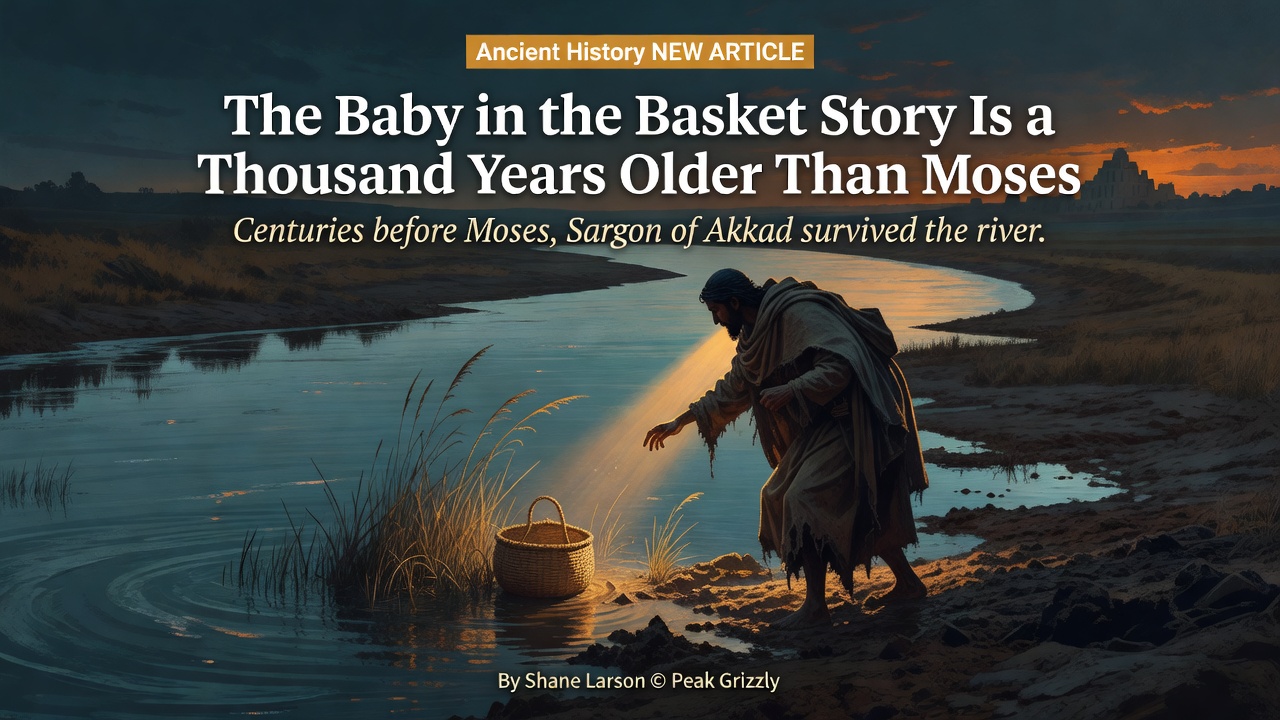
A woman bears a child in secret. Unable to keep him, she places him in a basket of rushes, seals it with pitch so it will float, and sets it on the river. The river does not drown him. He is found by someone drawing water, raised in an ordinary household far from his birth, and rises to become the most powerful man of his age.
Most readers will recognise that story.
It is told about Sargon of Akkad, in a text written in Akkadian, about a king who ruled around 2334 BC. It predates the Exodus narrative by something on the order of a thousand years. The earliest fragments of the Sargon account survive on tablets from the Neo-Assyrian period, though they clearly draw on older material that had circulated in scribal schools for centuries before that.
The Legend and What It Was For
The surviving version — usually called the Sargon Birth Legend — comes from tablets copied centuries after Sargon lived, and it is written in the first person. Sargon introduces himself, names his mother as a priestess, states that he did not know his father, and describes being placed in the sealed basket and set on the Euphrates. He is drawn out by a man who raises him as a gardener. The goddess Ishtar grants him her favour, and he becomes king.
The obvious question is why a king would tell this story about himself, since it amounts to announcing that he has no royal lineage, no claim by descent, and an origin somewhere between irregular and disreputable.
The answer is that Sargon almost certainly was a usurper, and the legend is doing precise political work. The city of Kish, where he first rose to power, had its own established ruling families, and later king-lists show a clean break between the previous dynasty and his accession. In a world where legitimacy came from inheritance, a man with no royal line has a problem. Inventing an ancestry is one option, and a poor one — people in Kish knew who his family was. The alternative is to reframe the absence entirely: he was not chosen by a father, he was chosen by a goddess. The river spared him. Divine favour selected him where blood did not.
The humble origin stops being a weakness and becomes the proof. If he rose this far from nothing, something more than human must have been arranging it. Later Assyrian and Babylonian rulers who invoked Sargon’s name understood this move; they repeated the same pattern when their own claims rested on conquest rather than pedigree.
The Cupbearer Detail
The other element of the story is the one that gives the book its title, and it is more revealing than the basket.
Before he was king, Sargon was cupbearer to Ur-Zababa, king of Kish.
To modern ears this sounds like a servant's job. It was not. The cupbearer handled the king's wine, which meant the cupbearer was in a position to poison the king every single day and chose not to. It was among the most trusted positions in the court, held close to the ruler, present for conversations that mattered, and generally given to someone regarded as absolutely reliable. In the administrative records of later Mesopotamian palaces, cupbearers appear as witnesses to land grants and diplomatic exchanges, indicating they moved in the highest circles without holding formal military rank.
Rise of the Cup Bearer
It is also the ideal vantage point from which to take a throne. You know the king's habits, his health, his rivals, and which of his nobles are unhappy. You are physically near him constantly, and nobody questions your presence. When Sargon eventually marched on Ur-Zababa’s city, the sources describe a sudden seizure of power rather than a long military campaign, which fits the profile of someone who already had daily access inside the palace.
Whether the story is literally true is not certain — the sources are later and the whole account is shaped. But it is exactly the kind of detail that a fabricator would not invent, because it undercuts the heroism. A legend built purely for glory makes its subject a warrior. This one makes him a servant who was in the room.
Why This Motif Recurs
The foundling-king pattern shows up across an enormous range of unconnected traditions. Sargon. Moses. Romulus and Remus, exposed and suckled by a wolf. Cyrus the Great, ordered killed as an infant and raised by a herdsman. Oedipus. Karna in the Mahabharata, set on a river in a basket.
Scholars have argued about this for a long time, and the plausible explanations are not exclusive.
Some of it is transmission — these cultures were in contact, stories travelled, and the Near East in particular shared narrative material across languages for millennia. Trade routes and diplomatic correspondence carried tales as readily as goods. Some of it is that the motif solves a problem every society with hereditary rule eventually faces: what do you say about a ruler whose claim is not by blood? The answer that works is always some version of the gods intervened, and a child saved from certain death is the most economical way to dramatise that. The exposed infant who survives becomes living evidence that ordinary rules of succession have been set aside for a higher purpose.
And some of it is that the story is simply good. A helpless infant, a river, an improbable rescue, an unrecognised destiny — it has structure, tension, and reversal. Stories that work get retold, and stories that get retold get attached to whichever powerful figure needs one.
What is not in dispute is which surviving version is oldest, and it belongs to a Mesopotamian usurper who took a throne he had no right to and needed an explanation.
The Man Underneath
The propaganda worked, and it worked for a very long time. Sargon's legend outlasted his empire by two thousand years — later Mesopotamian kings measured themselves against him, copied his titles, and had scribes reproduce his story for their own libraries. Even the famous law code of Hammurabi, written centuries afterward, echoes the same rhetoric of divine selection over bloodline.
The historical figure underneath was a formidable administrator who invented most of the machinery empires would use for the next three millennia. He standardised weights and measures across conquered territories, posted governors rather than relying on local dynasts, and created a standing army that could operate far from home. But that is not what got remembered longest.
What got remembered was a baby in a basket, and the claim that the river let him live.
Rise of the Cup Bearer: The Epic of Sargon is the story told as narrative — the basket, the palace at Kish, the cupbearer at the king's shoulder, and the rise of the man who assembled the first empire in history.
Rise of the Cup Bearer
New posts and releases, straight to your inbox. No spam, unsubscribe anytime.