The New Testament Has No Dates in It. One Broken Stone at Delphi Supplies Them All.
November 1, 2026 · 7 min read
In the museum at Delphi there is a slab of grey limestone in nine pieces. It carries part of a letter from the emperor Claudius to the city, and the letter is about nothing much. Claudius has long been fond of Apollo's town, he says. He has heard that it is short of people. He would like suitable people from other cities invited to settle there. Somewhere in the middle, reporting what he has been told about Delphi's condition, he mentions his source: Lucius Junius Gallio, my friend, and proconsul of Achaia.
That phrase is the reason anyone can put a year on the apostle Paul.
It is easy to forget how undated the New Testament is. Paul's letters never carry a date, a consul's name or a regnal year. The Acts of the Apostles names governors, kings and high priests, and never once says what year it is. The gospels place the crucifixion under Pontius Pilate, which gives a ten-year window and no more. For the best-documented traveller of the first century there is not a single absolute date anywhere in the sources. Every year attached to Paul in every book and every church calendar is an inference, and nearly all of those inferences run back through the stone at Delphi.
How an emperor dated a letter without meaning to
Claudius did not date his letter either, not in any sense we would recognise. He headed it with his titles, as every emperor did on every public document, and two of those titles were counters.
The first was the tribunician power. Every emperor since Augustus held the powers of a tribune of the people, renewed the grant each year on a fixed anniversary, and numbered each renewal. Claudius's ran from late January, and the Delphi letter gives his twelfth, which puts it between January 52 and January 53. The second counter was the acclamation as imperator, the salute troops gave a victorious general. An emperor was acclaimed whenever one of his armies won something, which happened irregularly, and the acclamations were numbered too. The Delphi letter gives Claudius his twenty-sixth.
That number can be squeezed. The great gateway that carried the Aqua Claudia into Rome, now called the Porta Maggiore, carries an inscription giving Claudius his twelfth tribunician power and his twenty-seventh acclamation, and Frontinus, who ran the city's water supply a generation later, records that the aqueduct was dedicated on 1 August 52. So by August the count had reached twenty-seven. The letter to Delphi, still at twenty-six, was written between late January and the end of July 52.
Now the governor. Proconsuls of senatorial provinces served for one year, and under Claudius they were ordered to be out of Rome by the middle of April, which put the start of a term in late spring or early summer. Claudius writes as though Gallio has already reported to him, so Gallio had been in Achaia for some time when the letter went out. The natural conclusion is that his year ran from the early summer of 51 to the early summer of 52. The alternative, a term beginning in summer 52, would need Gallio's report to reach Rome almost as soon as he landed, and few scholars think that likely. Seneca, who was Gallio's younger brother, adds a detail in one of his letters: Gallio came down with a fever in Achaia and took ship at once, insisting the illness belonged to the place and not to his body. He may not have served out his year.
So the stone says, with a small margin, that Gallio governed Achaia in 51 and 52. French excavators recovered the pieces from 1892 onward; four fragments were published in 1905, and more were joined to them over the following decades. Gallio's name is clear on the stone. The rest of the phrase is partly restored, and nobody disputes the reading.
From the stone to Paul
The stone says nothing about Paul. The link is a scene in Acts.
Paul, Acts says, had been in Corinth a year and six months. Then, "when Gallio was the deputy of Achaia," the leaders of the synagogue brought him before the governor's tribunal on a charge of persuading people to worship God contrary to the law (Acts 18:11–13). Gallio did not let him speak. If this were a crime, he said, he would hear it; but a question of words and names and their own law was their business, and "I will be no judge of such matters" (Acts 18:15). He had the party driven from the tribunal, and when the crowd then beat the synagogue's leader in front of him, "Gallio cared for none of those things" (Acts 18:17). It is the only appearance of Gallio in the New Testament, and Paul never mentions him.
Paul of Tarsus
Put the two together and the arithmetic starts. The phrasing in Acts has suggested to many readers that the synagogue tried its case on a new governor soon after he arrived, in the summer of 51. If Paul had by then been in Corinth for most of his eighteen months, he came in 50 or late 49 and left in 51 or 52. His first surviving letter, 1 Thessalonians, was written from Corinth not long after he arrived, so it belongs to about the year 50, which makes it the oldest Christian document in existence. Counting backwards from there: the crossing into Macedonia in 49 or 50; the meeting in Jerusalem about Gentile converts shortly before, in 48 or 49; and then, through the "fourteen years" and "three years" Paul gives in Galatians (Gal 1:18; 2:1), the experience outside Damascus in the early or mid 30s, which squares with the one other anchor in the letters, a Nabataean king named Aretas whose agent guarded Damascus when Paul escaped it and who died around the year 40. Counting forwards: Ephesus in the early-to-mid 50s, the letter to the Romans in 56 or 57, the arrest in Jerusalem around 57, and the voyage to Rome at the end of the decade.
There is a second, looser check. Acts says Paul lodged in Corinth with a couple called Aquila and Priscilla, "lately come from Italy" because Claudius had expelled the Jews from Rome (Acts 18:2). Suetonius records the expulsion in seven Latin words and gives no date; a fifth-century writer puts it in 49. If that is right, the couple reached Corinth just ahead of Paul, and a Roman source and a Christian one land on the same two or three years without either having consulted the other. Some scholars place the measure in 41 and the Corinth episode earlier, but the mainstream reading fits the stone.
What the stone does not prove
A single inscription that carries this much weight deserves to have its limits stated exactly.
It does not mention Paul, Jews, Corinth or any disturbance. It proves that a man named Gallio was proconsul of Achaia, and it dates his term. Whether Paul ever stood in front of him rests on Acts alone, written a generation or more after the event by an admirer. A determined sceptic could say that the author, knowing Seneca's famous brother had governed Greece, placed Paul before him for effect. Few scholars think so, because a writer inventing a scene to flatter his hero would hardly have had the governor refuse to hear him, and because the other Corinthian details in Acts check out against Paul's own letters wherever they can be checked. But the step from the stone to Paul goes through Acts, and anyone building a chronology should say so.
Nor does the stone say when within Gallio's year the hearing fell, or when within Paul's stay. The eighteen months in Acts may be counted before the hearing or around it. The chronology that hangs from the inscription is therefore secure to about a year in either direction, remarkable for a first-century craftsman and not as exact as some printed timelines imply. What is striking is that both schools of Pauline chronology, those who follow the sequence in Acts and those who rebuild the life from the letters alone and distrust Acts on the order of events, start from this stone. They quarrel about everything attached to it. They accept the date.
Gallio himself had a longer story than the stone records. Born in Spain, adopted by a rhetorician whose name he took, consul under Nero, he died in the purges that followed the conspiracy of 65, the year his brother Seneca was forced to open his veins. The inscription remembers him for a report on Delphi's population. The New Testament remembers him for a case he refused to try. Between them they fix the one episode in the life of Paul that can be tied to a calendar year, and everything else is counted from there.
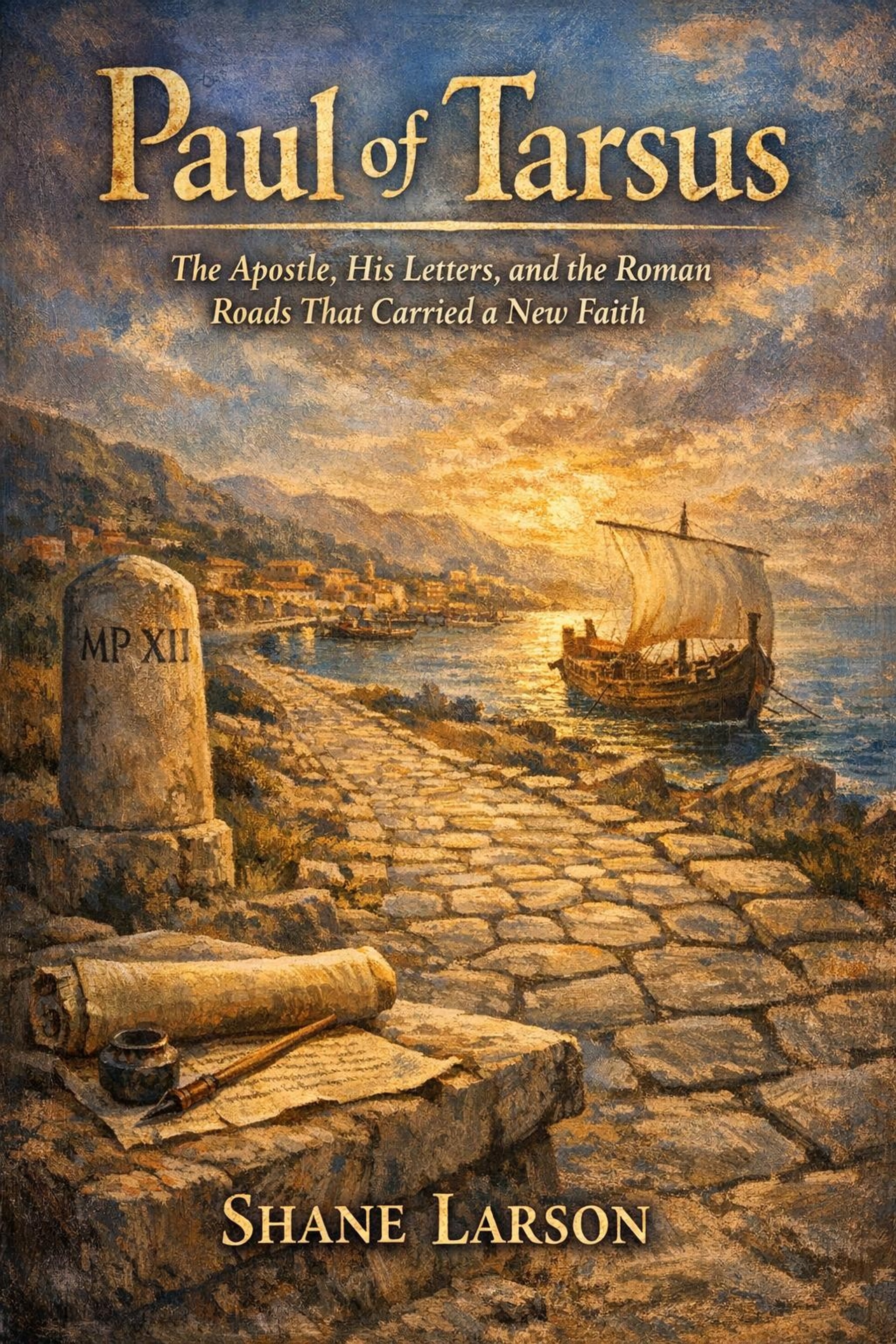
*Paul of Tarsus: The Apostle, His Letters, and the Roman Roads That Carried a New Faith* is a narrative biography built on the seven letters nearly every scholar accepts as Paul's, with Acts used where it can be tested and flagged where it cannot. The Gallio inscription gets a chapter of its own, alongside the Erastus pavement at Corinth, the Temple warning stones from Jerusalem and the sarcophagus under St Paul Outside the Walls. The book is neither confessional nor debunking; it describes what Paul claimed and what he did about it, and leaves the reader to weigh the rest. Available now in ebook, paperback, hardcover and audiobook.
Paul of Tarsus
New posts and releases, straight to your inbox. No spam, unsubscribe anytime.