What Was Hadrian's Wall Actually For? The Problem With Eighty Gates
November 2, 2026 · 7 min read
Stand at Milecastle 42, on the crags at Cawfields in Northumberland, and look at the north gate. It is a proper gateway, with piers and a threshold, wide enough for a cart. It opens onto a cliff. There is no road beyond it, no track, no reason for a cart ever to have come through, and yet the Roman army built it, and built one like it at every Roman mile along eighty miles of frontier, from the Tyne to the Solway. Eighty milecastles, eighty gates to the north. Add the forts that straddled the line with their own gates opening onto the far side, and Hadrian's Wall had something approaching a hundred openings in seventy-three modern miles.
That number is the place to start with the oldest question about the Wall, which is what it was for. A medieval castle has one gate, or two, and spends a great deal of ingenuity making them hard to get through. The Wall had one every mile or so, in country where most of them led nowhere in particular. Whatever the Romans were building in the 120s, it was not something whose first job was to stop people from reaching the other side.
The one sentence Rome left us
The written record is almost nothing. The Historia Augusta, a late and unreliable collection of imperial biographies, gives the Wall a single sentence: Hadrian went to Britain, set many things right, and was the first to build a wall, eighty miles long, to divide the barbarians from the Romans. That is all any Roman author says about why. It was written two centuries or more after the event by a compiler who had never seen the thing, and it describes a purpose the structure contradicts at every mile.
So the argument has had to be made from the ground, and it has been going on since the modern study of the Wall began. In 1921 R. G. Collingwood, the philosopher and archaeologist whose numbering of the milecastles is still in use, set its terms in a short paper. The Wall, he argued, was not a fighting line. The Roman army had no tradition of defending fixed positions from a parapet; it fought in the open, and the forts along the line had their main gates opening north precisely so that the troops could get out and do so. What the Wall could do was stop small-scale movement. A raiding party driving stolen cattle south, a smuggler with a pack, a dozen men looking for trouble: a ditch, a berm and ten feet of stone, watched from a turret every third of a mile, made that kind of crossing slow and visible. An army it could not stop and was not meant to.
That reading, with variations, is roughly where the question has rested for a century. But it leaves the gates unexplained, and the gates are the most striking thing about the structure.
A barrier designed to be crossed
A wall with a gate every mile is a wall designed to be crossed, at points of the builder's choosing, under the eyes of soldiers. That is the second reading, and the one the gates support best. Herdsmen taking cattle to the markets outside the forts, families with kin on the other side, traders with hides and grain: the Wall did not end that traffic. It put it through doorways. Everyone who crossed did so at a gate, at a time the garrison chose, after the garrison had looked at them and, very probably, taken something from them. Rome taxed goods crossing its internal and external boundaries as a matter of course, and though no customs post has been found on the Wall itself, the absence of a document is not evidence that nothing was collected.
The later history of the gates fits this reading better than any other. From the late second century onwards, at dates that are hard to fix, the north gates of several milecastles were narrowed, some to the width of a single person on foot, and a few were blocked entirely. That is what an organisation does when it has been letting carts and herds through and decides it wants less of that, or wants it concentrated at the forts, where there were more soldiers and better records. It is not what you do to a sally port. Narrowing a sally port defeats its purpose. The gates were a working part of a system for managing a flow of people, and the army adjusted them as the flow changed.
Hadrian's Wall
The Vallum tells the same story from the other direction. Behind the Wall, to the south, the army dug a second earthwork: a flat-bottomed ditch twenty Roman feet wide between two mounds, running the length of the line and crossable only at the forts, where a gated causeway with pivot holes for its doors has been found at Benwell. The Vallum faces the province, not the enemy. It marks off a military zone from the farmland behind it and controls who gets into that zone from the Roman side. A frontier that needed policing from the south as well as the north was not a frontier that expected the trouble to come from only one direction.
The objections, and why they matter
None of this means the Wall was a customs fence with a parade of friendly farmers passing through it. The strongest recent work on the Wall has pushed back hard against the gentler reading, and the objections have to be taken seriously.
The first is in the ground on the eastern sector. Since about 2000, excavations at Newcastle and Wallsend have found rows of pits on the berm, the strip between the Wall and its ditch, which once held sharpened stakes or branch entanglements. A smuggler is not stopped by a stake; those pits were dug for men trying to rush the line. The second is the fort decision itself. The original plan left the garrisons on the old road to the south; within a few years the army tore down turrets and milecastles it had just built and put the forts on the line, with three gates opening north. That is the behaviour of an army that wanted its cavalry out through the Wall fast. The third is the evidence, thin but real, of fighting in Britain early in Hadrian's reign: a coin issue of 119, a later remark about Roman losses, and a tombstone from Vindolanda of a centurion killed in war. Nobody builds eighty miles of stone in a quiet province.
The honest position is that the objections are right about the temper of the thing and wrong about its purpose. The word I have used for it in the book is membrane. A membrane is not a gentle object. It is a barrier with selective openings, and the selection is enforced, sometimes with force. The pits enforce it. The forts, with their north gates, are the means of acting on what the turrets see: a raid spotted from a tower, signalled along the line, met in the open by a cavalry regiment from Chesters before the raiders were back in the hills. The Vallum is the inner layer. The outpost forts beyond the Wall put Roman eyes and Roman power out into the zone to the north, so that the line was the last filter in a system of control that began well beyond it. That is not an army expecting to be left alone. It is an army that expected to manage a frontier with active and sometimes hostile neighbours, and had decided the way to do it was to control who crossed and where, rather than to try to stop everyone.
What the gates say about Rome
There is one more thing the gates say, and it is about the people on the far side. The army did not think much of them. A note from Vindolanda, written a generation before the Wall, calls the natives Brittunculi, little Brits, and a distance slab from the Antonine Wall shows a cavalryman riding down four naked Britons. Yet the same army built a line with a hundred doorways in it, because it could not do without the people it despised: their cattle, their grain, their markets and their labour. A society that builds a wall and then puts a gate in it every mile has decided that it needs the other side.
The modern habit of reading Hadrian's Wall as a national border gets this wrong. The Wall is in England, entirely; the Scottish border runs north of it along its whole length, by a few miles at the Solway and by more than sixty at the Tyne, and neither country existed for nine hundred years after the garrison faded. The Wall never divided two nations. It divided a controlled zone from an uncontrolled one and then spent three centuries letting people through from one to the other, counting them as they came.
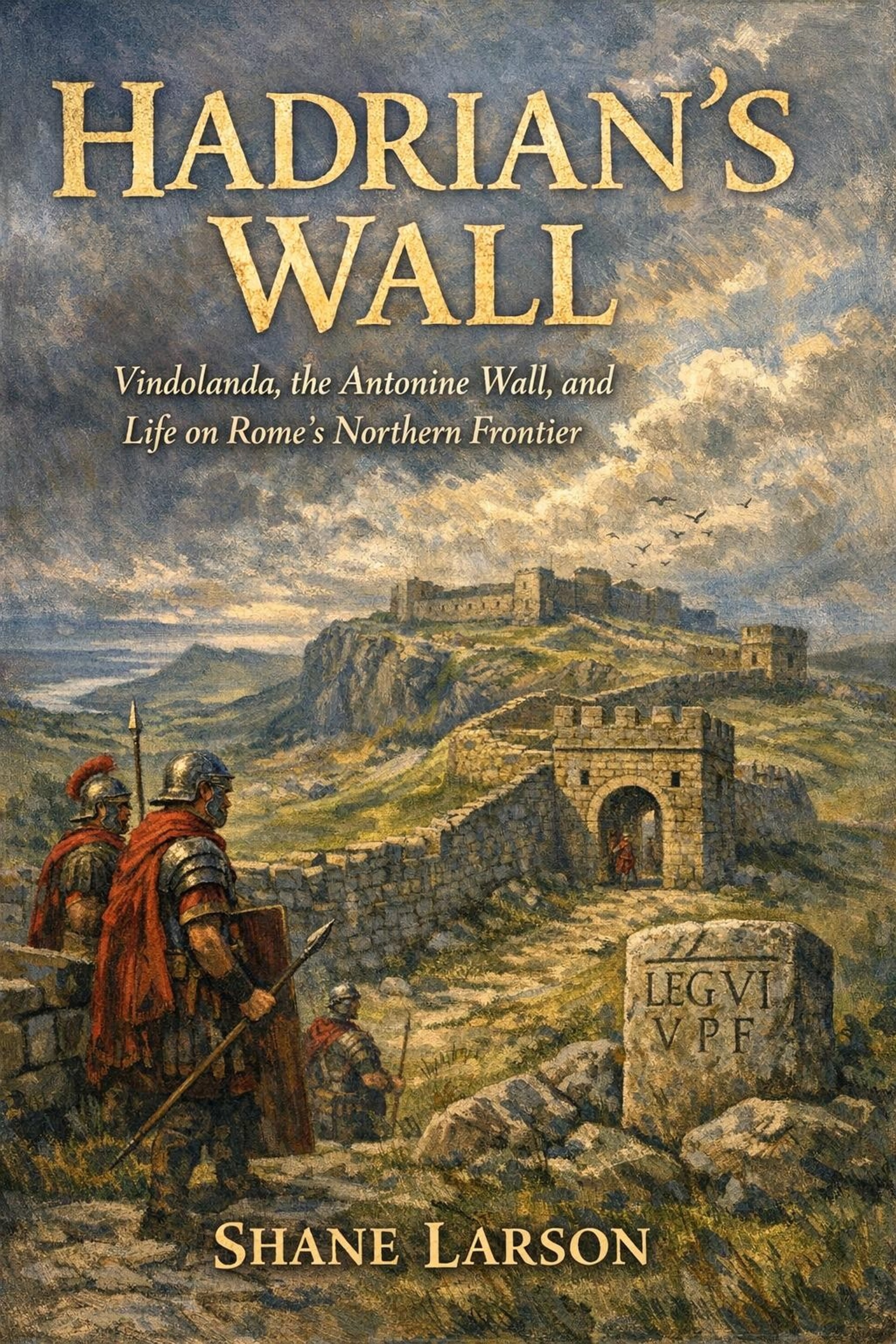
*Hadrian's Wall: Vindolanda, the Antonine Wall, and Life on Rome's Northern Frontier* is a biography of the frontier from the forts on the road before the Wall to the walkers on the National Trail. It opens on the Vindolanda tablets, which were mostly written before the Wall existed, gives the Antonine Wall a full chapter, and argues the question above with its objections laid out beside it. The revolt that burned London sixty years earlier is told in *Boudica*, and the decision of 122 in its empire-wide setting in *The Height of Empire*. The emperor who gave the order has his own life in *Hadrian*.
Hadrian's Wall
New posts and releases, straight to your inbox. No spam, unsubscribe anytime.