Did the Romans Really Leave Britain in 410? The Letter That May Have Gone to the Wrong Province
November 2, 2026 · 7 min read
Ask when the Romans left Britain and most people will give you a year. 410. It comes with a picture: the legions forming up on a beach, the standards going aboard, the ships pulling out into the Channel while the Britons watch from the shingle and wonder what the Saxons will do next. It is a clean ending, and nearly every part of it is wrong. Nobody left in 410, and the document the date rests on may not be about Britain at all.
One sentence in a careless compiler
The whole tradition hangs on a single passage in a Greek historian called Zosimus, a civil servant in Constantinople who put together a New History around the year 500 from earlier writers he did not always follow carefully. In his sixth book, in the middle of an account of Alaric's movements in Italy during 410, he reports that the emperor Honorius wrote to the cities of Britain telling them to look after their own defence. That is the letter: a few words, reported a century after the fact by a man who was not there, and the only evidence that Rome ever formally told Britain it was on its own.
Read the passage in its place and something odd stands out. The sentences before it are about Italy. The sentences after it are about Italy. In 1982 the scholar Philip Bartholomew pointed out that in Greek the name for Britain and the name for Bruttium, the mountainous toe of Italy where Alaric's Goths were about to camp, look very alike on a manuscript page, and he argued that either a copyist or Zosimus himself had put the wrong province into the sentence. An emperor writing to the towns of southern Italy, telling them to hold out while a Gothic army was loose in the peninsula, makes obvious sense in 410. An emperor writing to Britain, which had no army left for him to send and had expelled his officials the year before, makes rather less.
The argument is not settled. Zosimus had been describing British affairs a few chapters earlier, and a letter answering a British appeal is not impossible; historians have come down on both sides. But the fair summary is uncomfortable for the schoolbook: the most quoted date in the island's Roman history rests on one sentence that may be about Calabria.
The army had already gone
Suppose the letter was to Britain. Even then, the picture of legions sailing home in 410 cannot stand, because there were no legions to sail. The field army of Britain had crossed the Channel three years earlier, and nobody in Ravenna had recalled it. It had been taken.
The winter of 406 to 407 was the one in which the Rhine frontier gave way and Gaul filled with Vandals, Alans and Sueves. The troops in Britain, watching from across the water and apparently convinced that nobody in Italy was going to do anything about it, did what the army of Britain had done repeatedly for two hundred years: they made an emperor. In fact they made three in quick succession, killing the first two within months. The third was a common soldier whose chief qualification seems to have been his name, Constantine, which recalled the emperor proclaimed at York a century before. In 407 Constantine III took what remained of the mobile army of Britain to Gaul to fight for Gaul and Spain, and he never brought it back. Whatever was still garrisoned in Britain after that was not a force the central government controlled or paid, and the paying is the point.
The money stopped first
A Roman province ran on coin, and in Britain that coin came overwhelmingly from one source: the pay of the army and the salaries of the administration, shipped in from imperial mints on the continent. Britain struck nothing of its own after the 320s.
That supply can be dated, because coins carry emperors' names and mint marks, and archaeologists have counted them from hundreds of sites. Bronze and silver kept arriving in bulk through the 390s. Then, around 402, the flow effectively stopped. A few later issues trickle in, but the regular shipments end in the first years of the fifth century, before any usurper crossed to Gaul and nearly a decade before Honorius wrote any letter to anyone.
In a province where almost everything that looked Roman depended on army pay, that was the real announcement. No pay meant no army worth the name, which meant the towns that existed to administer and supply the army lost their purpose, which meant the villas that sold to the towns lost their market. None of it happened in a day. All of it was under way before 410.
Roman Britain
The Britons threw them out
There is one more piece of the Zosimus passage that the schoolbook version quietly drops. Before the letter, in 409, he reports that the Britons rose, expelled the Roman officials still in post, and took up arms in their own defence against the barbarians raiding the island. The province did not wait to be abandoned. With the field army gone and the pay chest empty, the people running it under imperial authority were put out by the people they ran.
Who did the expelling, and what they set up afterwards, we do not know. The best guess is the landowning class, the men who owned the villas and sat on the town councils, deciding that an administration that could no longer protect or pay them was not worth keeping. It is a ruling class pulling the plug on an empire that had already stopped delivering.
What the ground says
If the written sources are this thin, the ground has to carry the rest, and in Britain it does. The Hoxne hoard is the best single witness. In November 1992 a Suffolk farmer lost a hammer in a field and asked a friend with a metal detector to help find it. What the detector found instead was the largest hoard of late Roman gold and silver ever recovered in Britain: nearly 15,000 coins and about 200 pieces of silver tableware and gold jewellery, packed in a wooden chest. The latest coins were struck after 407, which means a wealthy family buried its portable fortune in East Anglia at exactly the moment the army left and the pay stopped, and never came back for it. Nobody who means to sail away buries a chest like that. Somebody who expects to need it again, and then cannot reach it, does.
The towns tell the same story at a different speed. In site after site the last Roman floors are sealed under a layer of dark earth with nothing in it that looks like urban life. London emptied so completely that when trade resumed in the seventh century it was from a settlement on the Strand, outside the walls. Villas show hearths lit on mosaic floors and corn-drying ovens built in dining rooms before they are abandoned altogether. And yet people were still there. Patrick's Latin confession, written by a man who grew up in a family of the municipal class a generation or so after 410, describes a late Roman world fading rather than gone. Germanus of Auxerre visited in 429 and found British churchmen to argue with. Gildas, a century on, wrote his sermon on the ruin of Britain in a Latin that could only have come out of a working school of rhetoric.
A switching-off, not a departure
So what ended, and when? Not a Roman presence. The garrison of Britain was largely born there, and those who did not cross with Constantine III had nowhere to go home to. What ended was a system: the chain that ran from the imperial treasury through the army's pay chest to the towns and markets and villas of the province. It broke link by link. Coins stopped around 402. The mobile army went in 407. The officials went in 409. Whatever Honorius wrote in 410, and whoever he wrote it to, was at most an acknowledgement of something that had already happened. Within a generation or two a Roman province had stopped working while most of the people who had lived inside it were still alive and still on the land.
Whether to call that a collapse or a transformation is a real argument among archaeologists, and the fifth-century evidence supports both sides. What it does not support is a date. At Richborough, where the invasion army dug its first ditches in the summer of 43, excavators have found more of the last Roman coins to reach the island than anywhere else: the small bronze that paid the garrison, dropped and not picked up, because by the time it fell there was nothing left to buy. That is what the end of Roman Britain looked like. Not ships leaving. Money arriving, and then not.
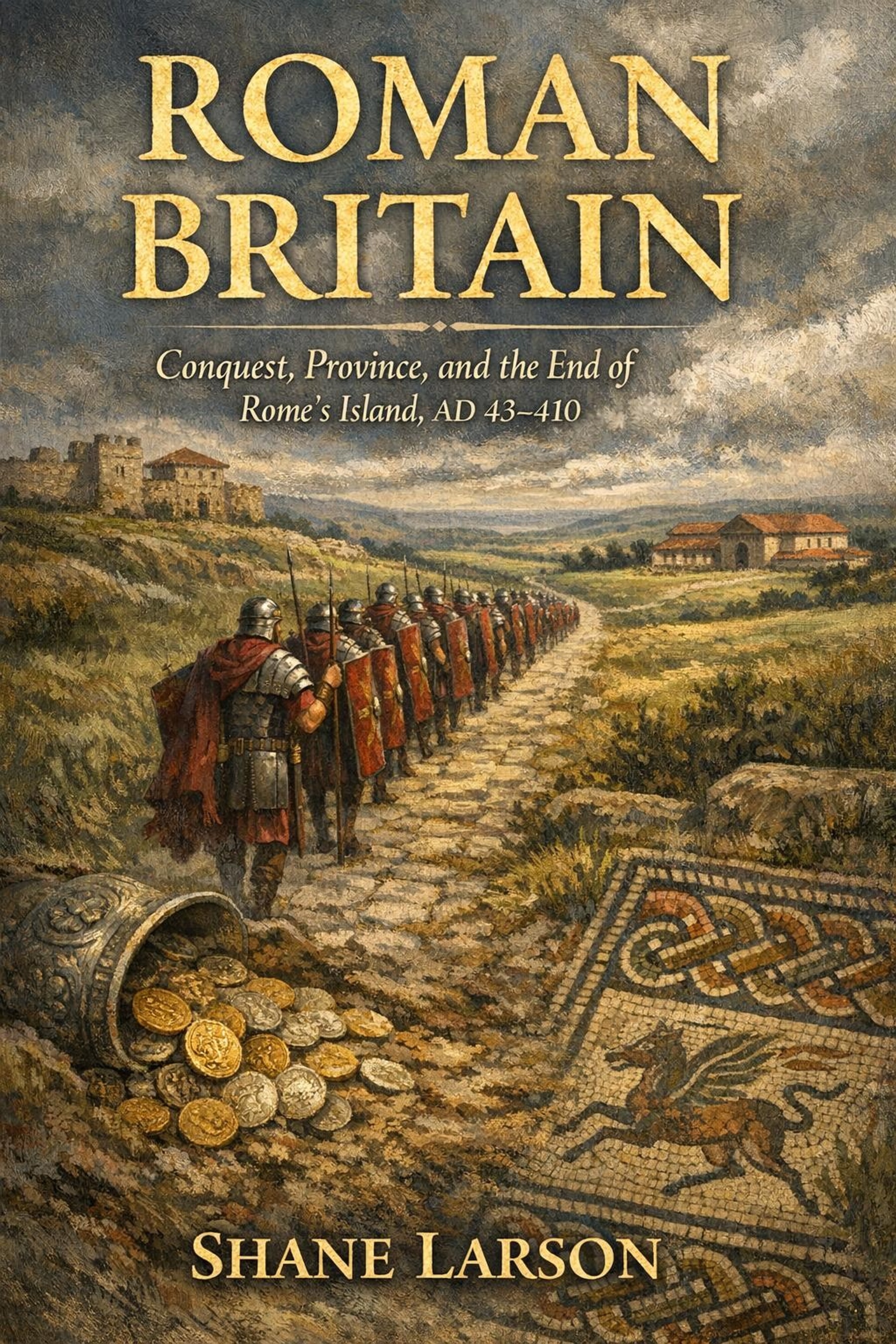
*Roman Britain: Conquest, Province, and the End of Rome's Island, AD 43–410* is a standalone history on the British shelf, picking up the province where *Boudica* leaves it in AD 61 and following it to the decade when the money stopped. It opens on the letter of 410 and the argument over where it was sent, and then tells the whole three and a half centuries, conquest to switching-off, with each chapter anchored to a site or an object that can still be seen and each contested point given as the debate it is.
Roman Britain
New posts and releases, straight to your inbox. No spam, unsubscribe anytime.