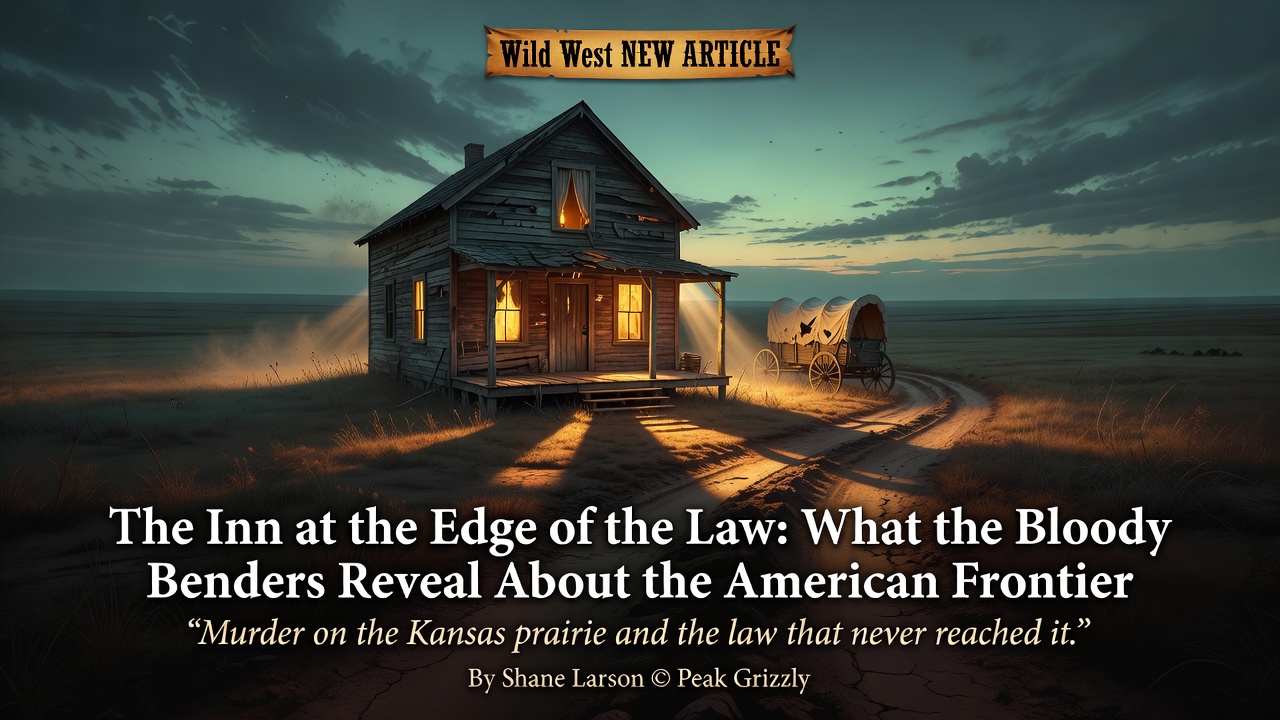
The Inn at the Edge of the Law: What the Bloody Benders Reveal About the American Frontier
July 5, 2026 · 7 min read
There is a particular kind of dread that belongs to empty country. Anyone who has driven a long, straight road across the American plains at dusk knows it — the sense of distance as a physical fact, the understanding that if something went wrong out here, it might be a very long time before anyone knew. In the 1870s, that distance was not a feeling. It was the law's actual reach. And on a low rise above a wagon trail in southeastern Kansas, a family named Bender built a business inside it.
The Bloody Benders are usually told as a horror story, and the raw facts certainly qualify. But the more time you spend with the documentary record, the more the case turns into something else: a study of how thin frontier justice really was, and how completely a determined predator could exploit the gaps. The murders are the surface. The blind spot is the subject.
A trail with no one watching
To understand the Benders, you first have to understand the country they chose. Post–Civil War Kansas was filling up fast. The Osage Diminished Reserve in the southeast had been opened to settlers, and homesteaders — many of them German and other recent immigrants — poured in to take claims. The land was good. The institutions were not yet there.
Consider what was missing. There was no statewide system for tracking people. No telegraphed bulletins for a missing traveler, no centralized record of who had passed through where. A man riding alone from one town to the next, carrying cash and maybe a good horse, existed in the eyes of the state only at his points of departure and arrival. The space between was unobserved. If he left Fort Scott and never reached his destination, the gap could stretch for weeks before anyone treated it as more than a delay. He might have changed his plans. He might have pushed on west. He might be anywhere.
This is the condition the Benders read correctly. Their victims were not careless people. They were ordinary travelers doing an ordinary thing — crossing open country alone — in a place where doing so made you, functionally, invisible.
Hospitality turned inside out
The frontier ran on a code, and the code was hospitality. Distances were too great and settlements too sparse for it to be otherwise. A traveler expected to find food and a roof at a wayside inn or a homesteader's cabin, and the people who lived along the trails expected to provide it, for a small price. Trust was not sentimental. It was infrastructure. The whole system of westward movement depended on the reasonable assumption that the cabin with the lamp in the window was a refuge.
The Benders inverted that assumption with chilling efficiency. They ran a combination store, inn, and eating house out of a single-room cabin, with a canvas wagon-cloth strung across the room to divide the living quarters from the dining area. A guest would be seated at the table with his back to that curtain — in the place of honor, the polite spot, the seat you'd give a respected visitor.
That detail is the moral center of the whole case, and it is why the story still unsettles people a century and a half later. The horror is not in the violence itself, which the best accounts handle with restraint. The horror is in the betrayal of the exact thing that was supposed to keep travelers safe. The seat of honor became the death seat. The refuge became the trap.
The daughter and the séance
The Bender household had four members, or appeared to: an older man who spoke little English; a woman known as "Ma," reputedly fierce and feared by neighbors; a younger man, John Jr.; and Kate, the daughter, who was something close to a local celebrity. Whether they were truly a family — or four unrelated people posing as one — was never established. Even their real names are uncertain.
Kate was the lure. She advertised herself as a spiritualist and healer, gave public lectures on séances, and offered to cure ailments and contact the dead. This was not as exotic as it sounds. The 1870s were the height of an American spiritualism craze; séances and mediums were ordinary parlor entertainment, and a charismatic young woman offering them would draw curious, paying visitors. What made Kate's act operationally useful was simple: it brought strangers to a remote cabin and gave them a reason to sit down and stay. The era's occult fashion became, in her hands, a marketing funnel.
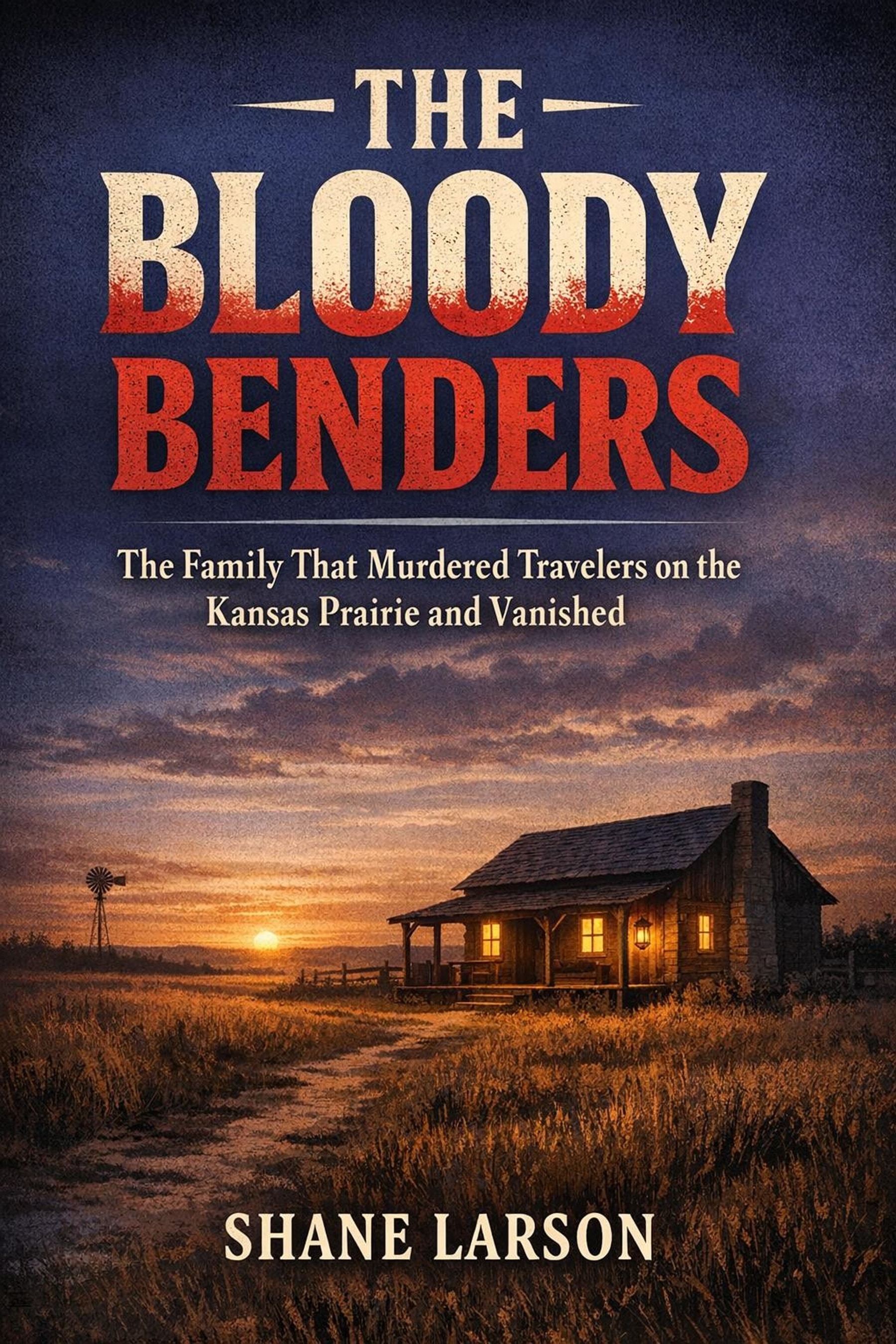
The Bloody Benders
The search that cracked it open
Isolated disappearances do not connect into a pattern on their own. Bodies turned up in creeks. Travelers were noted as overdue. Suspicion gathered slowly along the trail, the way it does when a place starts to feel dangerous without anyone being able to say why. But nothing forced the issue — until the wrong man went missing.
In March 1873, Dr. William Henry York, a respected physician from Fort Scott, set out alone and never arrived. Dr. York had brothers, and they were not people who could be ignored. One was a colonel. Another, Alexander York, was a Kansas state senator. When the search for one missing doctor came backed by that kind of standing, the machinery that had been absent for every earlier victim finally engaged. The senator's pressure is, in a real sense, the only reason we know the Bender story at all. It is also a quiet indictment: the system moved when a powerful family demanded it, and not before.
The York search led to a community meeting near the Bender claim. The family was calm. They denied everything. And then, within days, sensing the circle closing, they loaded a wagon and were gone.
The orchard
Neighbors noticed the abandoned cabin and the starving livestock before they noticed anything worse. When searchers finally examined the property in May 1873, they found bloodstains, a cellar beneath a trapdoor, and then — when they began to dig the apple orchard behind the house — the graves.
I'll keep the description where the documentary record keeps it: roughly a dozen bodies were recovered, including Dr. York. The exact toll was never fixed and never will be; serious estimates run from eleven to more than twenty. The discovery set off a national sensation. Newspapers carried the details coast to coast. Crowds descended on the site and stripped the cabin for souvenirs. And the Benders, decades before the modern vocabulary for such people existed, became the country's first widely publicized portrait of methodical, profit-driven murder done by a "family."
The ending that never came
Here is where the Bender case parts ways with the true crime we are used to. There is no capture. No trial of the actual killers. No verdict.
The Benders vanished into exactly the same blind spot they had exploited. Posses scoured the country. Vigilance committees formed. The governor of Kansas posted a reward. Rumor placed the family everywhere at once — fleeing south toward Texas and the Indian Territory, scattering across the West, killed quietly by a vigilante posse that kept its silence, or living out long lives under new names. In 1889, two women were arrested and brought back to Kansas to be tried as Ma and Kate Bender. The case against them collapsed for lack of identification, and they were released. Suspects surfaced as far away as Michigan. None of it ever held.
The honest position — the one the evidence actually supports — is that we do not know what became of the Benders, and almost certainly never will. The temptation in true crime is to force a resolution, to pick the most satisfying ending and present it as fact. The Bender case refuses that. Its open ending is not a flaw in the storytelling. It is the truest thing about it, because the same failure of reach that let the murders happen is the failure that let the killers escape. The blind spot closed over them exactly as it had closed over their victims.
Why the case still matters
It would be easy to file the Benders under frontier curiosities and move on. I don't think that's right. The case is a clean, terrible illustration of a pattern that keeps repeating wherever a new frontier opens faster than the institutions meant to police it. Predators find the gap. They operate in it, sometimes for years, precisely because the system cannot yet see them. By the time it can, they are gone, and what's left is rumor, legend, and a body count no one can agree on.
That's a frontier story, but it is not only a nineteenth-century one. It is the reason the Benders have stayed in the American imagination, retold in plays and ballads and a century of embellished legend, and it is the reason the case became the template for every "murder family" story that followed. The cabin is gone now. The trail is paved over. But the lesson it taught — slowly, and at a terrible cost — was that distance is not safety, and that a system which cannot see its people cannot protect them.
The Bloody Benders
New posts and releases, straight to your inbox. No spam, unsubscribe anytime.