
The Bloody Benders
The Family That Murdered Travelers on the Kansas Prairie and Vanished
By Shane Larson · The Wild West Series (Book 24)
About This Book
It is May of 1873, and the neighbors have finally come with shovels. The Bender cabin has stood empty for weeks — the family gone without a word, the livestock left to starve in the pen. Inside, the smell coming up through the floorboards is impossible to ignore. Someone pries up the planks over the cellar. Someone else notices that the soil in the apple orchard behind the house has been disturbed in long, regular depressions, like garden rows. By nightfall, the first body is out of the ground. Before the digging stops, there will be roughly a dozen more.
For two years, travelers had been disappearing along the Osage Mission Trail in Labette County, Kansas. Men rode out from Independence or Osage Mission with money in their coats and simply never reached the other end. The prairie was vast, the trail was dangerous, and a missing man could be explained a hundred ways — drowned at a river crossing, gone on to Texas, robbed by strangers. Nobody thought to look at the modest wayside inn where so many of them had stopped for a last meal.
This is the story of the Bloody Benders — America's first widely publicized serial-killer family, operating decades before anyone had words for what they were.
The Case
The Benders arrived in Kansas around 1870, four German immigrants staking claims on adjoining plots: an old man and his wife, a son, and a daughter named Kate. They built a single-room cabin, hung a canvas curtain across the middle of it, and opened for business — groceries in front, meals and lodging for travelers passing through. Kate became a minor local celebrity, advertising herself as a spiritualist healer, giving lectures, holding séances. She was young, magnetic, and fluent in English in a household where the others barely spoke it. She was also, by every reconstruction of the evidence, the bait.
The killing method was industrial in its consistency. A lone traveler — ideally one carrying cash, ideally one nobody expected anywhere soon — was seated at the table with his back to the curtain. Kate kept him talking. From behind the canvas came a hammer blow to the skull; a cut throat finished the work. The trapdoor beneath the table dropped the body into the cellar, and after dark it went into the orchard. Then the curtain was straightened, the table was reset, and the inn was open again.
The unraveling began when the wrong man vanished. Dr. William York disappeared on the trail in March 1873, and unlike the drifters and land-seekers before him, he had brothers with power — one of them a Kansas state senator. The search parties that fanned out across Labette County were persistent, organized, and impossible to wave off. One of them questioned the Benders directly. Days later, the family loaded a wagon and drove off the map. What the searchers found when they returned — the cellar, the orchard, the hammers, a little girl buried beside her murdered father — turned a county mystery into a national sensation.
Then history did something it almost never does with famous killers: it lost them. Posses rode in every direction. Vigilance committees swore oaths of silence about what they may or may not have done. The governor posted a reward. Over the following decades, suspected Benders were arrested in half a dozen states, and in 1889 two women were hauled back to Kansas for a trial that collapsed for lack of proof. The most notorious murder family on the frontier was never caught, never convicted, and never conclusively traced. The case remains open a century and a half later.
What You'll Discover
- Why the Osage Mission Trail was the perfect hunting ground — a corridor of solitary, cash-carrying strangers with no one tracking their progress
- The tangled identities of the four Benders, whose names, marriages, and blood relationships were likely fabrications from the start
- How Kate Bender's séances and healing lectures functioned as both cover story and victim pipeline
- The disappearance of Dr. William York, and how his senator brother's search finally put pressure on the cabin
- A grave-by-grave account of the orchard excavation, and why the final death toll — eleven? twenty? more? — can never be fixed
- The manhunt that followed: false arrests, imposter Benders, vigilante rumors, and the 1889 trial that ended in nothing
- What the Benders' clean escape exposes about law enforcement on the 1870s frontier, where jurisdiction ended at the county line and identity was whatever you claimed it was
Why I Wrote This
Most tellings of the Bender story reach immediately for the ghoulish details and stop there. What hooked me was the machinery around the murders — the fact that a family could kill travelers at a public inn, on a well-used trail, for two years, and the system around them was structurally incapable of noticing. No missing-persons databases, no identity records, no communication between counties. The Benders didn't outsmart the law; they operated in the spaces where the law simply didn't exist yet. And then, when discovery finally came, those same gaps swallowed them whole. I wanted to write the case as it actually stands in the documentary record — what's known, what's legend, and where the line between them sits — because the verified story is stranger than any of the embellishments.
Frequently Asked Questions
Is this fiction or nonfiction?
Nonfiction. This is a documented account of the Bender case built from contemporary newspaper coverage, court records, and the historical record, with clear flags wherever the sources conflict or later legend has crept into the story.
Were the Bloody Benders ever caught?
No — and that's central to the book. The family fled weeks before the graves were discovered, and despite nationwide manhunts, decades of arrests, and an 1889 trial of two suspected Bender women, no one was ever convicted. The book walks through every major theory about what happened to them, including the persistent rumor that a vigilante posse found them first.
How graphic is it?
The subject is dark, but the telling is restrained. The horror in this story comes from the method, the betrayal of hospitality, and the scale of what was found in the orchard — not from lingering on gore. If you read historical true crime for the investigation and the era rather than shock value, this is written for you.
Is this part of a series?
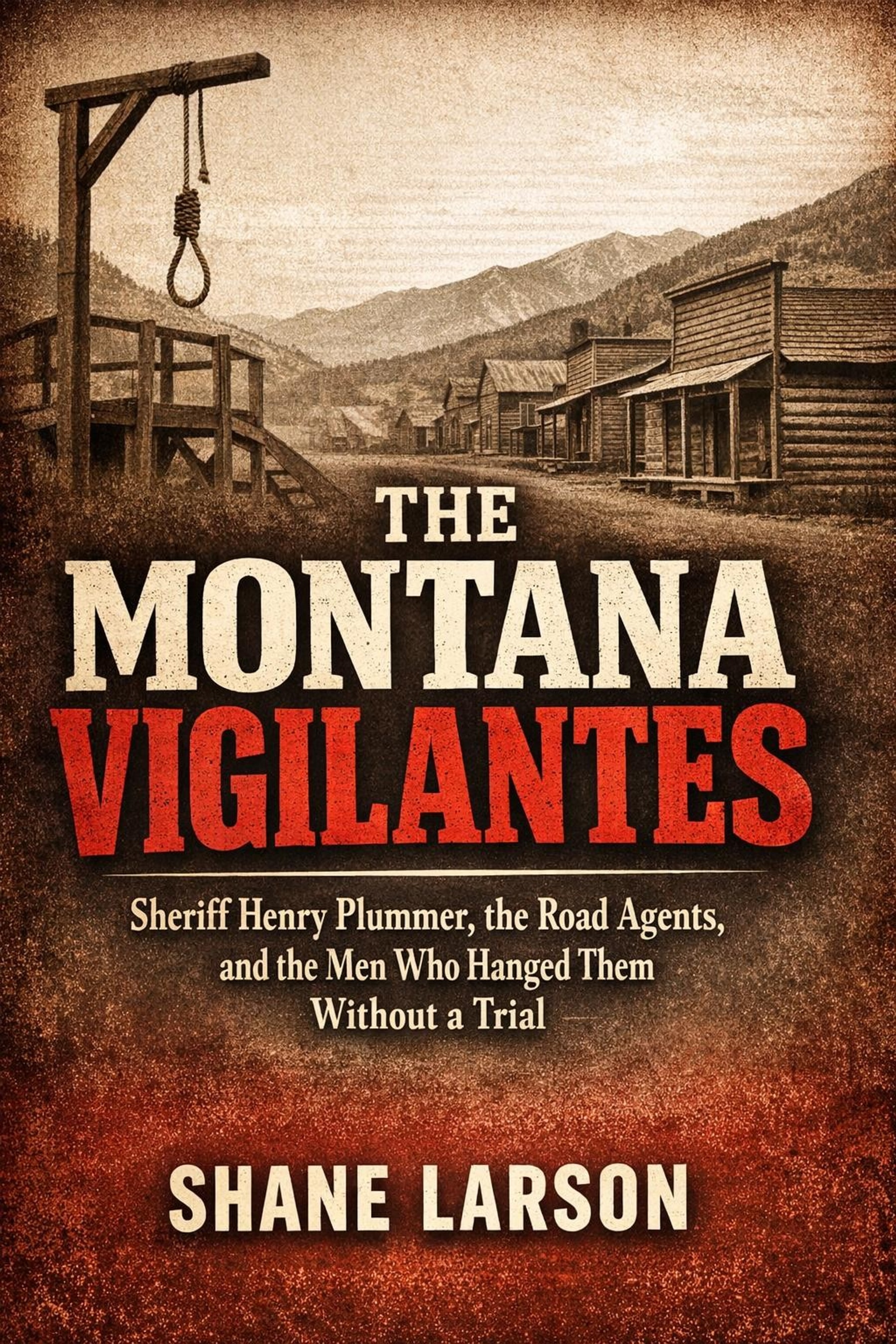
It belongs to Peak Grizzly's frontier true crime and Wild West history line, alongside books like The Harpe Brothers and The Montana Vigilantes. Each title stands completely on its own — there's no required reading order.
Is it available on Kindle Unlimited?
Yes. The ebook is enrolled in Kindle Unlimited, so subscribers can read it at no extra cost, and it's also available for purchase as a standalone ebook.
If You Liked This, You Might Like
- No Law Below the Pass — a frontier thriller set in the same lawless West the Benders exploited, where justice depends on who's willing to enforce it.
- Cahokia — the American prairie's other great vanishing: a city of thousands that emptied out and left the middle of the continent full of questions.
- Sea Peoples: Raiders of the Bronze Age — if the appeal here is a genuine historical cold case, this is the ancient world's version: destroyers who appeared, wrecked civilizations, and disappeared from the record.
Somewhere between eleven and twenty travelers sat down to dinner at a Kansas inn and never stood up. The family that killed them was never found. This is the full case — evidence, legend, and the open question at the end of it.
New Wild West / American Frontier History releases and free chapters — no spam, unsubscribe anytime.
More in The Wild West Series
View series →





















More in This Genre
View all →