Cannae: The Battle That Military Academies Have Studied for 2,200 Years
March 15, 2026 · 5 min read
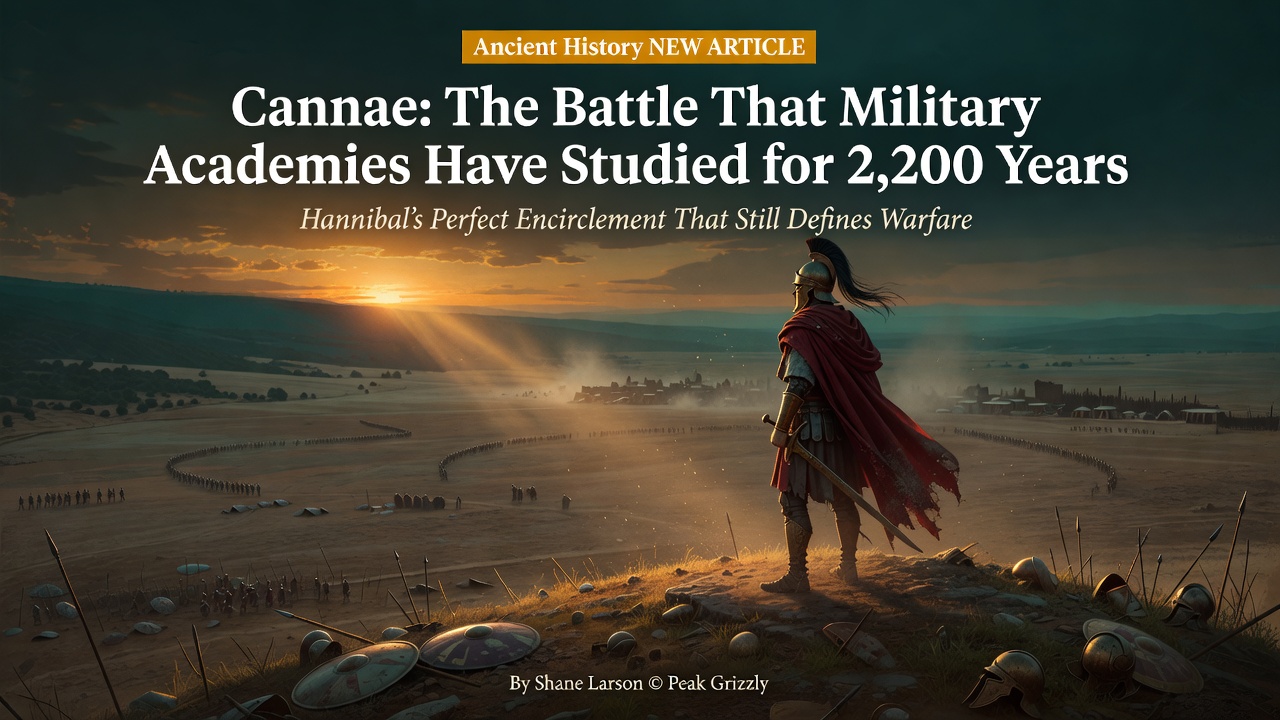
On August 2, 216 BC, somewhere between 50,000 and 70,000 Roman soldiers were killed in approximately eight hours. For perspective, the first day of the Somme in 1916 -- the bloodiest day in British Army history -- produced about 19,000 dead. Hannibal matched or exceeded that number with swords and spears, on a dusty plain in southern Italy, against the largest army Rome had ever assembled.
The Battle of Cannae is, by almost universal consensus, the most tactically perfect battle in recorded history. The German concept of Kesselschlacht -- the cauldron battle of encirclement and annihilation -- was directly inspired by it. The Schlieffen Plan of 1914 was explicitly modeled on it. Schwarzkopf's left hook in the 1991 Gulf War drew on the same principles. Every military academy in the Western world studies it.
What makes Cannae endlessly fascinating is not the concept -- encirclement is not a complicated idea -- but the execution. Hannibal pulled it off outnumbered nearly two to one, using troops of widely varying quality, against a disciplined and courageous enemy, on an open field with no terrain to help him.
He did it by understanding that Roman strength could be turned into Roman death.
The Trap Was the Roman Plan Itself
The Roman army at Cannae numbered roughly 86,000 men -- 80,000 infantry and 6,000 cavalry. It was the largest force Rome had ever fielded. The plan was simple and, by Roman standards, entirely reasonable: mass the infantry in unusually deep formations, narrow the gaps between units, and create a human battering ram that would push through Hannibal's center by sheer momentum. Quality and tactics were secondary. This was about physics.
Hannibal had approximately 50,000 men -- 40,000 infantry and 10,000 cavalry. He was outnumbered nearly two to one in infantry. But he held a decisive advantage in cavalry, and his 10,000 horsemen were qualitatively superior to anything Rome could field. More importantly, Hannibal understood exactly what the Romans would do, and he designed a counterplan that weaponized their own strategy against them.
The design had four interlocking components, and every one had to work in sequence.
First, his cavalry would destroy the Roman horsemen on both wings, then swing around to attack the Roman infantry from behind.
Second -- and this was the most dangerous element -- he placed his least reliable troops, Gallic and Spanish warriors, in the center, arranged in a convex arc bulging toward the Romans. When the Roman steamroller hit, these troops would fall back. Not in rout, but in controlled retreat. The convex arc would flatten, then bow inward, forming a concavity. The Romans, pressing forward eagerly, would follow -- pushing deeper and deeper into a pocket that was forming around them.
Third, Libyan heavy infantry stationed on the flanks -- Hannibal's best troops, many wearing captured Roman armor -- would pivot inward and attack the sides of the Roman formation as it pushed past them.
Fourth, the victorious cavalry would close the ring from behind.
Hannibal was asking his least reliable troops to perform the most demanding task in warfare: controlled retreat under overwhelming pressure from 80,000 men. If the Gauls and Spaniards broke and ran, the Romans would pour through and the plan would collapse. He bet the entire battle on their ability to bend without breaking.
Hannibal's War
Eight Hours in the Killing Pocket
The Gallic and Spanish center held. They fell back, fighting savagely, absorbing the full weight of the Roman advance while maintaining enough cohesion to keep the line intact. The Roman legions pressed forward, sensing the enemy giving way. The formations behind pushed forward too, adding weight. The entire Roman mass surged into the deepening pocket.
Then the Libyans struck from both flanks.
Polybius describes the effect: "The Libyans on each side, wheeling inward, delivered a charge on both flanks of the Roman army, which was now so wedged together that the men could not use their weapons."
The compression was the killer. The deep Roman formations -- designed to provide weight and momentum -- became a death trap. Soldiers in the interior couldn't reach the enemy. They couldn't swing their swords. They could barely raise their shields. Men who were killed couldn't fall down, held upright by the press of bodies around them.
When Hasdrubal's cavalry completed the ring from behind, it was over. What followed wasn't a battle. It was a slaughter that lasted hours. Hannibal's forces worked their way inward, methodically killing. Some Romans tried to dig holes with their swords and bury their faces, choosing suffocation over waiting for the blades. Eighty senators died. The consul Paullus was cut down fighting on foot. Between a quarter and a third of Rome's entire governing class was killed on a single afternoon.
Hannibal lost about 6,000 men -- mostly from the Gallic and Spanish center that had absorbed the Roman charge. The Libyan infantry and cavalry, which delivered the decisive blows, suffered relatively light casualties.
The Lesson That Still Resonates
After the battle, Hannibal's cavalry commander Maharbal urged him to march immediately on Rome. When Hannibal declined, Maharbal reportedly said: "You know how to gain a victory, Hannibal; you do not know how to use one."
The quote is almost certainly invented -- too perfectly constructed for a spontaneous battlefield remark. But the question it raises is real, and Hannibal's answer reveals something important about the limits of tactical brilliance.
Hannibal didn't march on Rome because his strategy had never been to capture the city. It was to destroy the alliance system that sustained Roman power. After Cannae, that strategy appeared to be working. Southern Italy was defecting. Philip of Macedon signed a treaty with Carthage. The alliance system was cracking.
He was wrong -- not because his analysis was faulty, but because he underestimated the one factor no amount of tactical genius could overcome: the Roman refusal to accept defeat. The Senate met in emergency session, and voices suggested negotiation for the first time in the war. But Rome did not negotiate. A state that had just lost a quarter of its Senate chose to keep fighting.
That is the deepest lesson of Cannae, and the reason it resonates beyond military history. It is not enough to be brilliant. It is not enough to execute perfectly. If your opponent's system can absorb your best shot and keep functioning, tactical perfection produces strategic stalemate.
Hannibal did not defeat the Roman army despite its size. He defeated it because of its size -- the deeper they pushed, the deeper they entered the trap. But he could not defeat the Roman system, which could raise new armies, absorb catastrophic losses, and simply refuse to admit that the war was over.
Cannae is the most studied battle in history not because it shows how to win, but because it shows that winning the battle and winning the war are fundamentally different problems.
Hannibal's War
New posts and releases, straight to your inbox. No spam, unsubscribe anytime.