The Cannon That Broke Constantinople Was Offered to the Defenders First. They Couldn't Afford It.
August 28, 2026 · 7 min read
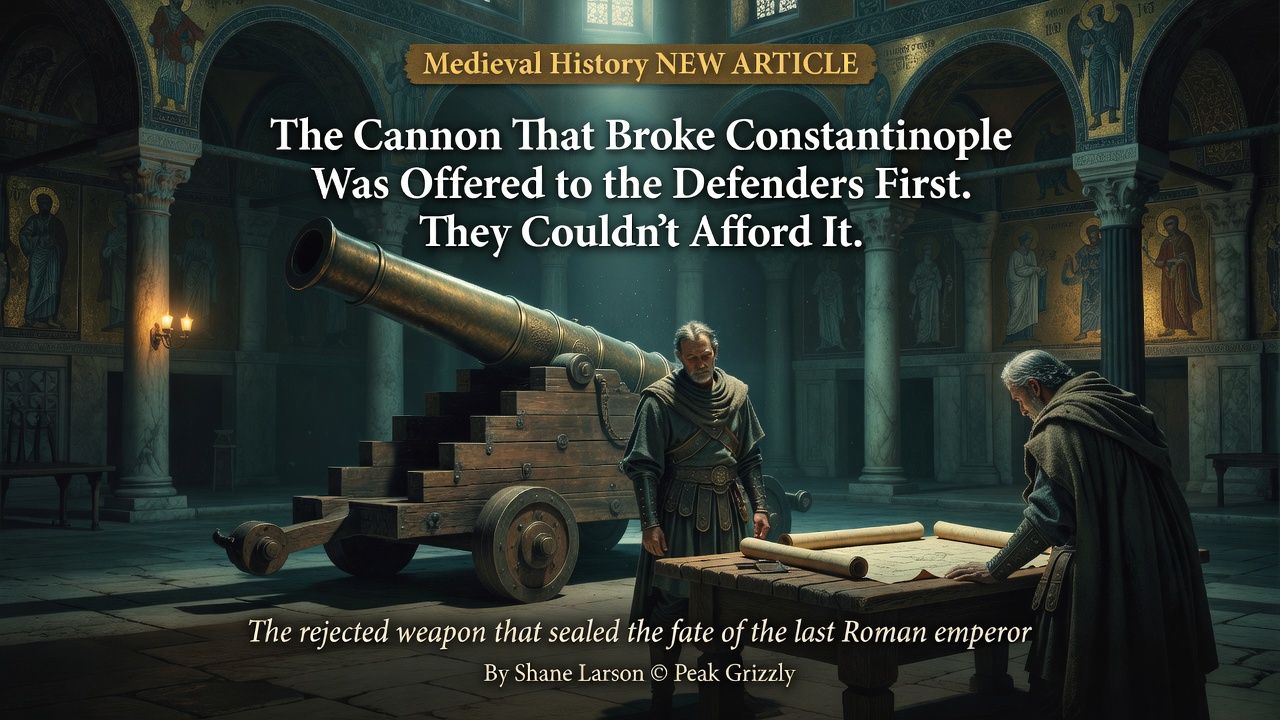
In the summer of 1452, a Hungarian engineer named Orban arrived in Constantinople with something to sell. He was a cannon founder — a specialist in the newest, most expensive, and least understood technology in the world — and he took his skills to the obvious customer first: the Roman emperor, Constantine XI, whose city was the most famous fortified position on earth and whose enemy was visibly preparing to attack it. Constantine interviewed him. Constantine wanted him. Constantine offered him a retainer so small it barely qualified as an insult, and then the treasury failed to pay even that.
So Orban walked. He crossed to Edirne and made the same offer to Mehmed II, the twenty-one-year-old Ottoman sultan, who asked him one question — could he build a gun capable of bringing down the walls of Constantinople? — and, on hearing yes, paid him four times what he had asked for and gave him every ounce of bronze he wanted.
Ten months later, the gun Orban built for the man who could pay was firing half-ton stone balls at the man who could not. The defenders of Constantinople spent fifty-three days being bombarded by a weapon they had already been offered.
It is the detail everyone repeats about the siege of 1453, and it deserves to be, because it compresses the whole event into a single transaction. The fall of Constantinople is usually told as a clash of armies. It is more honestly told as a procurement decision — and as the story of why one side had a budget and the other side had a legend.
The walls the gun was built to answer
To understand what Orban was selling, you have to understand what he was selling it against.
The Theodosian Walls had defended Constantinople's landward side since the early fifth century — a triple line running four miles from the Sea of Marmara to the Golden Horn. An attacker faced a moat, then an outer wall, then a raised terrace that turned the space between the walls into a killing ground, then an inner wall forty feet high studded with ninety-six towers. No besieging army had ever broken through them. The Avars failed in 626. The Arabs failed twice, in sieges that lasted years. Bulgars, Rus, rebel armies — for a thousand years, everything that came at those walls bounced off.
A thousand-year unbeaten record does something to military thinking. The walls were not just a defense; they were an assumption, on both sides. Byzantine strategy for centuries reduced, in the last resort, to get behind the walls and wait. Every attacker had to answer the same question — how do you get over, under, or through them? — and for a thousand years there was no answer.
Orban's pitch was that the question had changed. Height was the old wall's whole argument, and height meant nothing to a gun. A cannon did not need to climb the wall or tunnel under it; it needed only to hit the same stretch of masonry, again and again, until vertical stone did what vertical stone does under horizontal impact. The walls had been engineered, brilliantly, against every siege technology that existed when they were built. Orban was selling the technology that existed now.
The customer who couldn't pay
Why couldn't the Roman emperor afford the weapon his city's survival depended on? Because by 1452 the Roman Empire was an empire in roughly the sense that a retired boxer is a contender.
The real wound was two and a half centuries old. In 1204 the Fourth Crusade — a Christian army, nominally bound for Egypt — had sacked Constantinople, stripped it of its treasury and its relics, and ruled it for fifty-seven years. The empire that clawed its capital back in 1261 never recovered its tax base. By the 1450s it controlled little beyond the city itself, and the city was a shell: built for a million people, holding perhaps fifty thousand, with farmland inside the walls where neighborhoods used to be. Across the Golden Horn, the Genoese colony at Galata collected most of the customs revenue from the strait — foreign merchants, in sight of the palace, taking the money that should have funded the defense.
The Fall of Constantinople
So when Orban named his price, Constantine XI was not making a foolish decision. He was discovering that he had no decision to make. He understood exactly what was being offered — the sources are clear that he tried to keep Orban on a stipend, which is what you do when you cannot afford a thing and cannot afford to lose it either. The stipend went unpaid because there was nothing to pay it with. The emperor of the Romans had first refusal on the gun that would end the Roman Empire, and first refusal was worth nothing, because the empire had been bankrupted by its creditors and its co-religionists generations before Orban was born.
Mehmed, meanwhile, had the revenues of Anatolia and the Balkans behind him. The asymmetry of 1453 was never really seven thousand defenders against eighty thousand attackers. It was a state with a treasury against a city with a history.
What the gun actually did
Orban cast his masterpiece at Edirne that winter: a bronze bombard roughly twenty-seven feet long, with a bore a grown man could crouch in, throwing stone balls of over a thousand pounds. Getting it to Constantinople took sixty oxen, two hundred men, and a road crew working ahead of the convoy for a hundred and forty miles, leveling grades and reinforcing bridges for a load no road in Europe had been built to carry.
In action it was almost comically slow. The barrel had to cool between firings — the crews slathered it with oil — and it managed perhaps seven shots a day. It was inaccurate, exhausting to serve, and it eventually cracked under its own violence. A weapon this size was as much statement as instrument.
But seven shots a day, every day, for seven weeks, aimed at the same dip in the wall where the little Lycus river passed through the defenses, turned out to be enough. The rhythm of the siege became the rhythm of the gun: bombardment by day, and by night the defenders rebuilding the breaches with earth, timber, and rubble — a soft rampart that absorbed the shot better than the stone it replaced, and that had to be remade, by an exhausted and shrinking garrison, every single night for fifty-three days. The wall never exactly failed. The men did. When the final assault came before dawn on 29 May 1453, it broke through a defense stretched past its arithmetic — too few men, too many breaches, one commander wounded at the worst moment — and by that afternoon the Roman Empire, eleven hundred years after the West stopped counting it, was over.
The uncomfortable moral
It is tempting to file this story under great blunders, as if Constantine XI let the winning weapon slip through his fingers. That reading flatters us and misses the point. A defender's use for a twenty-seven-foot wall-smasher is limited; the real value of hiring Orban would have been denial — keeping the man and his skills out of Edirne. And even that was never available, because the choice had been foreclosed by the balance sheet. States do not fall the day the walls come down. They fall when they can no longer pay for the things their survival depends on, and then the walls come down later, as paperwork.
The technology was neutral. Orban was neutral — a craftsman selling his craft, first to the nearer buyer, then to the richer one. What 1453 demonstrates is not that gunpowder beat stone, though it did, permanently, and every fortress built afterward was built low and thick because of it. It demonstrates that a thousand-year reputation is not a line item. The walls had never lost. The treasury had already lost, and only one of those facts turned out to matter.
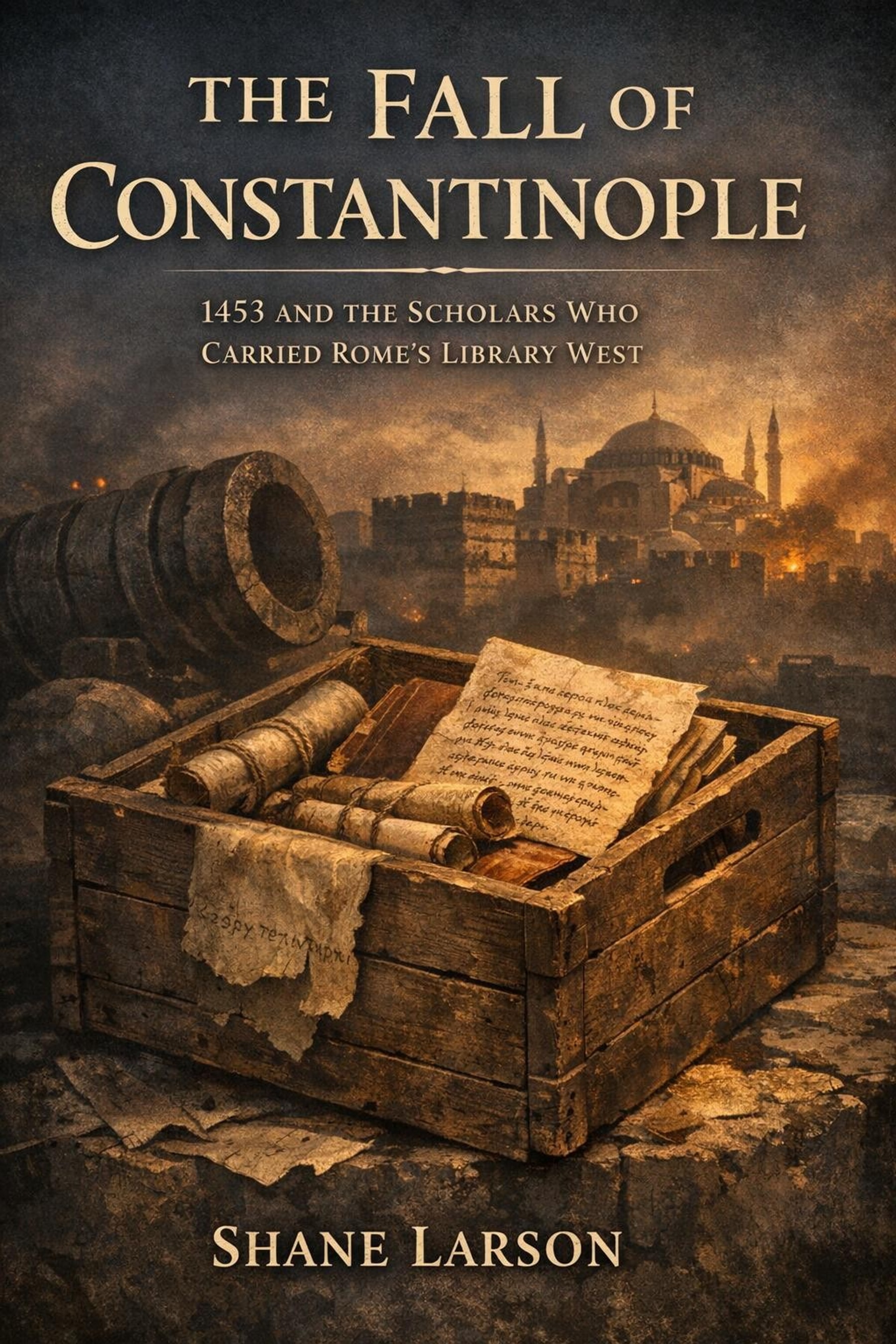
The siege is one half of the story I tell in my new book, The Fall of Constantinople: 1453 and the Scholars Who Carried Rome's Library West. The other half is the cargo — the scholars who read the situation correctly, some of them decades early, and carried Plato, Ptolemy, and Homer to Italy while the walls still held. The city fell; the library got out; the book follows both.
The Fall of Constantinople
New posts and releases, straight to your inbox. No spam, unsubscribe anytime.