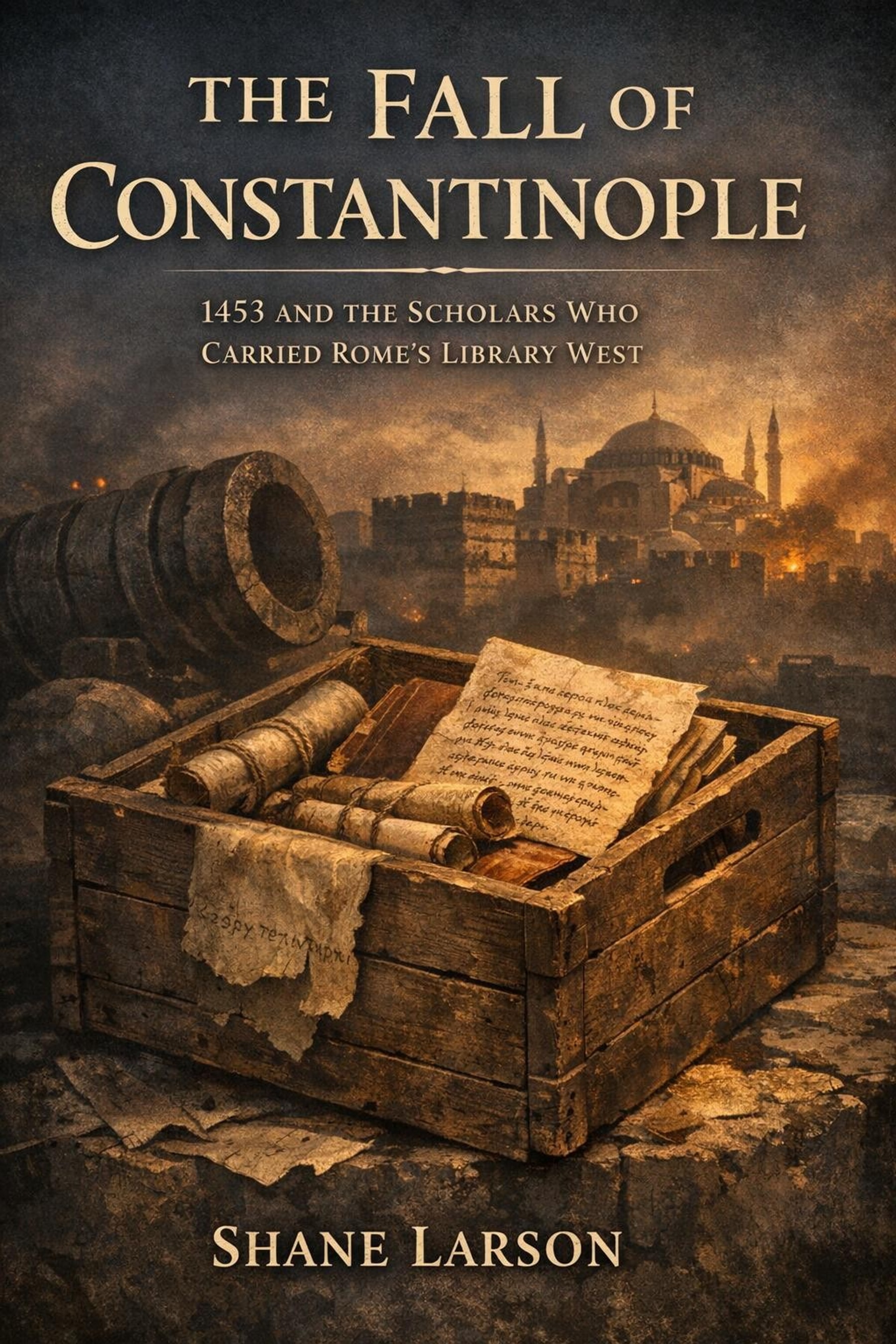
The Fall of Constantinople
1453 and the Scholars Who Carried Rome's Library West
By Shane Larson
About This Book
In 1397, a diplomat named Manuel Chrysoloras arrived in Florence and began teaching Greek. It does not sound like a historical event. But no one in Western Europe had been able to read the language for roughly seven hundred years — Plato existed there as two dialogues and a rumour, Homer as a name, Ptolemy's maps not at all. Chrysoloras's classroom was the first crack in that wall, and the Italians who sat in it taught the next generation of humanists.
He had come from Constantinople, and over the following decades others followed him down the same road — Plethon, Argyropoulos, Lascaris, and above all Cardinal Bessarion, who assembled the largest Greek library in the West and gave the whole of it to Venice, where it still sits in the Marciana. They came carrying manuscripts, and the strange thing about this evacuation is that it began fifty years before the disaster it anticipated. Most of the men who moved the books never lived to hear that the city had fallen.
The city they were leaving was not "Byzantium." Nobody who lived there ever heard the word; it was coined by a German scholar named Hieronymus Wolf in 1557, a century after the empire was gone. The people inside the walls called themselves Rhomaioi — Romans — and they had the credentials: an emperor in continuous succession, courts running on Roman law, a capital founded by Constantine himself. Restore that continuity and the events of May 1453 change size entirely. What the Ottoman guns brought down was not a leftover Greek principality. It was the Roman state, outliving its own famous "fall" by nearly a thousand years.
It was also a state that had already been killed once — and not by the Ottomans. In 1204 the Fourth Crusade, diverted by debt and opportunism, stormed and stripped the largest Christian city on earth, then occupied it for fifty-seven years. The empire recovered its capital in 1261 but never its tax base or its provinces. The Constantinople that Mehmed II surrounded had been built for a million people and held perhaps fifty thousand, with farmland inside the walls. The fatal wound was Christian, and it was two and a half centuries old.
Even so, the end was nearer-run than the odds suggest. A garrison of roughly seven thousand — Romans, Genoese, Venetians, Catalans, and one renegade Ottoman prince — stretched along a fourteen-mile perimeter against an army perhaps ten times its size, and it held for fifty-three days. What failed in the end was not the stonework but the numbers: no relief fleet, no reserves, a postern gate, and a wounded commander carried off the wall at the worst possible hour. This book gives the siege its full weight, then does what siege accounts almost never do: it follows the cargo, and asks honestly what the West's sudden ability to read Greek actually changed.
Why I Wrote This
I had already written the fall of Rome once — the 476 version, the western version — and the whole time I kept tripping over an inconvenient fact: the empire didn't stop. Half of it ran on for another thousand years, governed by people who called themselves Romans and had the paperwork to prove it. It felt like I had told half a story and let the textbook ending stand.
Two details finally made me commit. The first is that Orban offered his cannon to the defenders before he offered it to Mehmed — the losing side had first refusal on the gun that beat them, and turned it down over money. The second is that the scholars began leaving fifty years before the end, so the men who carried out the most consequential evacuation in European history mostly never saw the thing they were escaping. History rarely hands you material that clean.
Frequently Asked Questions
Did the Roman Empire really end in 1453 instead of 476?
That is the book's argument, and it makes the case rather than assuming it. What happened in 476 was the deposition of a western emperor; the eastern half of the same state carried on with Roman law, Roman offices, and an unbroken imperial succession for nearly a thousand more years. The people of Constantinople called themselves Romans, and the book takes them at their word.
Was the fall of Constantinople what caused the Renaissance?
No — and the book says so directly. The Italian Renaissance was well underway decades before 1453; Chrysoloras was teaching Greek in Florence in 1397. What the émigré scholars accomplished was transfer: they put the Greek language and hundreds of texts back into Western circulation faster and more completely than would otherwise have happened. The claim the book defends is acceleration, not causation.
How much of the book is the siege itself?
About a third. The siege of April and May 1453 is told day by day — the bombardment, the mining war, the naval actions, the portage, the final assault — but it sits between the thousand-year state and the manuscripts' journey west. The siege is the engine; the rest is what makes it matter.
Do I need to read The Fall of Rome or the other eastern Rome books first?
No. This book stands on its own and rebuilds everything it needs from the ground up. If you have read The Fall of Rome, Justinian and Theodora, or The Crusades, you will recognise threads being tied off, but none of them is homework.
How does the book handle the Ottoman side?
As protagonists with sources of their own, not as a faceless besieging force. Mehmed is drawn as a full character, his artillery programme and the overnight portage of his fleet are treated as the achievements they were, and the Ottoman chroniclers are used as evidence alongside the Italian and Greek eyewitnesses.
If You Liked This, You Might Like
- The Fall of Rome — the 476 half of the story; this book is the other bookend, and together they make one arc.
- The Crusades — includes 1204, the campaign that inflicted the wound this book's long decline begins from.
- Suleiman the Magnificent — the empire Mehmed remade, eighty years on and at the height of its power.
- The Library of Alexandria — the great library that was lost; this is the story of the one that got out.
Fifty-three days closed out eleven hundred years of empire. The books took the longer road — out of the city ahead of the guns, across the sea to Italy, and onto shelves where they are still being read. This is the account of both journeys.
What You'll Learn
- Where "Byzantine" came from — a scholar's coinage of 1557 — and how Gibbon and the Enlightenment turned it into a byword for decadence.
- The Fourth Crusade in full — the Venetian debt, the sack, the Latin occupation, and the plunder still on public display in Venice — placed at the centre of the empire's death.
- The union of the churches: what Rome demanded in exchange for military help, why the city refused the bargain its own emperor had signed, and whether that refusal was principle or suicide.
- Mehmed II at twenty-one — twice enthroned, once deposed, discounted by his own viziers — and the fortress he raised in a single building season to cut the city's grain route.
- The bombard: cast in bronze at Edirne, twenty-seven feet long, dragged behind sixty oxen, and capable of seven shots a day — each one an argument against vertical stone.
- The siege in close focus: Serbian miners tunnelling under the walls and the German engineer who hunted them, four ships fighting into the harbour, and a fleet crossing a ridge of dry land in a single night.
- 29 May itself — three assault waves, an unbarred gate, a wounded captain's withdrawal, and an emperor last seen at the breach whose body was never identified.
- The sultan's city afterwards: the repopulation policy, the patriarch he personally installed, and the Ottoman claim to Rome's own succession, taken seriously rather than laughed off.
- What the Latin West could suddenly read — Plato entire, Homer in Greek, Ptolemy, Archimedes, the Greek New Testament — and a plain answer to the counterfactual of how much would have arrived anyway.
Included with Kindle Unlimited — read it free if you're a member.
New Medieval History releases and free chapters — no spam, unsubscribe anytime.