Christian Kings Didn't Conquer Muslim Spain. For a Century, They Taxed It.
September 2, 2026 · 6 min read
The received story of medieval Spain is a long war: Muslim south, Christian north, and centuries of fighting until the north wins. Pick up the records of the eleventh century — the century of El Cid, supposedly the heart of that struggle — and something is off. The frontier's main product in those decades was not conquest. It was invoices. Gold moved north from Muslim treasuries to Christian ones on an annual schedule, was entered in wills and charters as ordinary income, and was fought over by Christian heirs the way heirs fight over any inheritance. For roughly seventy years, the Christian kingdoms of Spain did not primarily try to destroy the Muslim states to their south. They ran them as a revenue base.
Follow that money and the standard picture of the period does not survive.
Two dozen rich states with no army worth the name
The arrangement became possible in 1031, when the caliphate of Cordoba — for a century the dominant power of the western Mediterranean — collapsed into civil war and was formally abolished by its own city notables. What replaced it was fragmentation: some two dozen successor statelets, the taifas, centered on cities like Seville, Zaragoza, Toledo, and Granada.
The taifas were rich. They held the irrigated valleys, the cities, the craft industries, the Mediterranean trade, and — critically — the minting of gold coin, which the Christian north could not do at all. Their courts competed in poetry and astronomy the way later princes would compete in palaces. What they did not have was military weight. Two dozen small states, each watching its neighbors, could not field what the unified caliphate had fielded.
North of them sat kingdoms with the opposite balance sheet: León, Castile, Aragon, Navarre — poor, thinly populated, and organized for war. A soldier looking at that map sees a conquest waiting to happen. An accountant sees something better.
The protection business
The accountants won. The system the Christian kings built is known by the term the documents use: parias — regular tribute, paid in gold, by a Muslim ruler to a Christian one, in exchange for protection. Protection from other Christian kings, from other taifas, and, with a straight face, from the collector himself.
Fernando I of León-Castile turned it into an institution. By the end of his reign he was drawing parias from Zaragoza, Toledo, Badajoz, and Seville — most of the major taifas — and when he divided his realm among his three sons in 1063, he divided the tribute streams with it: one son took Castile with the Zaragoza parias attached, another León with Toledo's, the third Galicia with Badajoz and Seville's. That detail is worth pausing on. Tribute was not booty from a raid. It was treated as permanent crown revenue, assignable and heritable, like a province or a toll.
The logic was cold and sound. A conquered city has to be garrisoned, administered, and — hardest of all in the thinly peopled north — settled. A taxed city administers itself, keeps its own economy running, and remits. The eleventh-century Christian kingdoms lacked the population to hold and work the great cities of the south even if they could take them. Taxing al-Andalus was not a failure to conquer it. It was the more profitable option, chosen deliberately, decade after decade.
Where the gold went
The gold did not sit in chests. It hit an economy that had almost none of its own — Latin Christendom in this period minted essentially no gold and ran on silver — and the effects are visible in stone.
Land documents from León in these decades price transactions in mithqals, that is, in Muslim gold dinars: the coin of al-Andalus circulating as money of account deep inside a Christian kingdom. Fernando I used part of the flow to endow an annual payment to the abbey of Cluny in Burgundy, the most influential monastic house in Europe; his son Alfonso VI doubled it, to two thousand gold pieces a year, and sent extraordinary gifts on top. Cluny's third abbey church — begun in 1088, and for over four centuries the largest church in Christendom — rose in those exact years, with the Spanish payments among its largest funding sources. Closer to home, Fernando and his queen rebuilt San Isidoro in León as a royal burial church, and the pilgrimage road to Santiago de Compostela acquired the chain of Romanesque churches that still stands along it.
Al-Andalus
Put plainly: a substantial share of the great Romanesque building boom of the late eleventh century — in Spain and beyond the Pyrenees — was paid for with taifa gold, collected as protection money by Christian kings from Muslim states they had decided not to conquer.
What the evidence is actually worth
An honest account has to say where these numbers come from. The specific figures — how many dinars Zaragoza owed in a given year, what Seville paid — come from chronicles and charters, and no individual figure can be independently checked. Medieval chroniclers rounded, exaggerated, and copied one another, and a stated sum should be read as an order of magnitude, not an audited total.
But the aggregate does not rest on any single number. The gold itself corroborates it: Andalusi coin circulating in the north, northern documents denominated in dinars, and eventually Christian kings striking gold imitations of Muslim coinage because that was the money their subjects trusted. Cluny's own records corroborate the Spanish payments. And the building boom is standing corroboration — the money that raised those churches came from somewhere, and the north's own economy could not have supplied it. The individual invoices are beyond checking. The flow is not.
The collector in the legend
This is the world that makes sense of El Cid. Rodrigo Díaz de Vivar enters the documentary record not as a holy warrior but as a functionary of the system: the quarrel that got him exiled from Castile grew out of a mission collecting the Seville tribute for Alfonso VI. Exiled, he did what a first-rate commander in a mercenary century did — took service with the highest bidder, who happened to be the Muslim emir of Zaragoza. For years, Spain's future national hero drew a salary from a Muslim treasury and led armies against Christian Aragon, among others, on his employer's behalf. Nobody at the time found this remarkable. It only became embarrassing centuries later, when the poem and then the national myth needed him to have been fighting for the cross all along.
The system ate itself
The parias century ended because the system worked too well. To pay the tribute, taifa kings squeezed their own subjects with taxes their own religious scholars condemned as unlawful, bleeding away their legitimacy along with their gold. Alfonso VI squeezed Toledo hardest of all, and in 1085 the exhausted city passed into his hands almost without a fight — at which point every other taifa ruler could read his own future, and several made the desperate choice to invite in the Almoravids, a militant Berber movement from North Africa. The Almoravids defeated Alfonso in the field in 1086, then stayed, annexing the taifas one by one. The gold stopped. The frontier hardened into something much closer to the war the later legend describes — and the word most people now reach for, Reconquista, is scarce in the medieval sources themselves and owes its career mostly to historians writing centuries afterward. The eleventh-century documents talk about tribute.
For about seventy years, the most important thing crossing the frontier of medieval Spain was not an army. It was an invoice, and the receipts are built into the churches of the north.
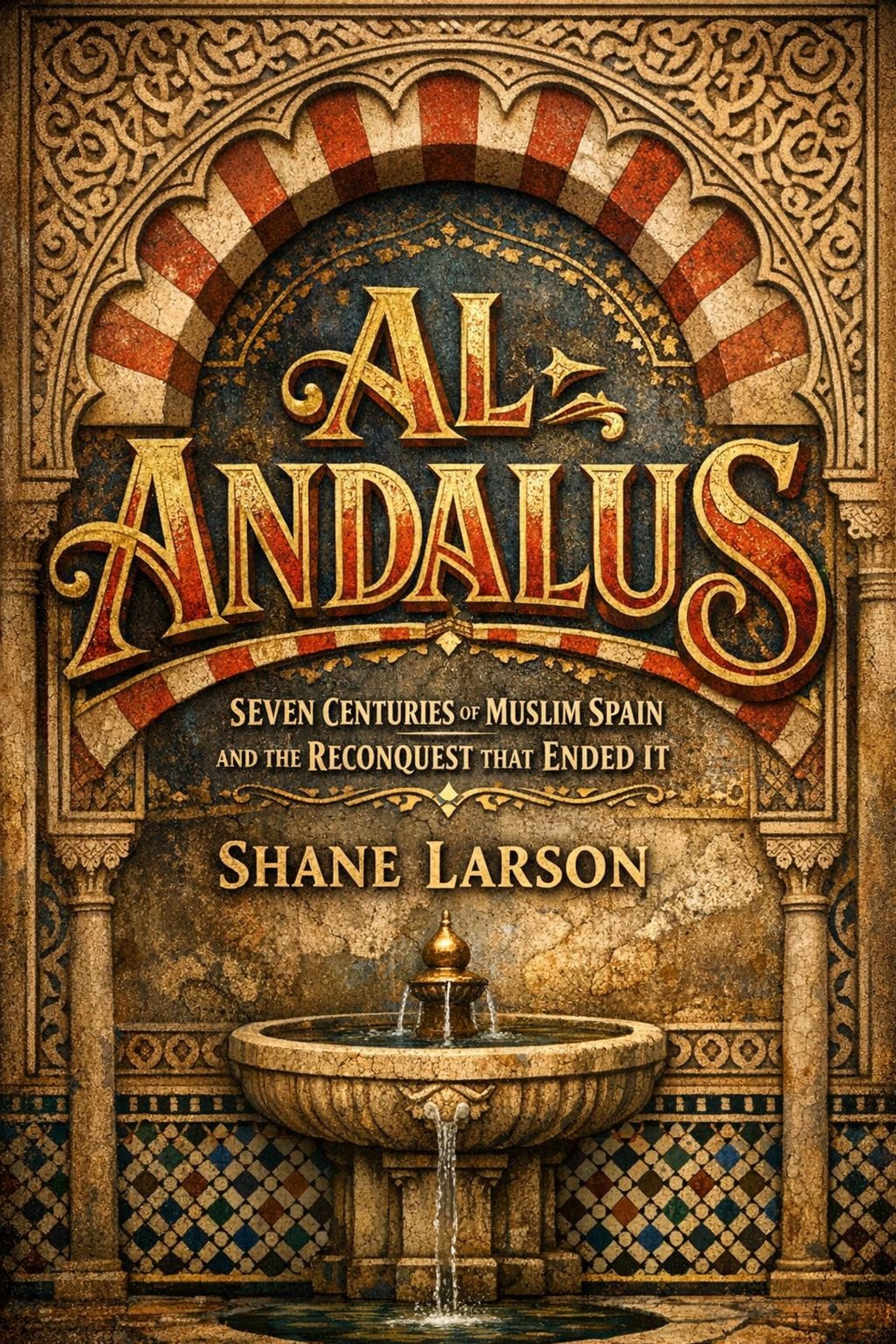
That century is one stretch of a much longer story — seven hundred and eighty years of it, from the landing at Gibraltar in 711 to the surrender of Granada in 1492 and what followed. I tell the whole span as one continuous story, ledgers and all, in Al-Andalus: Seven Centuries of Muslim Spain and the Reconquest That Ended It. If the tribute system surprised you, the rest of the evidence is stranger still.
Al-Andalus
New posts and releases, straight to your inbox. No spam, unsubscribe anytime.