Al-Andalus
Seven Centuries of Muslim Spain and the Reconquest That Ended It
By Shane Larson
About This Book
On the second morning of January 1492, a small mounted party came down from a hilltop palace above Granada and stopped before two waiting monarchs. The last Muslim ruler on the Iberian Peninsula — a young emir the Castilians called Boabdil — handed over the keys to the Alhambra. The paperwork was generous: his former subjects were guaranteed their religion, their mosques, their law, their property, and freedom from forced conversion. Within a decade nearly every clause had been voided — Arabic books burned in a public square, baptisms compelled, a revolt in the old quarter used as the pretext to declare the whole agreement dead.
What ended with those keys had begun 781 years earlier, when a Berber commander crossed the strait from Africa and gave his name to the mountain where he landed — Jabal Tariq, Gibraltar. In between lies one of the longest and strangest stories in European history: al-Andalus, the Muslim-ruled society that at its height made Cordoba the greatest city west of Constantinople, produced philosophers Latin Europe spent centuries arguing about, and then contracted, kingdom by kingdom, until only Granada was left.
Almost no one tells that story straight. It usually arrives pre-shaped into one of two molds, and this book was written because both molds are wrong.
The first account holds that medieval Muslim Spain was a lost paradise of interfaith harmony, destroyed by intolerance from the north. The second holds the mirror image: an eight-century occupation, heroically undone. Each was assembled long after the fact to win arguments of its own, and each collapses against what the treaties, tax rolls, charters, and chronicles actually record.
What they record is a peninsula run on arrangements rather than principles. Hasdai ibn Shaprut, a Jewish physician, conducted the caliphate's diplomacy for two rulers of Cordoba. A century later Samuel ibn Naghrillah served as vizier of Muslim Granada and led its armies in the field — and a generation after that, the same city murdered its Jewish community in a single day. Christian kings of the eleventh century found it more profitable to invoice the Muslim successor states than to invade them, and the protection payments, called parias, financed church-building across the north. Whatever that world was, it was neither a harmony nor a holy war. It was politics, conducted by people who read their interests faster than their theologies.
The book follows the full span as a single narrative, carried by its people rather than by dynasties: the fugitive Umayyad prince who built a state out of homesickness for Damascus; the judge of Cordoba who explained Aristotle so clearly that Paris tried to ban him; the tributary kings of Granada who kept a doomed emirate alive for two and a half centuries by paying, marrying, and playing their neighbors against each other. It ends where the arrangements ended — expulsion, forced conversion, and the long unravelling that followed 1492.
What's Inside
- Cordoba measured, not mythologized. The aqueducts, paved streets, paper mills, and markets of Europe's largest city — including an honest accounting of the famous 400,000-volume library figure and what the evidence will actually support.
- How minority status really worked. The dhimma system in practice: the tax, the communal courts, the autonomy, the periodic violence — and the strange episode of the Cordoba martyrs, Christians who sought execution on purpose while their own bishops tried to stop them.
- The century when everyone fought everyone. The taifa courts competing in poetry and astronomy, the tribute economics that inverted the military balance, and El Cid's real career set against the national legend built from it.
- Toledo, 1085 — the conquest that mattered most. How a city taken without a battle became the translation workshop where Gerard of Cremona and his colleagues moved Aristotle, Euclid, Ptolemy, and Ibn Sina into Latin, seeding Europe's first universities.
- The hardening. The Almoravid and Almohad invasions from Africa, the end of protected status in the south, the flight of Maimonides' family — and the military orders and crusading rhetoric rising north of the frontier in the same generation.
- Granada's long survival. How a mountain emirate lasted 250 years as a tributary state, and the Alhambra as what it actually is — a fortified palace-city whose walls carry their own commentary.
- The ending, told plainly. The 1491 surrender terms in detail, the decade in which they were dismantled, the expulsions of 1492 and 1609, and the purity-of-blood statutes that turned a religious test into a hereditary one.
Why I Wrote This
The Mezquita of Cordoba did it. There is a full Renaissance cathedral standing inside it — not beside it, inside it — planted in the middle of a thousand-year-old forest of striped horseshoe arches. No other building states the problem of this history so bluntly: neither layer erased the other, and you cannot look at either one honestly while pretending the other is not there. Then I started reading, and found the books split into two camps that had examined the same treaties and tax records and come away with opposite verdicts, both suspiciously convenient. I had just finished writing about the translation movement in Baghdad for The House of Wisdom, and kept finding the same manuscripts surfacing at the other end of the Mediterranean, in Toledo, moving north. This book is the western half of that story — with a much harder ending — and my attempt to tell it without joining either camp.
Frequently Asked Questions
Does this book side with the golden-age view or the national-reconquest view of medieval Spain?
Neither, and that refusal is the book's actual argument. Both frameworks were constructed centuries after the events — the conclusion traces when each term entered historiography and what work it was built to do, stopping in the mid-twentieth century. In place of a verdict, it describes the actual arrangements century by century and lets the reader watch them shift.
Is this a good book to read before visiting the Alhambra or the Mezquita in Cordoba?
Yes — that reader was in mind throughout. The Mezquita's construction, expansions, and conversion into a cathedral run through the whole narrative, and a full chapter treats the Alhambra as the fortified city it is, including what its wall inscriptions say. It is a history rather than a guidebook — the story behind the monuments.
Do I need any background in medieval or Islamic history to read it?
No. Every term — dhimmi, taifa, parias, Morisco — is explained when it first appears, and the narrative is carried by individual people rather than by dynastic tables.
Does the book quote the original Arabic, Hebrew, and Latin sources?
It paraphrases them. The content of the key documents — the Treaty of Tudmir, the Granada capitulations, the palace inscriptions — is worked into the narrative in my own words rather than block-quoted from modern translations.
How does it connect to The House of Wisdom and the other medieval titles?
It is the western half of the story The House of Wisdom tells in Baghdad — the same Greek and Arabic learning, transmitted this time through Toledo into Latin Europe, with a very different ending. Each book stands entirely on its own; together they cover the whole arc.
Does it cover what happened after 1492?
Yes, at length. The final chapter runs past the fall of Granada through the expulsion of the Jews, the forced conversions, the Morisco revolts, and the final expulsion of 1609–1614. The surrender was the beginning of the ending, not the end of it.
If You Liked This, You Might Like
- The Crusades: Two Centuries of Holy War Between Christendom and Islam — the same religious frontier seen from its eastern theater, where the crusading movement that reshaped Iberia's wars was born.
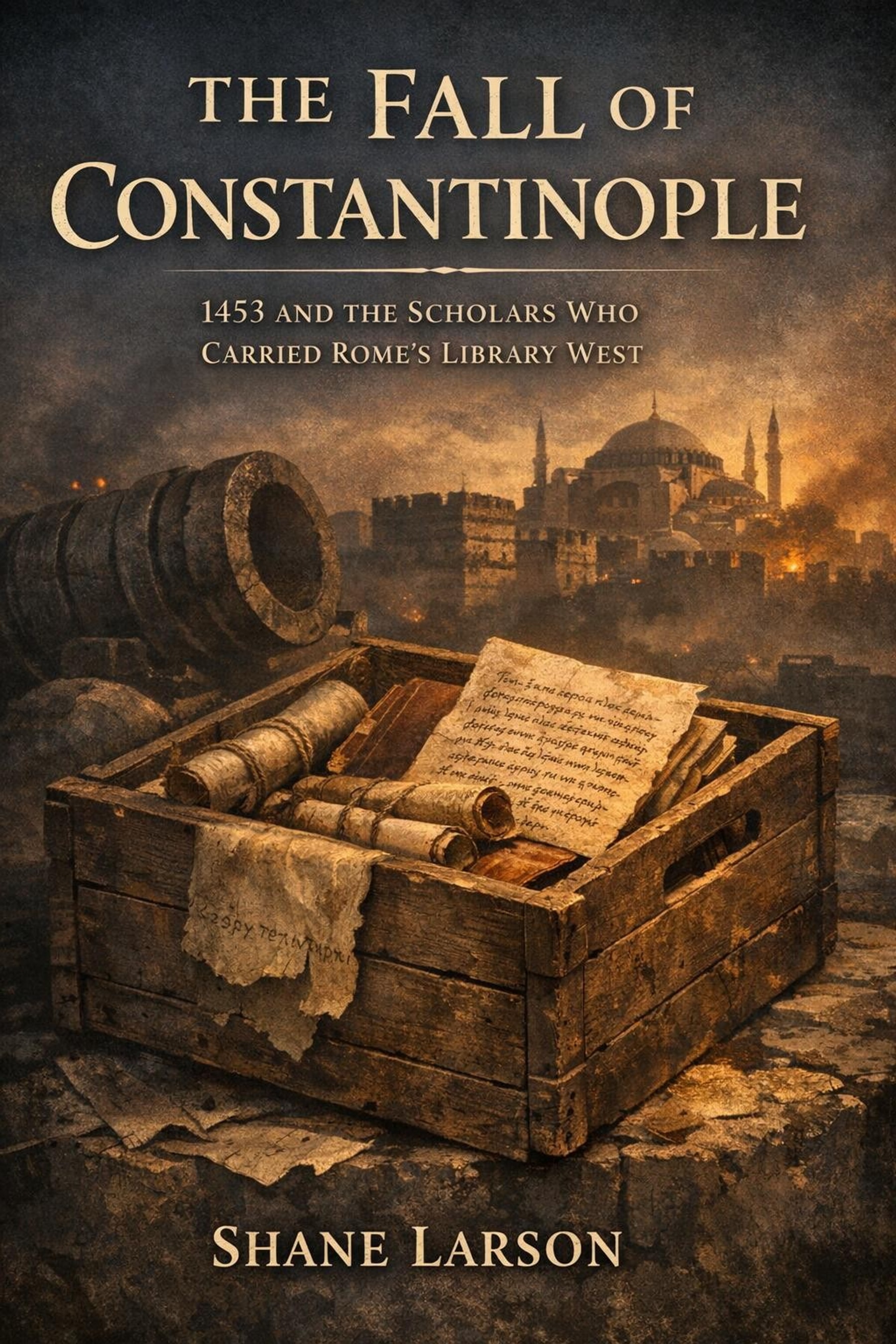
- The Fall of Constantinople: 1453 and the Scholars Who Carried Rome's Library West — the other great channel by which classical learning reached Europe, forty years before Granada's keys changed hands.
- The Conquistadors' Smallpox War: How Disease, Not Steel, Conquered the New World — what the kingdom that took Granada did next, beginning with a voyage funded the same year.
Seven hundred and eighty-one years separate a landing on a mountain from a handover of keys, and no slogan invented afterward fits what happened in between. Here is that span told whole, with the verdict left to you.
What You'll Learn
- Why the Visigothic kingdom fell in four years — and why the speed points to treaties, not sieges
- What a Jewish merchant, a Christian farmer, and a Muslim judge each actually faced under the caliphate
- How the tribute system worked — Christian kings taxing Muslim states instead of conquering them
- El Cid's documented career, and how far it sits from the legend built centuries later
- How the translation workshops of Toledo carried Greek and Arabic science into Latin Europe
- How Granada survived as a tributary kingdom for 250 years — and why it fell in ten
- What followed 1492: the broken guarantees, the forced conversions, and the expulsions of 1492 and 1609
Included with Kindle Unlimited — read it free if you're a member.
New Medieval History releases and free chapters — no spam, unsubscribe anytime.