The Sewer That Made the Roman Republic Possible
August 7, 2026 · 7 min read
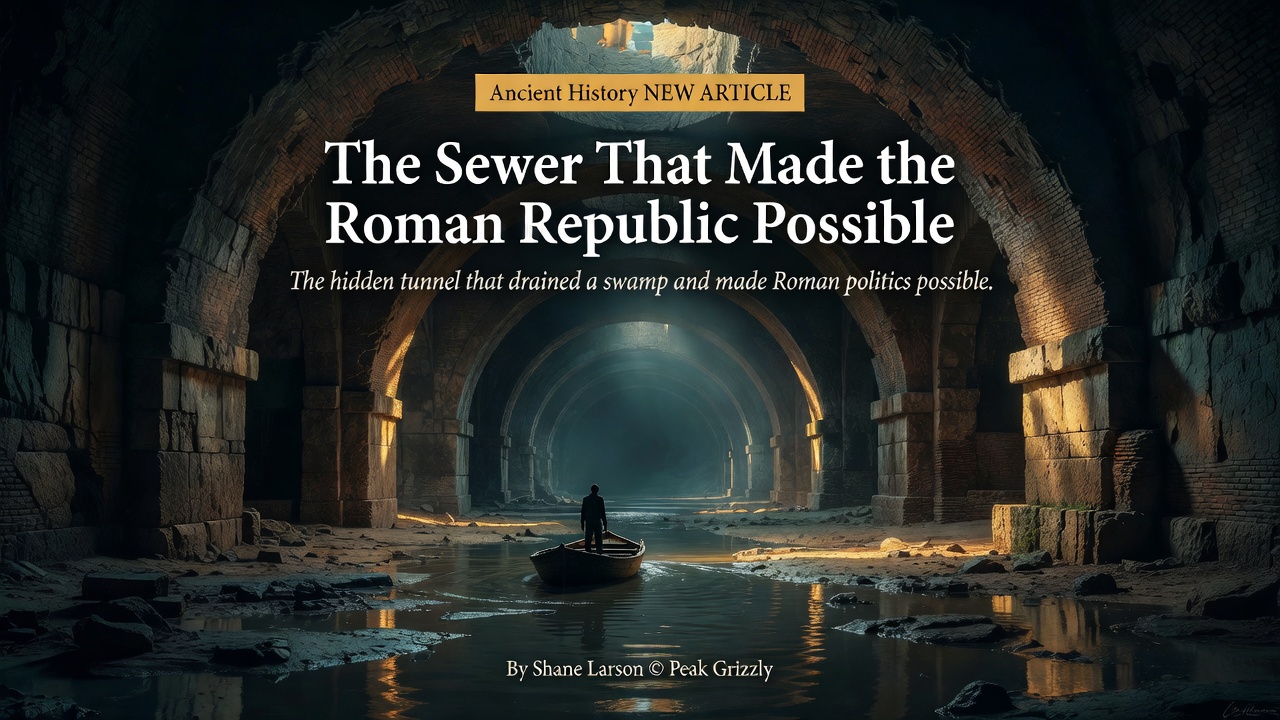
In 33 BC, one of the most powerful men in the Roman world got into a boat and went underground. Marcus Agrippa — Augustus's general, admiral, and fixer — had taken on the job of overhauling Rome's infrastructure, and the report that survives says he inspected the city's sewers by sailing through them, riding the channels beneath the streets all the way out to the Tiber.
The tunnel he floated down was already about five hundred years old. It had been built by kings, and Rome had spent those five centuries insisting that kings were the worst thing that ever happened to it. Nobody proposed filling the tunnel in. They couldn't. Everything above it depended on it.
That tunnel is the Cloaca Maxima — literally the "greatest drain" — and there is a serious argument that it is the most consequential structure Rome ever built. Not the Colosseum, not the aqueducts, not the roads. A sewer. Because before the Cloaca Maxima existed, the Roman Forum was a swamp, and a city whose central valley is a swamp cannot have a center. And a particular kind of politics — the kind the Roman Republic ran on for five hundred years — turns out to need one.
The swamp between the hills
Picture Rome around 700 BC and delete almost everything. No marble, no temples, no pavement. What you have is a handful of hill villages: clusters of oval thatched huts on the Palatine, the Capitoline, the Quirinal, each hilltop its own little world of a few hundred people. Archaeologists have found the postholes of those huts cut into the Palatine rock, and they are as humble as architecture gets.
Between the hills lay the problem. The valley that would become the Forum is a low trough of ground, barely above the level of the Tiber a few hundred yards away. A stream wandered through it, fed by runoff from the surrounding slopes, and the drainage was miserable. When the river rose — and the Tiber rose violently, and often — water backed up into the valley and stood there for days. For months of the year the future political center of the Mediterranean world was sedge, mud, and standing water. The early Romans used it for the one thing waterlogged ground is good for: they buried their dead in it. Under the pavement of the Forum, excavators found a cemetery.
That geography matters more than it looks. A collection of hill villages is not a city, in the same way that a collection of neighbors is not a household. What separated Rome's villages was not distance — you could shout across it — but a strip of ground nobody could build on, assemble on, or reliably even walk across. As long as the valley stayed wet, "Rome" was plural.
An engineering answer from across the river
The Roman tradition credits the fix to the Tarquin kings — the dynasty founded by an immigrant from the Etruscan city of Tarquinii — and for once the tradition, the engineering, and the dirt all point the same direction. The Etruscans were the acknowledged hydraulic engineers of ancient Italy. Their homeland north of the Tiber is riddled with drainage cuttings and water tunnels, and managing wet ground was a skill they demonstrably had and the Latin hill villages demonstrably lacked.
What the Tarquins' engineers did was straightforward in concept and enormous in labor. They took the meandering stream and forced it into a straight, built channel — at first an open canal, only later vaulted over in stone — running the length of the valley and out to the river. They filled and graded the marshy trough. And the archaeology puts a date on the payoff: around 625 BC, the valley floor received its first deliberate gravel paving. That layer of gravel is the physical birth certificate of the Forum. It is the signature of a community that has decided to have a shared center — and, maybe, the moment several villages quietly became one city.
The Founding of Rome
The scale of the thing kept impressing people for centuries. Strabo, the Greek geographer, claimed the main channel was roomy enough for a wagonload of hay. Pliny the Elder, writing in the first century AD, marveled that the structure had stood for seven hundred years while the whole weight of Rome rolled and grew on top of it. He was writing closer to the sewer's construction than to us, and the channel has kept working in the interval: portions of the Cloaca Maxima still carry storm water into the Tiber today, some 2,600 years after the first cut. Its stone mouth is still visible in the river embankment. It may be the oldest piece of municipal infrastructure on earth still doing its job.
What dry ground actually bought
Here is where the story stops being about engineering and starts being about politics.
Roman government, for the entire life of the Republic, was an outdoor, in-person, bodily activity. There was no representation. Nobody voted for someone to go vote on their behalf. A Roman citizen exercised his citizenship by physically showing up: standing in an assembly to shout at a speaker, filing through the voting pens, watching a trial, hearing a magistrate announce war or peace from the speaker's platform. The constitution was not a document — Rome never had one. It was a set of things that happened in specific open spaces, and if the citizen body could not assemble, the constitution simply did not run.
Which means the Republic had a hard physical prerequisite that is easy to miss: it needed a floor. A large, flat, dry, central space where thousands of people could stand within earshot of one speaker. The drained valley became exactly that. The Comitium — the assembly place — sat at one end of it. The Senate house went up beside the Comitium. The rostra, the speaker's platform, faced the open square. Trials, funerals, elections, riots, triumphs: the entire repertoire of Roman public life played out on ground that engineers had manufactured out of a marsh.
Run the causal chain backward and it is uncomfortably short. No drain, no dry valley. No dry valley, no Forum. No Forum, no place for the citizen body to assemble as one body — and Rome's particular political invention, mass face-to-face self-government sustained for centuries, has nowhere to happen. The hill villages stay villages. You do not get the Republic without getting the real estate first, and the real estate was built.
The Romans themselves half-remembered this. In the middle of the paved Forum, for the whole life of the city, there was a curious marked-off spot called the Lacus Curtius — the "Pool of Curtius" — a dry stone enclosure commemorating, in the oldest version of the story, a Sabine cavalryman whose horse foundered in the marsh during a legendary battle fought in the valley bottom. Long after anyone had seen standing water there, Romans kept a monument that said, in effect: this used to be a swamp, and we do not intend to forget it.
The awkward part
There is one more twist, and it is the best part. The Cloaca Maxima was the work of the monarchy — and the Republic that assembled on top of it was built on hatred of the monarchy. After the last king was expelled in 509 BC, rex became the most poisonous word in Roman politics, career-ending for five centuries, ultimately fatal to Julius Caesar. And yet every assembly that ever voted in the Forum, every speech from the rostra, every trial and triumph, happened on ground the hated kings had drained, above a channel the hated kings had dug.
Regimes die; drains persist. The unglamorous machinery the Roman kings left behind — a calendar, a census, a sewer, a Senate — outlasted the kings, outlasted the Republic that expelled them, and in the sewer's case has outlasted Rome itself as anything but a city among cities. If you want to know what a state actually values, watch what it refuses to stop maintaining.
The kings who built that machinery — including the immigrant dynasty that drained the swamp — are the subject of my book The Founding of Rome: The Tiber, the Twins, and the Seven Kings, which follows the city from the first huts above the ford to the night the monarchy fell. If Roman history has always started for you at Caesar, this is the five centuries that made Caesar possible.
The Founding of Rome
New posts and releases, straight to your inbox. No spam, unsubscribe anytime.