The Machine Invented to Reduce Labor Made American Slavery Enormously More Profitable
August 5, 2026 · 5 min read
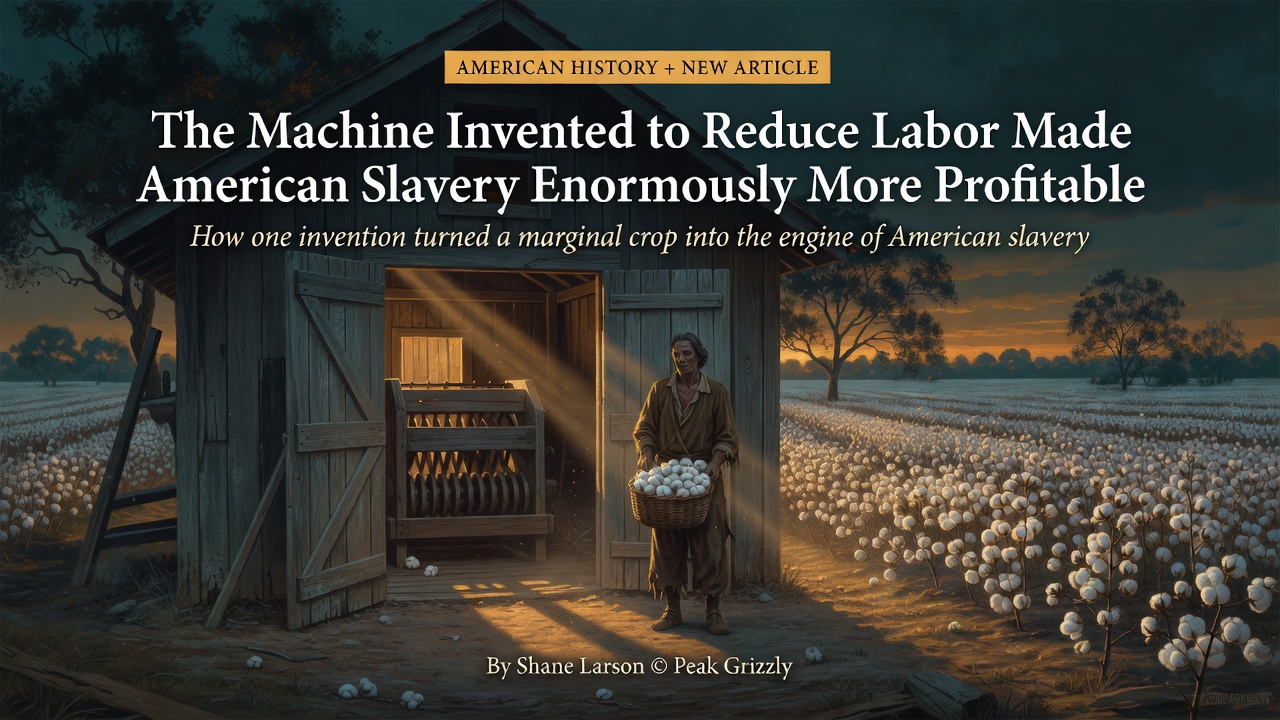
Eli Whitney patented the cotton gin in 1794. It is taught as a labor-saving device, which is accurate, and as a milestone in American ingenuity, which is also accurate.
What it actually did was make American slavery dramatically more profitable, and it did so directly.
The Bottleneck It Removed
Before the gin, the constraint on cotton was not growing it. It was cleaning it.
Long-staple cotton, which separates from its seeds relatively easily, only grew well in a narrow coastal band. The short-staple variety grew across the whole interior South and was economically marginal, because separating the fibre from the sticky seeds by hand was punishingly slow — a person could clean roughly a pound a day. That limit kept inland cotton from competing with other crops or with imports.
The gin destroyed that limit. Suddenly short-staple cotton could be processed fast enough to sell at volume, which meant that an enormous amount of inland territory that had been agriculturally unremarkable became the most valuable farmland in the country. Production figures show the shift plainly: American cotton output rose from roughly 3,000 bales in 1790 to more than 4 million bales by 1860. Cotton acreage expanded explosively. And because the machine solved the processing bottleneck without touching the planting and picking bottleneck, the demand for field labour rose in direct proportion to the new profitability.
The enslaved population of the United States was somewhere around 700,000 at the first census in 1790. By 1860 it was close to four million. Much of that growth came through natural increase rather than new imports, but the internal slave trade moved hundreds of thousands of people from the Upper South to the cotton districts of the Deep South to meet the expanded need. The gin did not cause all of that on its own. It is, however, the single clearest mechanism by which a labour-saving invention entrenched and expanded forced labour — because it saved labour at the wrong point in the process, and every unit of efficiency it created translated into demand for more people in the fields.
Whitney himself, by most accounts, did not intend this and did not profit from it. The gin was simple enough to copy that his patent was infringed everywhere and enforcement was hopeless. He made his money later, on government arms contracts.
Nearly Nobody Invented What They Are Credited With
Once you start checking, the pattern in American invention repeats with remarkable consistency: the famous name is usually the person who made a thing manufacturable or sellable, not the person who thought of it.
Isaac Singer did not invent the sewing machine. Elias Howe held the key patent and won a lawsuit about it. Singer's contribution was a better practical machine and, more importantly, the instalment payment plan and a distribution network — a commercial innovation that put machines in ordinary homes. Howe had already solved the core mechanical problem of a lock-stitch machine that could run continuously; Singer turned that device into something households could buy on credit and have serviced locally.
Thomas Edison did not invent the light bulb. Incandescent lighting had been demonstrated for decades by multiple researchers. Edison's team produced a filament and a vacuum that lasted long enough to be commercially viable, and — the actually decisive part — built the generating stations, wiring, meters, and business model that made electric light something you could buy. Without the parallel development of central power plants and billing systems, the bulb remained a laboratory curiosity.
American Inventors
Henry Ford did not invent the automobile, which was European and predated him. He invented a production system that put a car within reach of the people building it. The moving assembly line and standardized parts allowed wages high enough that workers could afford the product, but the basic layout of the gasoline engine and chassis had already been worked out abroad.
Charles Goodyear discovered vulcanisation partly by accident, spent years and his family's wellbeing pursuing it, and died substantially in debt while others commercialised rubber. The process itself was the breakthrough, yet turning it into reliable tires, boots, and industrial goods required later refinements in compounding and factory methods that Goodyear did not live to see.
The lesson is not that these people were frauds. It is that the popular category of "inventor" collapses two different achievements — having the idea, and making it exist at scale — and consistently awards the credit to the second while describing it as the first.
The Interchangeable Parts Story Is Mostly Wrong
Whitney is also credited with introducing interchangeable parts to American manufacturing, usually via a famous demonstration for government officials in 1801 in which he assembled muskets from randomly selected components.
The demonstration appears to have been staged. Historians examining his surviving output have found that the parts were hand-fitted rather than genuinely interchangeable, and his armoury never delivered on the promise at the scale or precision claimed. Contemporary records show that Whitney's muskets still required skilled fitting at the point of assembly, and delivery schedules slipped repeatedly.
The real development of interchangeable manufacture happened over the following decades at the federal armories, particularly through the work of people like John Hall at Harpers Ferry, and required advances in machine tools, gauges, and inspection that did not exist in 1801. Hall's rifles achieved tighter tolerances through systematic use of milling machines and inspection fixtures that could be checked against master gauges. It was slow, institutional, and unglamorous, which is precisely why a single dramatic demonstration by a famous name displaced it in the popular account.
Why the Simplified Version Persists
Because a system needs a person.
"American manufacturing precision developed gradually across two federal armories over thirty years through incremental improvements in gauging" is true and unusable. "Eli Whitney showed the War Department that any lock fits any musket" is memorable, dramatic, and wrong. The staged 1801 demonstration became the story because it fit an existing template of individual genius solving a national problem in one stroke.
The same substitution happens everywhere. The electrical grid becomes Edison. Mass production becomes Ford. An entire industrial ecosystem becomes one man in a workshop having a thought.
And the simplification is not neutral, because it removes exactly the parts that would be instructive. It hides that commercialisation is usually harder than invention. It hides how much depends on institutions and accumulated technique rather than genius. And in the cotton gin's case, it hides the most important consequence entirely — because a story about a clever man with a machine has no room in it for four million people.
American Inventors: Pioneers of Progress runs through the whole cast — Fulton, Whitney, Colt, Singer, Goodyear, Strauss, Drake, Edison, the Wrights, Armstrong, Ford, Eastman and the rest — what each one actually did, and what followed from it.
American Inventors
New posts and releases, straight to your inbox. No spam, unsubscribe anytime.