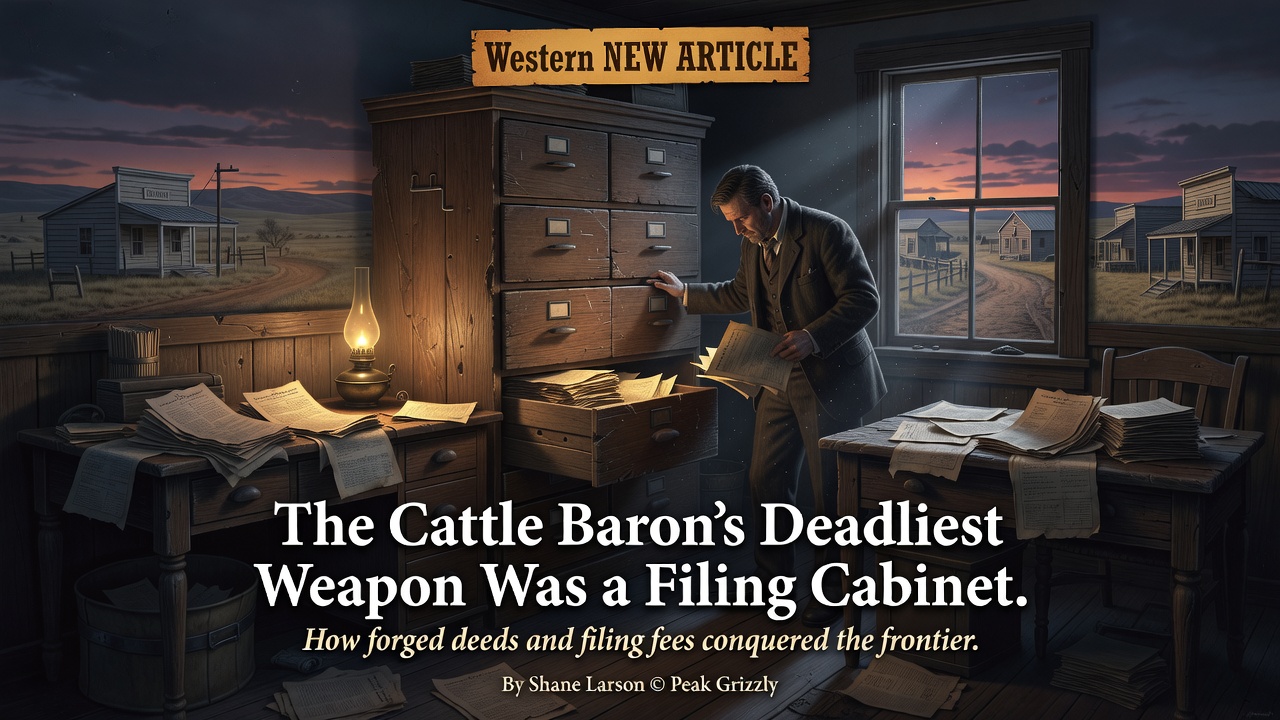
The Cattle Baron's Deadliest Weapon Was a Filing Cabinet
5 min read
The popular image of how the West was taken involves a man on a horse with a rifle. The reality involved a man in a suit with a fee schedule.
Between roughly 1865 and 1895, enormous quantities of the American West changed hands — and the overwhelming majority of it moved not at gunpoint but through instruments: land patents, quit-claim deeds, water filings, timber and stone entries, desert land claims, tax sales, and the recording fees that made all of it official. The gunfights we remember were, almost without exception, the last resort of somebody who had already lost the paperwork.
This is not a small correction to the mythology. It changes who the villain of the West actually is.
The Homestead Act was easier to defraud than to use
The 1862 Homestead Act offered 160 acres to anyone who would live on the land five years and improve it. It sounds generous, and for a substantial number of families it was.
It was also, from the perspective of a man assembling a cattle empire, an unusually convenient piece of legislation — because it created hundreds of thousands of small, separable, legally transferable titles in exactly the country he wanted, and it made no serious provision for verifying that any given claimant was a real person acting in his own interest.
The standard technique was the dummy entryman. A cattle company would recruit cowboys, drifters, recent immigrants, its own employees, and in some documented cases people who did not exist at all, and file homestead claims in their names on carefully selected parcels. Each dummy would perform the minimum ritual of improvement — sometimes a genuine shack, sometimes a "twelve by fourteen" dwelling that turned out on inspection to be twelve by fourteen inches — and then, once title issued, sign it over to the company for a nominal sum.
The 1885 report of the General Land Office is remarkably blunt about how routine this had become. Investigators found entire townships patented to men who had never seen them.
Water was the real prize
The genius of the technique was that you did not need most of the land. You needed the wet parts of it.
In semi-arid country — eastern Montana, Wyoming, the Dakotas, much of Colorado and Nevada — rangeland without water access is nearly worthless for cattle. The animals must drink. A ranch that controls the creeks, springs, and river frontage effectively controls every dry acre those creeks are the only water for, whether or not it holds title to a single square foot of it.
So the sophisticated operators did not try to buy a valley. They bought, filed on, or fraudulently patented the water in a valley: a chain of quarter-sections strung along the creek bottoms, each one legal on its face, together rendering tens of thousands of surrounding acres unusable to anyone else. The public domain remained public. It was simply inaccessible.
This is why a homesteader holding a single quarter-section with good water could become an intolerable problem to an operation running thirty thousand head. He was not competing for grass. He was a hole in a monopoly.
The county was the unit of capture
Here is the part that most western fiction gets wrong, and that the historical record is emphatic about: the fights were won at the county level, because that is where the instruments lived.
The Widow's Debt
A frontier county's power sat in a handful of unglamorous offices. The recorder or clerk decided what got entered in the book and in what order — and in a first-in-time system, order is title. The district judge heard the disputes. The sheriff served process, executed evictions, and chose which complaints were worth a ride. The newspaper, often the only one, printed the legal notices that a valid claim required, and could bury or misprint a notice into invalidity. The assessor decided whose taxes became delinquent, and delinquency was the cleanest route to a tax sale.
Capture five offices in a county of two thousand people and you do not need to break the law. You are the law's operating procedure. Every subsequent theft is performed with correct forms, filed on time, by consenting officials, and is nearly impossible to unwind — because unwinding it requires filing in the same court.
The Johnson County War of 1892 is the case where this machinery finally failed in public. Wyoming's largest cattlemen, having exhausted the legal instruments, hired roughly fifty gunmen and rode north with a written list of men to kill. It is remembered as the West's most brazen act of violence. It is better understood as an admission of defeat: they resorted to guns because the paperwork had stopped working.
Why the truth is a better story
There is a reason this version is not the one that ended up in the dime novels, and it is not that the truth is boring. It is that the truth does not resolve with a gunfight.
If a cattle baron's power is a fast draw, a faster draw destroys it, and the story ends in thirty seconds in a dusty street. If his power is a bought recorder, a captured judge, and eleven forged land patents, then shooting him accomplishes almost nothing. The deeds are still filed. The judgments still stand. His estate still holds the water. Someone else inherits the apparatus and the homesteaders are exactly as evicted as they were the day before.
To actually beat him you need the one thing he cannot purchase in advance: the record itself, in the open, in front of enough witnesses that it cannot be quietly amended. You need his own book read out loud.
That is a harder and stranger kind of heroism than the one we inherited, and it asks something the myth never asks — patience, and a willingness to want a trial more than you want a reckoning. It is also, unlike the gunfight, roughly what actually happened when these operations came apart: a ledger surfaced, a newspaper printed it, a federal officer arrived, and a man who had owned a county for a decade discovered that his power had always been a clerical arrangement.
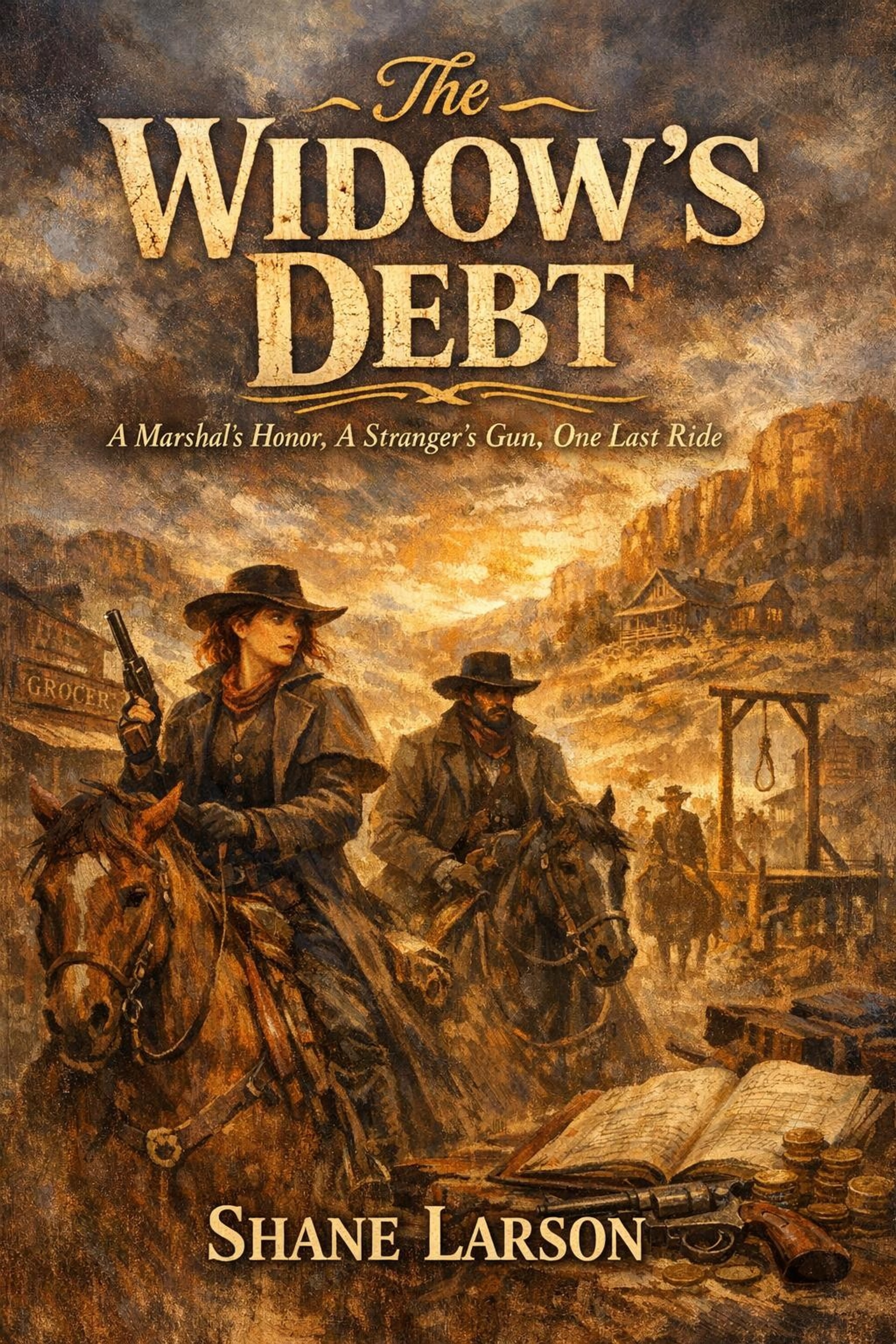
I spent a long time reading about frontier land fraud and eventually concluded it needed a novel rather than another history. The Widow's Debt is that novel — a Montana marshal who lost her badge for refusing a bribe, forty-five miles of badlands, a cattle baron who owns the court, and a ledger in a basement vault with her dead husband's name in it. She could end it with one shot. She wants a trial instead, and the book is about what that costs her.
*For the documented history behind it, see The Johnson County War and The Montana Vigilantes.*
The Widow's Debt
New posts and releases, straight to your inbox. No spam, unsubscribe anytime.