The Putney Debates: The Week an Army Argued About Who Should Get the Vote
November 4, 2026 · 8 min read
In 1891 an Oxford historian named C. H. Firth published a set of papers that had been sitting in the library of Worcester College for more than two hundred years. They were the working files of William Clarke, assistant secretary to the council of the New Model Army, and among them were his shorthand notes of a series of meetings held in a parish church in the autumn of 1647, written up in longhand afterwards and then put away. Until Firth printed them, the Putney Debates were known to history as a meeting. Afterwards they were a transcript, and the transcript held the most quoted sentence of the English revolution.
The sentence was spoken by a colonel to the commanding general's son-in-law across a communion table, and it was about who should vote.
How an army came to be debating anything
Armies do not usually hold constitutional debates, and this one had not meant to. By the spring of 1647 the New Model had won the first civil war and the king was a prisoner, and the Parliament that had raised the army wanted it gone: most regiments disbanded, the rest sent to Ireland, with the foot owed about eighteen weeks' pay by the army's own reckoning and the horse about forty-three, and six weeks of it on offer. When the soldiers petitioned Fairfax about pay and indemnity, the Commons passed a declaration on 30 March 1647 calling the petitioners enemies of the state and disturbers of the public peace.
That declaration made the army political. In April the cavalry regiments elected representatives they called agitators, meaning agents. When Parliament voted disbandment anyway, the regiments refused, and on 4 June a cornet named George Joyce arrived at Holdenby House with several hundred troopers and took the king into the army's keeping. The next day the army bound itself not to disband until its grievances were met and created a General Council to speak for it: the generals, plus two officers and two private soldiers from every regiment. In a declaration of 14 June, drafted by Henry Ireton, Cromwell's son-in-law, it told the kingdom that it was not a mere mercenary army, hired to serve any arbitrary power of a state. Officers back from a generation of exactly that kind of war on the Continent (see *The Thirty Years' War*) knew precisely what that meant. By August the army was in London.
The paper
The generals had a settlement in mind. Ireton's Heads of the Proposals would have kept the king and the Lords, kept bishops but stripped them of the power to compel, redistributed seats and fixed regular elections. The king would not accept it, and the soldiers who watched Cromwell and Ireton ride back and forth to Hampton Court all summer concluded that their generals were being played.
In October the agents of five cavalry regiments, new men in contact with the London radicals around John Lilburne, published a short paper they called an Agreement of the People. Seats were to go by number of inhabitants rather than ancient borough right; the Long Parliament was to dissolve itself by September 1648; Parliaments were to be elected every two years; and the people's representatives were to be supreme, with conscience, conscription, indemnity and equality before the law reserved from them altogether. It said nothing about the king. Fairfax agreed that the General Council should discuss it.
The room
The council met on 28 October 1647 in St Mary's church at Putney, beside the Thames, where the army had its headquarters. Fairfax was ill, and Cromwell took the chair. The officers sat, by tradition, around the communion table, with the agitators and two civilians from the Leveller side, John Wildman, then in his mid-twenties, and Maximilian Petty. They argued for several days, with interruptions for prayer, and Clarke sat with them and wrote.
What survives is not a recording. There are gaps where Clarke could not keep up, passages that are garbled, and every speech is a reconstruction from shorthand. But the voices are distinct, and most of them belong to soldiers.
On the first day Edward Sexby, a trooper turned agitator, told the council that the army had laboured to please a king, and that unless they went about to cut all their throats they would not please him. Cromwell, who had spent the summer trying to please exactly that king, spoke against the Agreement as something new and untried: if this paper were accepted, might not another company of men produce another, and another after that? He said, in a phrase his admirers have quoted ever since, that he was not wedded and glued to forms of government.
29 October
The next morning the first article of the Agreement was read, the one giving seats by number of inhabitants, and Ireton asked what it meant. If it meant that every man who lived in England was to have an equal voice in choosing Parliament, he was against it.
The English Civil War
Colonel Thomas Rainsborough answered him. Rainsborough was a naval commander's son and a former sea captain who had taken Prior's Hill fort in the storming of Bristol, and he was the most senior officer in the room to side with the Levellers. He thought, he said, that the poorest he that is in England has a life to live, as the greatest he; and therefore that every man who was to live under a government ought first by his own consent to put himself under it, and that the poorest man in England was not bound, in a strict sense, to a government he had had no voice in choosing.
Ireton's reply deserves to be stated as he made it, because it was the serious argument on the other side. No one, he said, had a right to a share in choosing the lawmakers unless he had a permanent fixed interest in the kingdom: the men who owned its land, and the freemen of its corporations. If birth alone gave a man a vote, then by the same reasoning birth gave him a claim on other men's property, and a majority without property, once it had the vote, could vote away the estates of those who had it. He was defending the franchise as it existed, which gave the county vote to men with freehold land worth forty shillings a year.
Rainsborough said he could find nothing in the law of God that a lord should choose twenty members of Parliament, a gentleman two, and a poor man none, and he asked what the soldier had fought for all this while, if it was to enslave himself and hand power to men of estate. Sexby put it more bitterly: many thousands of soldiers had ventured their lives and had little property in the kingdom, and yet they had a birthright, and if they had no right to the kingdom they had been mere mercenaries. Cromwell said that the consequence of their rule must end in anarchy, and proposed a committee.
The catch
It was Petty, on the Leveller side, who showed that the Levellers themselves did not all mean every man. Servants and those who took alms, he said, should be left out, because they depended on the will of other men and would be afraid to displease them.
How far the Levellers meant to go has been argued ever since. In 1962 the political philosopher C. B. Macpherson argued that they consistently excluded servants and wage-earners, which in the seventeenth century could cover a large share of the adult men in England, and that they were defenders of the small proprietor rather than democrats. Others have replied that the Leveller writings are inconsistent on the point, that Rainsborough plainly meant all men, and that Petty was offering a compromise rather than a doctrine. Austin Woolrych, whose study of the army debates is the fullest, thought Putney's immediate influence slight. Everyone agrees on one thing: nobody in that church proposed votes for women.
What the council decided
On 1 November, after another prayer meeting, some officers began to ask whether the army should be negotiating with the king at all. A newsletter from the army reported that a meeting a few days later voted, with only three against, that all soldiers and others except servants and beggars should have the vote. The generals had lost control of their council. On 8 November Cromwell moved that the agitators go back to their regiments, the meetings were suspended, and Fairfax ordered the army to assemble in three separate rendezvous rather than one.
Three days later, on the evening of 11 November, the king escaped from Hampton Court, and nothing said at Putney mattered as much as that.
On 15 November, at Corkbush Field near Ware, two regiments arrived without orders with copies of the Agreement in their hats. Cromwell rode into one of them, Robert Lilburne's, with his sword drawn and had the papers pulled out. Three men were condemned and cast lots; Private Richard Arnold was shot at the head of his regiment. Rainsborough tried to present the Agreement to Fairfax and was sent away in disgrace.
Afterwards
Rainsborough was killed at Doncaster on 29 October 1648, a year to the day after he answered Ireton, by Royalists from Pontefract who had come to kidnap him. His funeral in London was followed by thousands wearing ribbons of sea-green, the Leveller colour. Ireton wrote the army's Remonstrance demanding the king's trial, signed the death warrant, and died of fever at Limerick in 1651. The Levellers were broken at Burford in May 1649, where three men were shot against the churchyard wall.
The questions asked in St Mary's were not answered in Rainsborough's lifetime, or in Lilburne's, or in their century, or in the one after. They were asked, though, and because one clerk could write shorthand we know exactly how.
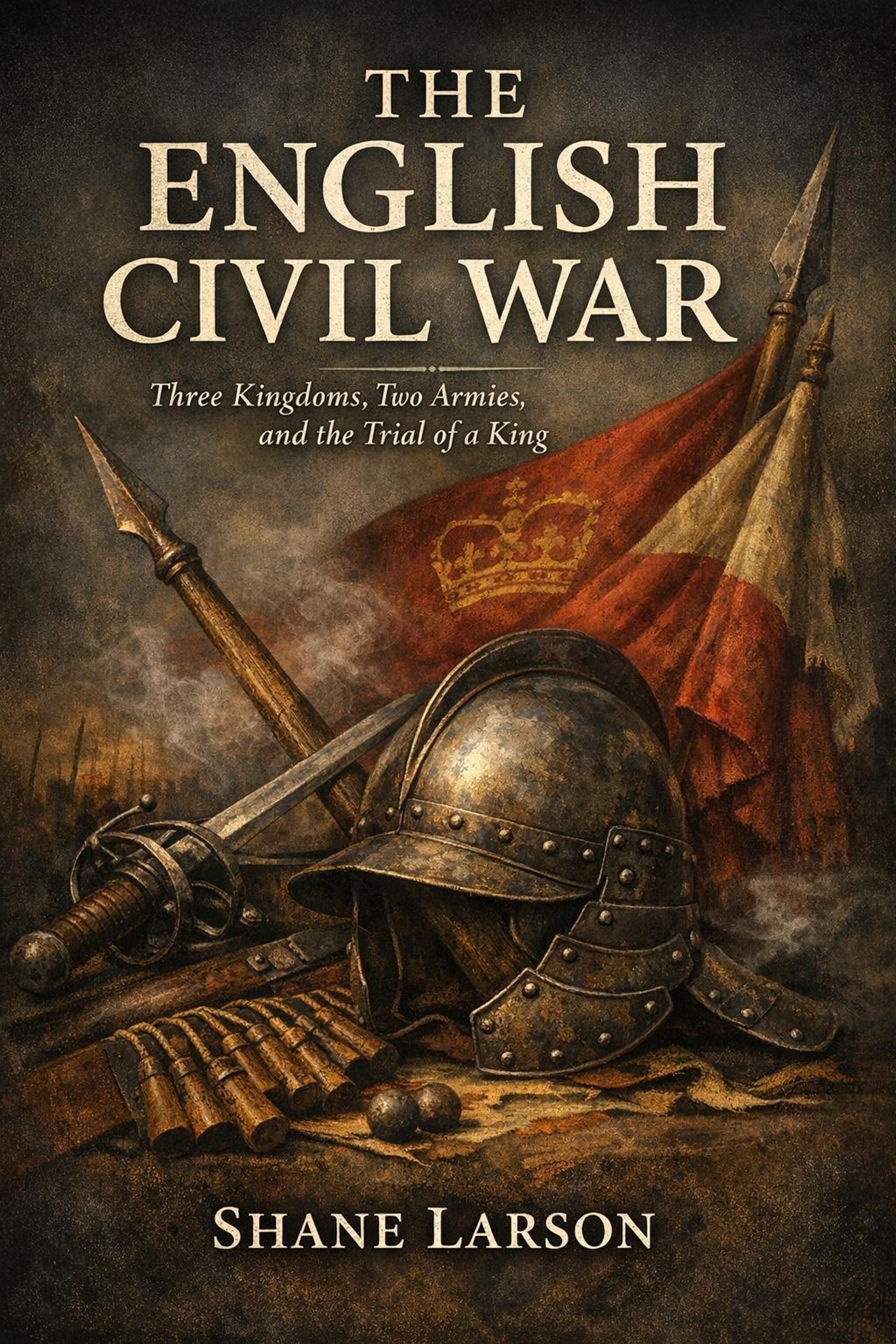
The English Civil War: Three Kingdoms, Two Armies, and the Trial of a King is a standalone military history on the English-history shelf, after The Powder Treason and beside The Thirty Years' War. It follows the war from the prayer-book riot in Edinburgh in 1637 to the last battle at Worcester in 1651, across all three kingdoms, and gives the Putney Debates a full chapter of their own.
The English Civil War
New posts and releases, straight to your inbox. No spam, unsubscribe anytime.