Did the Great Fire of London End the Plague? What the Bills of Mortality Actually Show
November 4, 2026 · 7 min read
Stand at the foot of the Monument on Fish Street Hill for long enough and you will hear it. The Great Plague of 1665 killed a fifth or a quarter of London; the Great Fire of 1666 burned the filthy timber city, rats and all; a clean brick city rose in its place and the plague never came back. Two disasters, one happy ending. It is one of the most repeated propositions in English history, and it is wrong in three separate ways. Each can be shown from evidence the people who first told the story already had in their hands.
Where the story came from
The claim is old. It was being made within a generation of the events, it was a commonplace by the eighteenth century, and in the nineteenth it became a lesson, because the sanitary reformers who wanted to pull down London's slums found a precedent useful. A disaster that is also a cure is a comfortable thing to believe in. It gives the dead of 1665 a purpose and the ruins of 1666 a reward, and it turns two catastrophes a year apart into a single story with a moral. Whether it is true is a separate question, and the place to answer it is the document Londoners read every Thursday.
The curve: what the Bills of Mortality show
For more than sixty years before 1665 the Company of Parish Clerks had printed a weekly sheet, the Bill of Mortality, listing the burials reported from some hundred and thirty parishes in and around London, with a separate column for those judged to be plague. The Bills are not a perfect record. Searchers, usually elderly women paid a small fee, decided the cause of death; families hid cases to avoid being shut up; Quakers and other Nonconformists buried their dead outside the parish system altogether. But the Bills are a consistent record, kept the same way week after week, and consistency is what a curve needs.
The curve is steep on both sides. Plague deaths climbed through the summer of 1665 to a peak in the week ending 19 September, when the sheet recorded 7,165 plague burials out of 8,297 in all: more people buried in seven days than most English towns contained. Then the figure fell nearly as fast as it had risen. About 5,500 the following week. Under 5,000 the week after. Roughly 2,700 by the middle of October, around a thousand by the end of it, into the hundreds through November, and below two hundred a week by the turn of the year. On 31 December Samuel Pepys, who had stayed at the Navy Office through all of it, closed his diary for the year with the observation that he had never lived so merrily, besides that he had never got so much, as he had done this plague time.
The whole of 1666 added about two thousand plague deaths to the Bills, most of them in the outer parishes, and by late summer the weekly plague figure was in the tens. The fire broke out in Thomas Farriner's bakehouse in Pudding Lane at about one in the morning on Sunday 2 September 1666. If plague had meant to return in strength that year, it would by then have been raging for two months. It was not. Whatever ended the Great Plague of London had done its work between October 1665 and the spring of 1666, and nothing burned in those months except the usual chimneys.
The map: what burned, and where the plague had been
The second problem is geography. The fire of September 1666 destroyed the walled City: the square mile or so inside the old wall, from near the Tower in the east to the Temple in the west, from the river north to Cripplegate and Moorgate, with a strip beyond the wall along Fleet Street. Some 13,200 houses, 87 parish churches, St Paul's, the Guildhall and the Royal Exchange went, on about 436 acres, perhaps four-fifths of the ground inside the wall.
It was not where the plague had been worst. The General Bill for 1665 puts the plague deaths of the ninety-seven parishes within the walls at a little under ten thousand. The sixteen parishes just outside the walls recorded nearly twenty-nine thousand; the twelve out-parishes further into Middlesex and Surrey more than twenty-one thousand; the five parishes of Westminster and its neighbourhood more than eight thousand. The disease had come first to St Giles-in-the-Fields, west of the walls, and it had killed in the greatest numbers in the poor, crowded suburbs: St Giles Cripplegate to the north, which buried more people in 1665 than any other parish in London; Stepney and Whitechapel to the east; Clerkenwell; the Southwark parishes across the bridge.
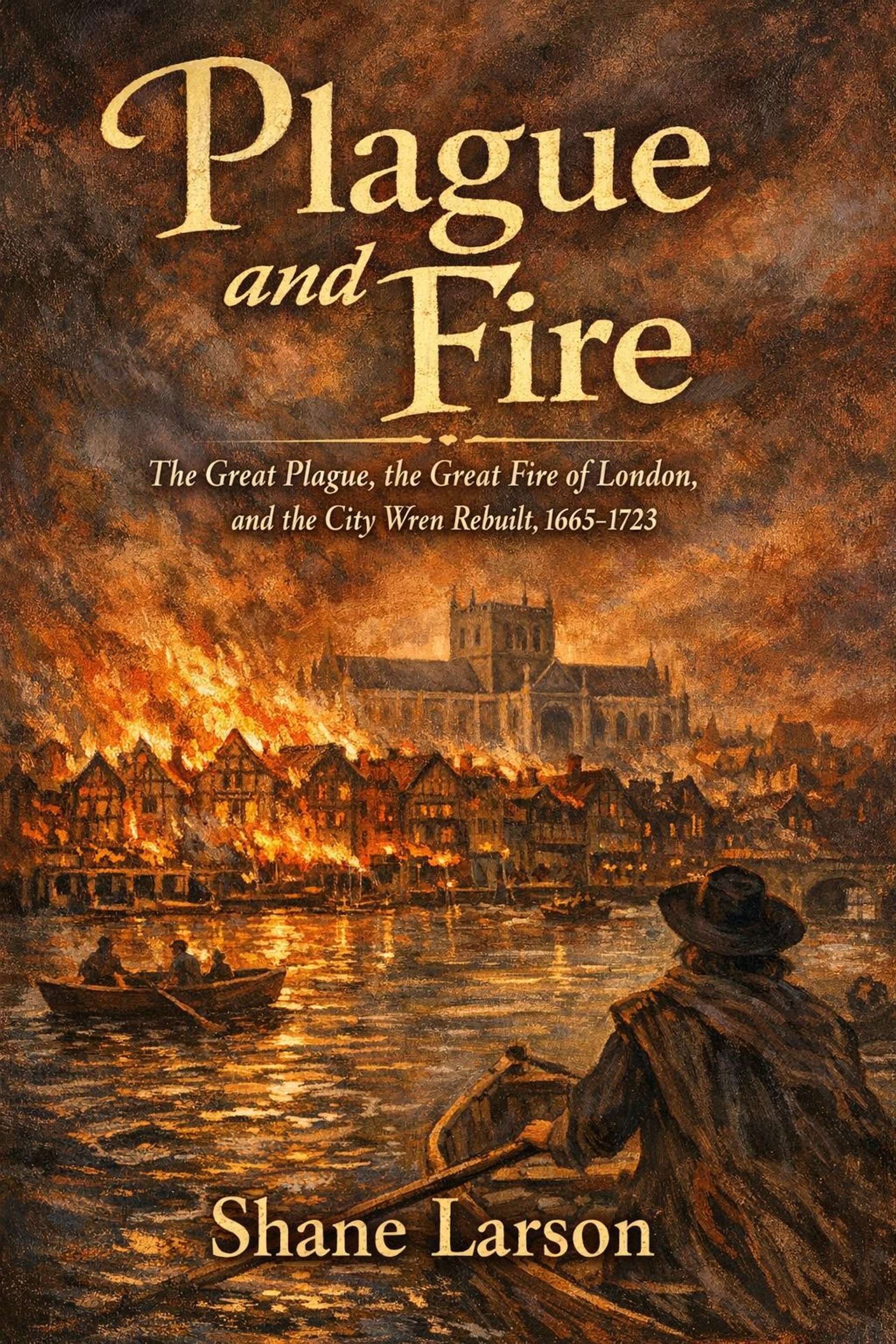
Plague and Fire
None of those burned. St Giles Cripplegate's church, where the fire reached the wall and stopped, is standing today. The suburbs that had been the plague's real home were still timber, still crowded and still unburned in 1667, and plague did not come back to them. If fire cleansed anything, it cleansed the part of London that had least needed it.
The rest of the map
The third problem is everywhere else. Plague left England after the 1660s. The last great provincial outbreaks ran through 1665 and 1666 in Colchester, Norwich, Southampton and Cambridge, and in Eyam, the Derbyshire village that sealed itself off, and then the disease simply stopped recurring. None of those towns burned.
Nor did Amsterdam, which had buried tens of thousands in 1663 and 1664 and lost the plague on much the same timetable as London. Nor did the towns of northern France after their outbreaks of the later 1660s. Plague withdrew from one region of western Europe after another over the following century, with a last great outbreak at Marseille in 1720. London's sister cities lost the plague without losing a single parish church to do it. The fire is an English explanation for a European event.
So what did end it?
Nobody knows, and this is one of the more interesting unsolved problems in the history of disease. The disease was the same Yersinia pestis that had arrived in 1348, a point confirmed in 2016 when ancient DNA was recovered from teeth in the Bedlam burial ground, dug up for Crossrail near Liverpool Street. (For its first arrival, see *The Black Death*.) Why it stopped coming back is argued along four main lines.
The first is quarantine. By the later seventeenth century European states had learned to hold ships from infected ports for forty days, and the Privy Council had already held Dutch ships at the mouth of the Thames in 1663 and 1664. Plague in England was never native; it arrived by sea, and the historian Paul Slack has argued that imperfect quarantine could still have been enough to break the chain of reintroduction. The second is the rat. The black rat, which lived in roofs and carried the fleas, was displaced across much of Europe by the brown rat, which prefers sewers. The trouble is the calendar: the brown rat is not recorded in Britain until the 1720s, half a century after the last English plague. A variant looks at housing instead, brick and tile replacing timber and thatch, and here the rebuilt City supports the story while the unburned suburbs, where the plague had actually been, do not.
The remaining candidates are biology, weather and chance. Rats, people or the bacterium itself may have changed after three centuries of mutual selection. The 1660s sat in the cold phase of the Little Ice Age, and flea-borne transmission depends on temperature. And because plague in England always burned out locally and had to be brought in again, the chain may have been broken by nothing more than a run of years in which it happened not to arrive, while the reservoirs that fed Europe retreated eastward for reasons that had nothing to do with England.
None of these is proven. What can be said with confidence is the negative: the fire of 1666 is not on the list, and has not been on any serious list for a long time.
What the fire actually changed
That is not to say the fire changed nothing. The Rebuilding Act of 1667 required brick or stone, forbade the overhanging jetties that had let flames leap a lane, fixed four sorts of house with set storey heights, and became the pattern for the London built outside the walls over the next century and a half. There were bad fires afterwards; there was never another that took a city. The fire's real inheritance is a matter of mortar, not of medicine.
The plague's end belongs to a different story, one that was already over in the suburbs before the first spark left Pudding Lane. Londoners made the two disasters one because one story with a meaning is easier to live with than two without. Three and a half centuries on, the guides at the Monument are still telling it.
*Plague and Fire: The Great Plague, the Great Fire of London, and the City Wren Rebuilt, 1665–1723* is a standalone history on the English shelf, picking up five years after *The English Civil War* ends. It opens by taking the cleansing myth apart with the Bills and the map, then tells the plague, the fire and the rebuilding as three movements of equal weight, from the first deaths in St Giles-in-the-Fields to Wren's tomb under the floor of St Paul's.
Plague and Fire
New posts and releases, straight to your inbox. No spam, unsubscribe anytime.