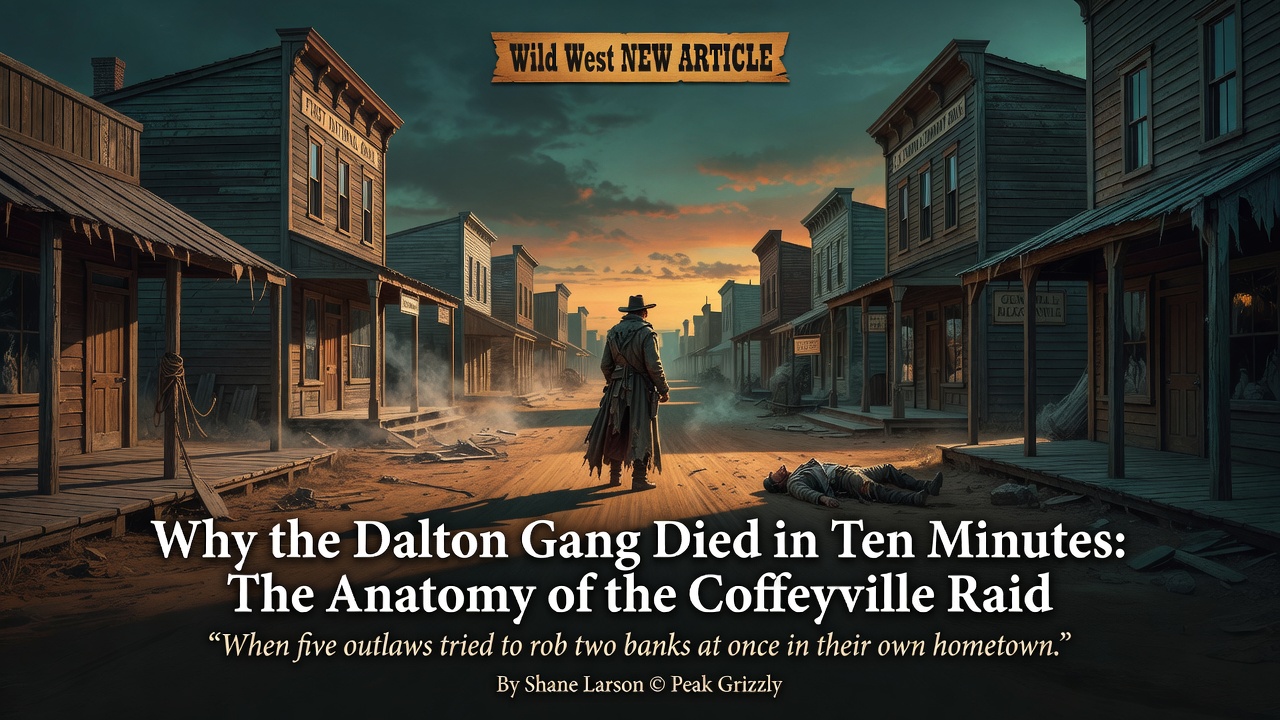
Why the Dalton Gang Died in Ten Minutes: The Anatomy of the Coffeyville Raid
July 5, 2026 · 6 min read
There is a particular kind of failure that only ambition can produce. Not the failure of the timid or the unlucky, but the failure of the person who decides that the thing already done is not enough — that it must be done bigger, louder, in a way no one has dared before. On the morning of October 5, 1892, five men rode that exact impulse straight into the streets of Coffeyville, Kansas, and roughly ten minutes later most of them were dead.
The Dalton Gang did not set out to rob a bank that day. They set out to rob two banks, at the same hour, in the same town square. It was a feat no outlaw in the history of the American West had ever attempted — not the James boys, not the Youngers, not anyone. And that was precisely the point.
The men who should have known better
What makes the Coffeyville raid so strange, and so instructive, is that the Daltons were not strangers to law and order. They came from a marshal's family. Their older brother, Frank Dalton, had worn a deputy U.S. marshal's badge out of Judge Isaac Parker's court at Fort Smith — the hard, dangerous frontier court that policed Indian Territory — and he was shot dead in the line of duty in 1887. Bob, Grat, and Emmett Dalton themselves rode as lawmen for a time, wearing badges in the same territory their brother had died defending.
Then they drifted. Horse theft. Whiskey-running. Graft committed while still nominally on the right side of the line. The frontier between deputy and desperado was always thinner than the legends admit, and the Daltons walked across it without much ceremony. By 1891 they were a full-fledged gang, holding up Santa Fe and Southern Pacific trains across Oklahoma and Indian Territory, building exactly the kind of reputation that should have satisfied a working outlaw.
It did not satisfy Bob Dalton. He had a measuring stick, and the marks on it were named James and Younger. To be merely another train-robbing gang was to be a footnote. Bob wanted the headline. And so he conceived the plan that would kill him.
Two banks, one hour
Coffeyville had two banks standing almost across the plaza from one another: the C.M. Condon & Company bank and the First National Bank. The plan was to take both simultaneously. Bob and Emmett would handle the First National. Grat, with gang members Bill Power and Dick Broadwell, would take the Condon. They would walk out with two banks' worth of money and ride into a legend that eclipsed everything that had come before.
There was one obvious problem with the plan, and the Daltons either ignored it or talked themselves out of it: Coffeyville was home. Bob, Grat, and Emmett had grown up just outside the town. People on those streets knew their faces. The false beards they wore that morning were a thin defense against a community that had watched some of these men grow up.
The disguises fooled no one. A man near the plaza — and the hardware clerks whose stores ringed the square — recognized the riders almost as soon as they dismounted. The cry went up. And here the second, fatal flaw in the plan revealed itself.
The hitching rail and the time-lock lie
The gang had counted on tying their horses at a hitching rail on the plaza, close to both banks. But the rail had been removed for street construction. With nowhere convenient to leave their mounts, the outlaws tied them in a narrow alley a block away — a gap of open ground they would have to cross again, on foot, to escape.
Inside the Condon bank, the plan slowed further. When Grat demanded the vault, a quick-thinking bookkeeper told him it was on a time lock that would not open for several minutes. It was a lie. But it was a believable lie, and Grat believed it long enough to matter. Those minutes — the ones the gang stood waiting inside the bank — were the same minutes the town outside was using to arm itself.
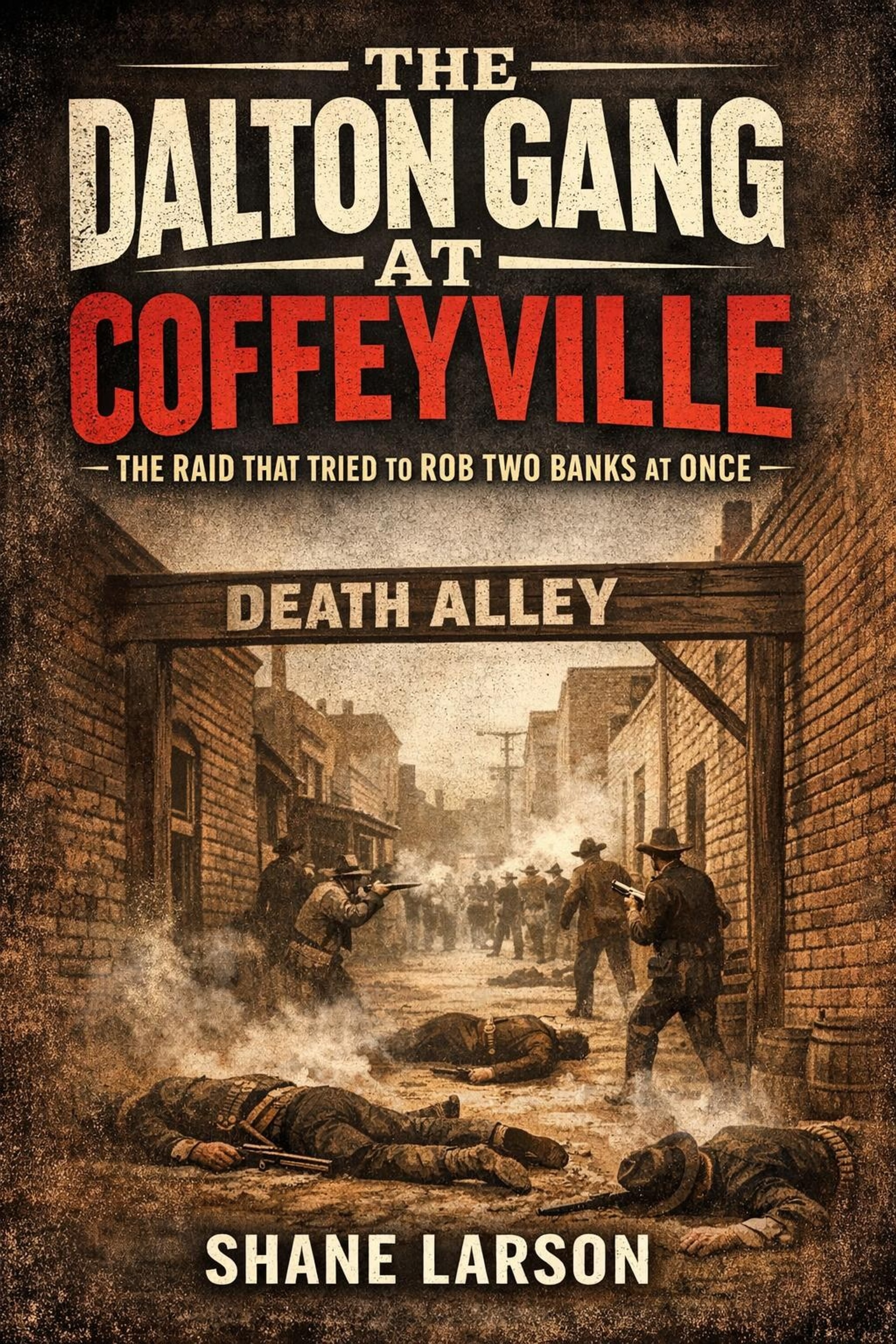
The Dalton Gang at Coffeyville
This is the hinge of the whole disaster. Coffeyville did not wait for a sheriff or a posse. The citizens armed themselves directly, passing rifles, shotguns, and pistols across the counters of the very hardware stores that surrounded the plaza. By the time the outlaws stepped back out into the square, they were walking into the guns of an entire town.
Ten minutes in Death Alley
What followed has been called the battle of Death Alley, and the name fits. As the outlaws tried to fight their way back across the open plaza to their horses, citizens and the town marshal poured fire into the square and the alley from doorways, windows, and behind buildings. The outlaws were caught in the open, in a crossfire, in a town that knew every angle of the ground better than they did.
It lasted about ten minutes. When the shooting stopped, four members of the gang were dead: Bob and Grat Dalton, Bill Power, and Dick Broadwell. Four townsmen had been killed as well, among them Marshal Charles Connelly — men who died defending their banks and their streets, and who are remembered in Coffeyville as the Dalton Defenders.
Only Emmett Dalton survived. He had gone back into the gunfire to try to save his brother Bob and was cut down for it, found riddled with more than twenty wounds — buckshot and bullets — and somehow still alive.
The survivor's long second act
The story did not end in the alley. Emmett Dalton recovered from wounds that should have killed him three times over. He was convicted and sent to the Kansas State Penitentiary, where he served fourteen years before being pardoned. And then he did something almost no outlaw of his era ever got the chance to do: he lived a whole second life.
He married. He moved to California. He wrote about his outlaw past — and publicly condemned the life he had led, insisting that crime had paid no one. He worked on the fringes of the early film industry, in the very decades when Hollywood was busy spinning the violence of the frontier into entertainment. The man who had survived the destruction of his gang lived long enough to watch the West turn his own world into myth, and to play a small part in the selling of it.
Historians have to handle Emmett's later testimony carefully. A reformed outlaw writing for money and reputation is not a neutral witness, and his accounts smooth and shade events in ways the bank ledgers and the inquest record do not. The honest version of the Coffeyville story is the one that reads the legend against the documents and says plainly where they part.
Why Coffeyville mattered
Strip away the dime-novel gloss and the buried-treasure tales, and Coffeyville is a turning point as much as a tragedy. By 1892, the conditions that had made the mounted outlaw gang possible were vanishing. Railroads and the telegraph could summon help and spread word faster than any horse could run. Posses were better organized. And towns, as Coffeyville proved, were armed and willing to defend themselves.
The raid is the close bookend to a story that has another famous bookend sixteen years earlier and a few hundred miles north: Northfield, Minnesota, where the James-Younger Gang was broken by another town that fought back. Two raids, two towns, two gangs destroyed not by lawmen but by ordinary citizens. Between them they mark the closing of the open-range outlaw window. The age of the gang was ending, and Coffeyville helped end it.
That is the real lesson buried in the false beards and the gunsmoke. The Dalton Gang did not fall because the law finally caught up with it. It fell because it overreached — because Bob Dalton needed to be bigger than Jesse James, and chose to prove it in the one town most likely to recognize and resist him. Ambition wrote the plan. A hometown wrote the ending.
The Dalton Gang at Coffeyville
New posts and releases, straight to your inbox. No spam, unsubscribe anytime.