Did Richard III Have a Hunchback? What His Skeleton Actually Shows
November 9, 2026 · 8 min read
Ask anyone to describe Richard III and you will get a body before you get a reign: the hump, the withered arm, the dragging leg, the king who tells the audience in his first speech that he is deformed, unfinished, sent before his time into this breathing world scarce half made up. It is the most physically specific portrait of any English monarch, and for four hundred years there was no way to check it. Then, in September 2012, University of Leicester archaeologists lifted a skeleton out of a grave in the choir of a vanished friary, and for the first time the hump could be measured against a spine.
The short answer is that Richard III did not have a hunchback. He had something real, which his enemies knew about, and which three generations of Tudor writers built into something else. The longer answer is worth having, because the skeleton shows exactly where the truth stopped and the invention started.
Nobody who saw him mentioned it
Start with what the people who met Richard said about his body, which is almost nothing. Dominic Mancini, an Italian cleric who was in London through the spring and summer of 1483 and wrote an account of the usurpation before the year was out, describes Richard's conduct in detail and his body not at all. The continuator of the Crowland Chronicle, writing in 1486 from inside the government and with no love for the late king, says nothing about a deformity. The city of York, which recorded his doings for twelve years, never remarked on his back. A foreign visitor who met him in 1484 and left a description said he was slightly built. That is the whole contemporary record on the subject, and it is a silence, not a denial.
That silence matters because the men who described his body later were all writing under the man who had killed him, or under that man's son.
Rous adds the hump, the teeth and the two years in the womb
The first deformity appears about five years after Richard's death. John Rous was a Warwickshire chantry priest who had written an illustrated roll of the Earls of Warwick during Richard's reign, and in it he praised the king warmly. After Bosworth he produced a history of the kings of England for Henry VII, and in it Richard is remade. He was, Rous now wrote, carried two years in his mother's womb, born with teeth and with hair down to his shoulders, small of stature, with unequal shoulders. Rous gives the right shoulder as the higher one. Hold on to that detail; the skeleton will come back to it.
The two-year pregnancy and the teeth are the language of monstrous birth, a medieval way of saying that a man was marked from the start. The shoulders are different. They are the kind of thing somebody who had seen Richard, or talked to someone who had, might actually have noticed, and Rous had been at the Yorkist court.
More adds the arm and the strawberries
Thomas More was seven years old when Richard died. In the 1510s he drafted a history of the reign that he never finished and never published; it appeared in print decades after his own death. It is a literary portrait of a tyrant, built partly on Polydore Vergil's official history and partly on the recollections of John Morton, the bishop Richard had arrested in 1483 and who had no reason to remember him kindly. More's Richard is little of stature, crook-backed, with one shoulder much higher than the other. More has it the other way round from Rous: he gives the left shoulder as the higher.
More also supplies the scene everyone remembers. At the council meeting of Friday 13 June 1483, Richard sends for a dish of strawberries from Morton's garden, leaves, comes back changed, bares his left arm and declares that witchcraft has withered it, and has Lord Hastings taken out and beheaded. The execution is a fact; the strawberries and the arm appear nowhere before More. Nothing in any earlier source gives Richard a damaged arm, and the man who commanded at Barnet at eighteen, fought at Tewkesbury and led the final charge at Bosworth did not have one.
Shakespeare turns the body into a soul
Edward Hall's chronicle of 1548 and Raphael Holinshed's of 1577 carried Rous and More forward, and Shakespeare, writing around 1592, took what he needed. His Richard has the hump, the arm and a limp, which no earlier writer had given him. He is a bunch-backed toad, a bottled spider. And in the opening soliloquy the deformity becomes a motive: since he cannot prove a lover, he is determined to prove a villain. The crooked back has become a crooked nature, and that is the idea which has outlasted everything else, from Garrick to Olivier to McKellen.
Richard III
By the time the first spade went into the Leicester car park, the Tudor body had five centuries of theatre behind it, and the defence that grew up against it from the seventeenth century onward tended to deny the whole thing: no hump, therefore no truth in any of it.
What was lying in the grave
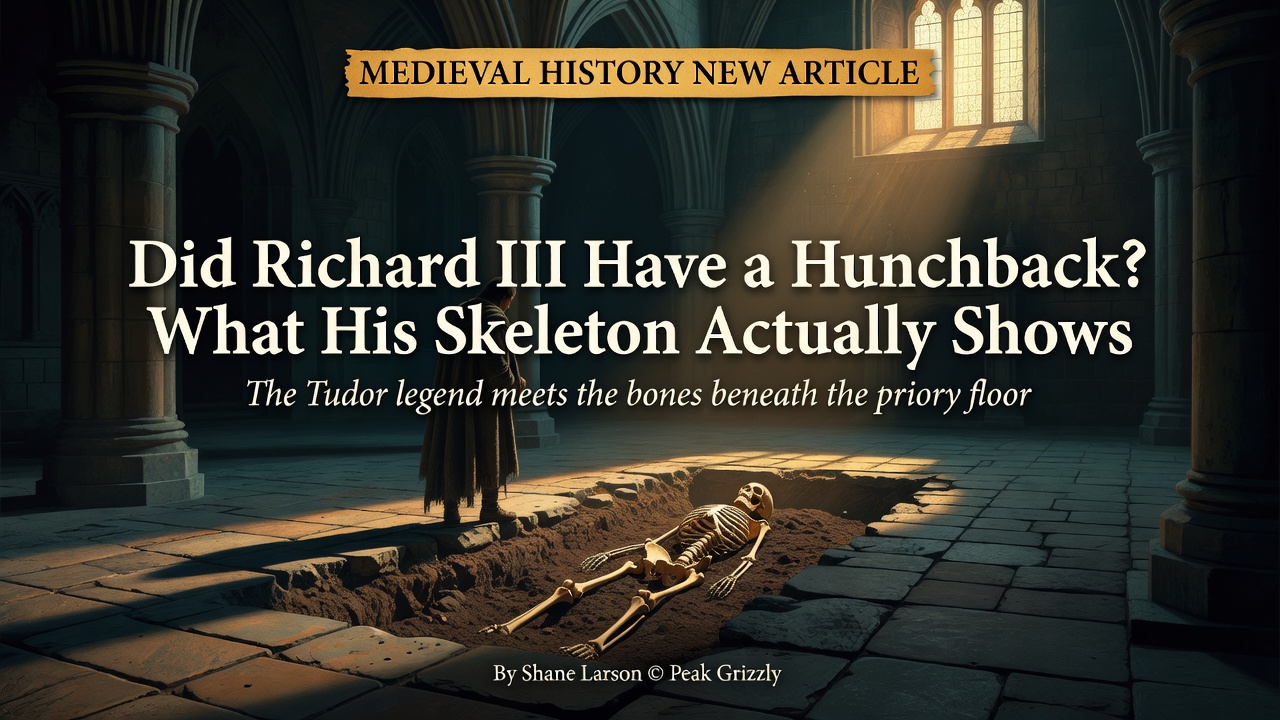
The grave was found on the first day of digging, 25 August 2012, in the first trench, and the skeleton was lifted on 4 and 5 September once the team had traced the walls of the friary church and shown that it lay in the choir, where the written record had always put Richard. The grave was too short for the body, which had been pushed in with the head propped against one end, without a coffin or shroud. The University of Leicester osteologist working in the trench could see the curve of the spine as the soil came off it. In the laboratory the vertebrae were scanned and a three-dimensional model of the spine was printed, so the shape of the curve could be studied without handling the originals. The full analysis was published in The Lancet in 2014.
Scoliosis is not a hunchback
The condition was scoliosis: a sideways curve of the spine that, in this case, bent to the right and twisted as it went. A hunchback, in the sense the Tudor writers meant and Shakespeare staged, is kyphosis, a forward bowing of the upper back that produces a visible hump between the shoulder blades. They are different conditions in different planes, and the skeleton had one and not the other.
The curve was severe. Measured at its worst, the angle lay somewhere between sixty-five and eighty-five degrees. It was of the kind now called idiopathic, meaning it has no identified cause, and the state of the bones placed its onset after the age of ten, in the growth years around puberty. The boy at Fotheringhay had been straight. The youth training in the Earl of Warwick's household at Middleham began, in his early teens, to bend.
The effects on his appearance would have been real and limited. The curve was balanced, which means the head stayed over the pelvis instead of tipping to one side, so what an observer would have seen was a trunk short for the length of his limbs and a right shoulder sitting higher than the left. Rous had it right; More had it backwards. The curve took a few inches off a standing height that would otherwise have been about five feet eight, above average for the time. It did not produce a limp, and it did not affect the arms, which were both entirely normal. Under good tailoring and armour made to measure, most of it would have been invisible, which fits the fact that nobody who met him thought it worth writing down. A curve of that severity can cost some lung capacity under exertion; the authors of the study said only that it was unlikely to have stopped him fighting in armour, which the record of three battles shows he did.
Where the truth stopped
Put the two portraits side by side and the line is clear. The uneven shoulders were real, and a few people close enough to Richard to see him undressed, or to talk to someone who had, knew it. Rous, who had been at court, got the correct shoulder. That single accurate detail was then built on: More reversed the shoulder and added the arm, Shakespeare added the limp and made the whole thing into a motive, and the two years in the womb and the teeth were never anything but the stock furniture of a monstrous birth. The one thing in the Tudor account that survives contact with the bones is the one thing a witness might actually have noticed.
There is a temptation to read the skeleton as a vindication, and Richard's defenders have done so. It is not quite that. The spine shows that the Tudor writers exaggerated, which was already suspected. It does not show that they lied about anything else, and it says nothing about what kind of man carried it; the scientists who studied it made that point themselves when the identification was announced in February 2013. The bones can tell you how tall he stood, how his shoulders sat, what he ate in his last years and how many times he was struck in the head at Bosworth. On whether he was the villain of the play or the wronged king of the defence, they have nothing to say, and the argument goes on where it always was, in the documents.
Richard III: The Last Plantagenet, the Car Park Grave, and the Fight Over a King's Reputation is a standalone biography on the English shelf, beside The Wars of the Roses. It tells the life from Fotheringhay to Bosworth and then the afterlife from Rous to the Leicester reburial, with the Tudor case and the Ricardian case tested against the sources at every contested point, and the science of the 2012 excavation explained from first principles.
Richard III
New posts and releases, straight to your inbox. No spam, unsubscribe anytime.