Were the Knights Templar Guilty? The Pope Who Abolished Them Said the Case Was Never Proved
8 min read
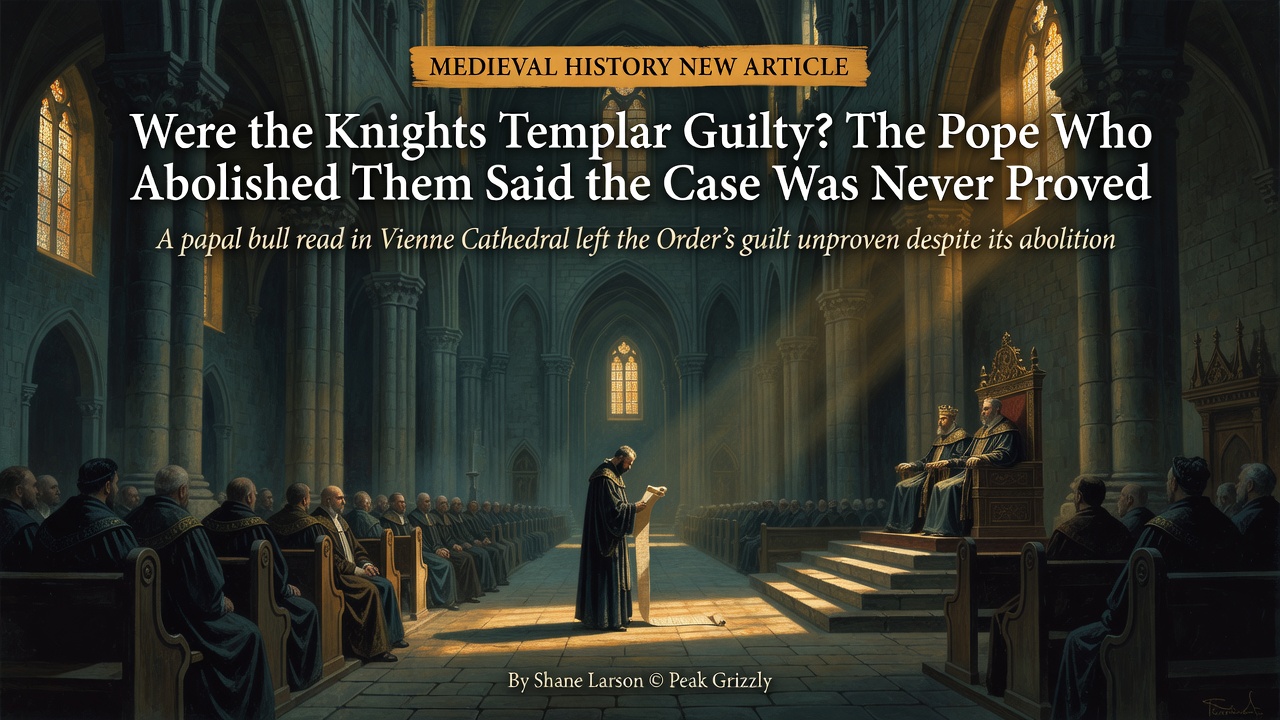
On 3 April 1312, in the cathedral at Vienne on the Rhône, a clerk stood up in front of several hundred bishops and read them a long Latin document. The bishops had been told that any man who spoke would be excommunicated. The king of France sat beside the pope. The document was a papal bull dated twelve days earlier, Vox in excelso, and it abolished the Order of the Temple.
Most accounts of the Knights Templar stop there, or hurry on to the pyre two years later. The sentence that matters is the one they leave out. The pope did not find the order guilty. He said, in the most public forum the medieval Church possessed, that a condemnation of the order by law could not be given on the evidence that had been gathered, and that he was suppressing it anyway: non per modum diffinitive sententie, not by way of definitive sentence, but per viam provisionis seu ordinationis apostolice, by way of provision, on the pope's authority to order the Church's affairs as he saw fit.
Christendom's most famous religious order, the one every secret-survival story of the last three centuries has claimed went underground, was never convicted of anything. The man who shut it down put that in writing in the instrument that shut it down.
What the charges were, and what the confessions were worth
The case had begun four and a half years earlier. Before first light on Friday 13 October 1307, royal officers across France opened sealed letters they had been carrying since 14 September and arrested every Templar they could find. The letters were drafted in the king's name by Guillaume de Nogaret, and they set out the accusations: that the order's secret reception ceremony made each new brother deny Christ and spit on the cross, that it involved indecent kisses and a promise of himself to the brothers, that there was an idol, and that the order's priests left the words of consecration out of the Mass. The letters also said that torture was permitted if the answers did not come.
The answers came. Between 19 October and 24 November, 138 Templars were questioned in Paris by the inquisitor Guillaume de Paris and his deputies, with royal officers in the room. All but four confessed to something. The Grand Master, Jacques de Molay, confessed on 24 October and again the next day before the masters of the University of Paris, admitting that at his own reception more than forty years earlier he had been made to deny Christ and spit near the cross.
That is the evidence on which the whole affair rested, and it is worth being exact about what it was. A confession taken after weeks in irons is a fact about the interrogation before it is a fact about the man. Molay retracted before the cardinals in December 1307. When a papal commission began hearing the order's defense in 1309 and 1310, nearly six hundred brothers came forward to defend it. Then, on 12 May 1310, the archbishop of Sens, a royal appointee, burned fifty-four of them in a single day as relapsed heretics. Their crime was withdrawing what they had said under torture. The defense collapsed, which was the point.
Same charges, different kingdoms
Here is the test that settles the question. The pope, who had not been consulted before the arrests and was furious about it, found himself in November 1307 ordering every ruler in Christendom to arrest the Templars in his own lands. The same list of charges was put to the same order in England, Aragon, Castile, Portugal, Cyprus and the German lands. What changed was the procedure.
In England, Edward II was reluctant, torture was not admitted until late in the process, in 1311, and there were almost no confessions. In Aragon the brothers shut themselves inside their castles at Miravet and Monzón and held out for a year, and when the council of Tarragona heard the case in 1312 it acquitted. Castile acquitted. In Portugal the inquiry found nothing, and in 1319 the king of Portugal and the pope founded a new order, the Order of Christ, to take over the Portuguese Templar houses and many of the brothers. On Cyprus in 1310 seventy-six brothers denied everything and outside witnesses spoke for them, before the island's politics interrupted the case. A council at Mainz the same year found for the order after armed brothers appeared before it, and the pope refused to accept its verdict. In Italy, where torture was used, some confessed.
Lay the results on a map and the pattern is not subtle. Confessions appear where the king of France's officers and their instruments were in the room, and almost nowhere else. The councils of Tarragona, Salamanca, Ravenna and Mainz saw the gap between what was charged and what could be shown, and they said so by acquitting. Nearly every historian who has worked on the trial since the records were first printed in the nineteenth century has reached the same conclusion: the charges were false. The live arguments among scholars are narrower, about what the reception ceremony actually involved behind a closed door, and about what three cardinals meant when they absolved Molay at Chinon in August 1308.
The Poor Knights
Why a pope would abolish an order he could not convict
If the case was that weak, why did the bishops at Vienne not simply throw it out? The council had opened in October 1311, and the bishops refused, twice, to condemn the order without giving it a hearing. A handful of Templars had even turned up to defend it. The pope's answer, in the end, was to take the decision out of the bishops' hands.
The reason sat beside him in the cathedral. Philip IV had spent five years making it clear that no outcome in which the Templars survived was acceptable to him, and in March 1312 he arrived at Vienne with armed men to make the point again. He was a king at war with England and with Flanders who had debased his coinage, borrowed from the Lombard bankers and then attacked them, and in 1306 expelled the Jews of his kingdom and taken their property. In 1303 he had sent Nogaret to Anagni to lay hands on Pope Boniface VIII, and had then spent years pressing a heresy trial against the dead pope's memory. The method used on the Templars, sudden arrest, a list of articles, questioning under torture, published confessions, and a demand that the Church ratify what the crown had found, had been rehearsed on a pope. Clement V, a Gascon who had been crowned at Lyon and never set foot in Rome, had watched it happen.
Vox in excelso is the record of what a constrained man did with a case he could not win and could not drop. He abolished the order for the scandal that now clung to its name, and said in plain Latin that he was not condemning it. Six weeks later a second bull, Ad providam, gave the Templars' property to the rival Order of the Hospital, minus the 200,000 livres tournois the French crown extracted for its expenses by the settlement of 1313.
Two years after that, on 18 March 1314, Molay and Geoffroi de Charney, the preceptor of Normandy, were brought before a platform outside Notre-Dame to hear themselves sentenced to perpetual imprisonment. Both stood up and said the order was innocent and their confessions false. That made them relapsed heretics in law, and the king had them burned that evening on a small island in the Seine. Clement died on 20 April. Philip died on 29 November, after a riding accident while hunting. The curse that is supposed to have summoned both men to judgment within the year was built afterward out of that coincidence.
The gap is where the legend grew
An order that is convicted has an ending. An order that is abolished without sentence, on charges nobody could prove, by a pope who said so, has a wound instead, and a wound invites explanation. The feeling that something unjust happened in 1307 is correct, and the legends feed on it. They offer the order a secret victory because history denied it a public one: a treasure fleet, a hidden survival, a grail, a bloodline.
None of it is medieval. The treasure fleet grows from a single deposition of 1308, in which a brother who had seen none of it said that the preceptor of France had fled with fifty horses and put to sea with eighteen ships. The idea that crusading knights were the ancestors of Freemasonry dates from an oration of 1737, which named the Hospitallers; German lodges made them Templars in the 1750s. Baphomet is a scribe's spelling of Mahomet in a confession taken under torture, made into an idol in 1818 and given a goat's head in the 1850s. Rosslyn Chapel was founded in 1446, more than a century after the last Grand Master died. Friday the thirteenth became an unlucky day in the nineteenth century, not in 1307. A reader who came to the Templars through a novel, a game or a documentary is not wrong to find the story compelling. Each piece of it was made from a real fragment of the record by clever people, and each deserves to be dated and tested rather than sneered at.
What the record offers instead is smaller and truer. The charges were never proved, and nearly every historian who has worked on the record holds them false. The pope conceded the first point, in Latin, in front of the bishops of Europe and the king who wanted it otherwise. And the two men who said the same thing on a platform in Paris paid for it the same evening. That is a better story than a treasure, because it happened.
*The Poor Knights: The Templars, the King of France, and the Destruction of an Order That Became a Legend* is a narrative history of the Order of the Temple from a handful of knights on the pilgrim road in 1119 to the pyre on the Seine in 1314, and then into its second life as a legend. It takes the order's life, its destruction and its afterlife in turn and keeps them apart, ties every claim to a document whose author and loyalties are named, and dates each piece of the legend to the person who made it and the reason they needed it.
The Poor Knights
New posts and releases, straight to your inbox. No spam, unsubscribe anytime.