Did the Minoans Inspire the Legend of Atlantis?
April 9, 2026 · 9 min read
Did the Minoans Inspire the Legend of Atlantis?
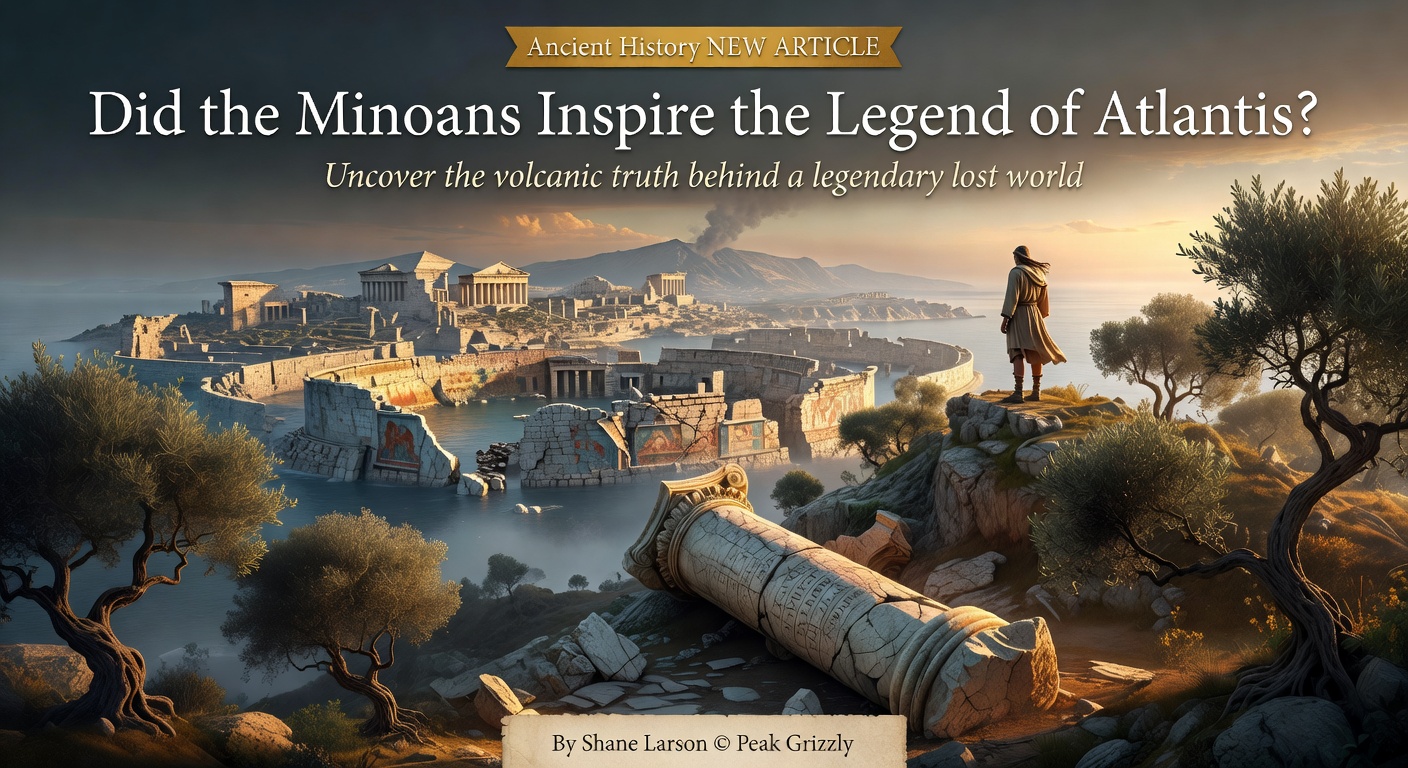
In the fourth century BCE, the philosopher Plato told a story about an island civilization called Atlantis. It was wealthy beyond measure. Its people were brilliant engineers and architects. They commanded a powerful navy that dominated the surrounding sea. Their capital was a marvel of concentric rings of water and land, adorned with magnificent buildings.
Then the gods grew angry, and the sea swallowed Atlantis whole.
Plato attributed the story to Solon, the great Athenian lawmaker, who supposedly heard it from Egyptian priests at the temple of Sais. The priests told him it was ancient history -- an account of a real civilization that had existed nine thousand years before Solon's time and had been destroyed in a single day and night of catastrophic violence.
For twenty-four centuries, people have argued about what Plato meant. Was Atlantis a philosophical allegory? A cautionary tale about hubris? Or was it a garbled memory of something real -- a civilization that actually existed, actually dominated the sea, and was actually destroyed by a catastrophe?
If it was a memory, there is really only one serious candidate. And they were real.
The Civilization Nobody Remembered
Around 2700 BCE -- more than two thousand years before Plato was born -- a civilization began to emerge on the island of Crete in the eastern Mediterranean. We call them the Minoans, a name invented in 1900 by the archaeologist Arthur Evans, who borrowed it from the mythological King Minos. We don't know what they called themselves. We can't read their writing.
What we do know, from a century of excavation and analysis, is extraordinary.
The Minoans built the first multi-story palaces in European history. The Palace of Knossos -- the largest Bronze Age structure in Europe -- featured a throne room, a grand staircase, light wells that channeled sunlight into interior rooms, a drainage system with clay pipes and stone channels, and storage magazines that could hold enough olive oil and grain to supply thousands of people. They had paved roads. They had indoor plumbing. Nothing comparable would exist in Europe for over a thousand years after their civilization collapsed.
They painted their walls with frescoes of dolphins, flowers, and young athletes leaping over the horns of charging bulls. They crafted pottery of such beauty and technical skill that it influenced art across the eastern Mediterranean. They carved seal stones smaller than a thumbnail with scenes of such intricate detail that you need a magnifying glass to fully appreciate them.
They controlled the sea lanes of the Aegean with a merchant and possibly military fleet so dominant that -- unlike every other major Bronze Age civilization -- they did not fortify their cities. The absence of city walls on Crete is one of the most remarkable facts in Bronze Age archaeology. The Minoans felt safe. The sea was their wall.
And they developed two writing systems: Cretan Hieroglyphic and Linear A. We have thousands of tablets and inscriptions in these scripts. We cannot read either of them. The language they record is unknown, and without a bilingual text -- a Rosetta Stone for the Minoans -- decipherment remains elusive. This means that everything we know about Minoan religion, politics, social organization, and daily life comes from interpreting their material remains: the art, the architecture, the tombs, the careful work of archaeologists piecing together a civilization from objects rather than words.
The Catastrophe
Sometime around 1600 BCE (the exact date remains one of the great debates in Aegean archaeology), the volcano at the center of the island of Thera -- modern Santorini, about seventy miles north of Crete -- erupted with a force estimated at four to five times greater than the 1883 eruption of Krakatoa.
The eruption was cataclysmic. A Plinian column of ash and pumice rose miles into the atmosphere. Pyroclastic flows -- superheated currents of gas and rock traveling at hundreds of miles per hour -- raced across the surface of the sea. The center of the island collapsed into the magma chamber, creating the caldera that exists today. A tsunami radiated outward across the Aegean.
On Thera itself, the Minoan town of Akrotiri was buried under approximately sixty feet of volcanic deposits. When archaeologists began excavating it in 1967, they found an astonishingly well-preserved snapshot of Minoan life: two- and three-story buildings with magnificent frescoes still on the walls, pottery on shelves, furniture in rooms. No bodies were found -- the inhabitants had apparently fled before the final eruption. But their town was frozen in volcanic time, a Bronze Age Pompeii preserved for three and a half millennia.
The impact on Crete, seventy miles to the south, was severe. Ashfall blanketed eastern Crete. A tsunami struck the northern coast. The disruption to trade routes, agricultural land, and the broader Aegean economy was significant. But here is the critical point: the Minoans survived the eruption. Palatial activity on Crete continued for approximately another century after Thera. Whatever killed Minoan civilization, it was not the eruption alone.
The end came around 1450 BCE, when nearly every major site on Crete was destroyed -- burned, looted, or abandoned. Only Knossos survived, and under new management: the Mycenaean Greeks from the mainland, who replaced Linear A with their own script (Linear B, which Michael Ventris deciphered in 1952 as an early form of Greek), introduced new pottery styles and warrior burial customs, and effectively absorbed what remained of Minoan culture into their own.
Within a generation, the Minoan palatial civilization that had dominated the Aegean for seven hundred years was gone.
The Atlantis Parallels
Now consider what Plato wrote about Atlantis, and count the parallels:
An island civilization. Atlantis was an island in the sea. The Minoans were an island civilization centered on Crete, with outposts across the Aegean.
A maritime empire. Atlantis commanded a powerful navy and controlled the surrounding waters. The Minoans were a thalassocracy -- a sea power -- whose naval dominance was so complete they didn't build walls.
Extraordinary wealth and sophistication. Atlantis was described as fabulously wealthy, with magnificent architecture and advanced engineering. The Minoans built the most sophisticated structures in Bronze Age Europe, with engineering that wouldn't be matched for a millennium.
The Minoans
Sudden catastrophic destruction. Atlantis was destroyed "in a single day and night of misfortune," sinking beneath the sea. The eruption of Thera -- an island that literally sank into the sea when its caldera collapsed -- was followed by the destruction of Minoan civilization within a century.
Lost to memory. Atlantis was forgotten by everyone except the Egyptian priests. The Minoans were so thoroughly erased from historical memory that they weren't rediscovered until Arthur Evans began digging at Knossos in 1900.
The parallels are striking. But there are problems.
Where the Theory Gets Complicated
The Atlantis-Minoan connection was first proposed in the early twentieth century and gained major traction in 1969 when the Greek archaeologist Angelos Galanopoulos published Atlantis: The Truth Behind the Legend. Galanopoulos argued that Plato's account was based on a real tradition about the Minoans, distorted by centuries of retelling and a factor-of-ten error in the numbers (multiply Plato's dimensions by one-tenth and they match Crete and the Aegean remarkably well).
The theory is elegant. But honest scholarship requires acknowledging the difficulties:
The timeline doesn't match. Plato placed Atlantis 9,000 years before Solon's visit to Egypt (c. 600 BCE), which would put Atlantis around 9600 BCE -- thousands of years before the Minoans. Proponents argue this is the factor-of-ten error: 900 years before Solon fits the Minoan collapse perfectly. But you cannot selectively correct numbers in an ancient text and call it evidence.
The geography is wrong. Plato placed Atlantis beyond the Pillars of Hercules (the Strait of Gibraltar), in the Atlantic Ocean. Crete is in the eastern Mediterranean. Proponents argue that "beyond the Pillars of Hercules" could be a misunderstanding or a later addition. Possible, but speculative.
Plato may not have meant it as history. The Atlantis story appears in the Timaeus and the (unfinished) Critias, dialogues that are philosophical in nature. Many scholars believe Atlantis was a deliberate invention -- a thought experiment about a powerful civilization corrupted by hubris, designed to illustrate Plato's political philosophy. If Atlantis is allegory, the Minoan parallels are coincidental.
The details don't match. Plato describes Atlantis as a continent-sized landmass with a specific layout of concentric rings. Crete looks nothing like this. Plato describes Atlantis as having elephants. Crete had no elephants (though pygmy elephants did once exist on some Mediterranean islands).
What We Can Say
The honest answer -- and the answer that I think the evidence supports -- is that we cannot prove the Minoans inspired Atlantis, but the connection is plausible in a specific way.
The Minoans were not Atlantis. Plato's detailed description of Atlantis as a continent in the Atlantic Ocean with concentric rings and elephants does not describe Minoan Crete. If Plato was drawing on a historical tradition, he transformed it beyond recognition.
But here is what is almost certainly true: by Plato's time, the Greeks retained garbled, fragmentary memories of a civilization that had preceded them in the Aegean. They knew about King Minos, the Labyrinth, and the Minotaur. They knew Crete had once been powerful. They knew something catastrophic had happened. And the Egyptians -- who had been in direct contact with the Minoans during the Bronze Age and whose historical memory was far longer than the Greeks' -- may well have preserved traditions about the fall of Minoan civilization that reached Solon in distorted form.
The Minoans didn't inspire Atlantis the way a historical event inspires a documentary. They inspired it -- if they inspired it at all -- the way a half-remembered dream inspires a myth. The details wrong, the emotional truth precise. Something magnificent existed on an island in the sea. It was powerful and sophisticated and beautiful. And then it was gone.
That is the story the Greeks told themselves for a thousand years. They just couldn't remember the name.
The Real Story Is Better Than the Legend
The Atlantis debate is fascinating, but here is what I've found after spending months researching and writing about the Minoans: the real civilization is more interesting than any legend.
Atlantis is a story about a place that might not have existed. The Minoans are real. We can walk through their palaces. We can see their art -- the bull-leapers, the dolphins, the snake goddesses, the saffron gatherers. We can stand on the rim of the Thera caldera and look down at the sea that filled the void left by the eruption. We can visit Akrotiri and see rooms that haven't changed in three and a half thousand years. We can hold their seal stones and marvel at craftsmanship so precise it challenges our assumptions about what ancient people could do.
We just can't read their words. And that silence -- that combination of extraordinary material evidence and absolute textual silence -- is what makes the Minoans endlessly fascinating. They are close enough to reach out and touch, and far enough away that they will never fully explain themselves.
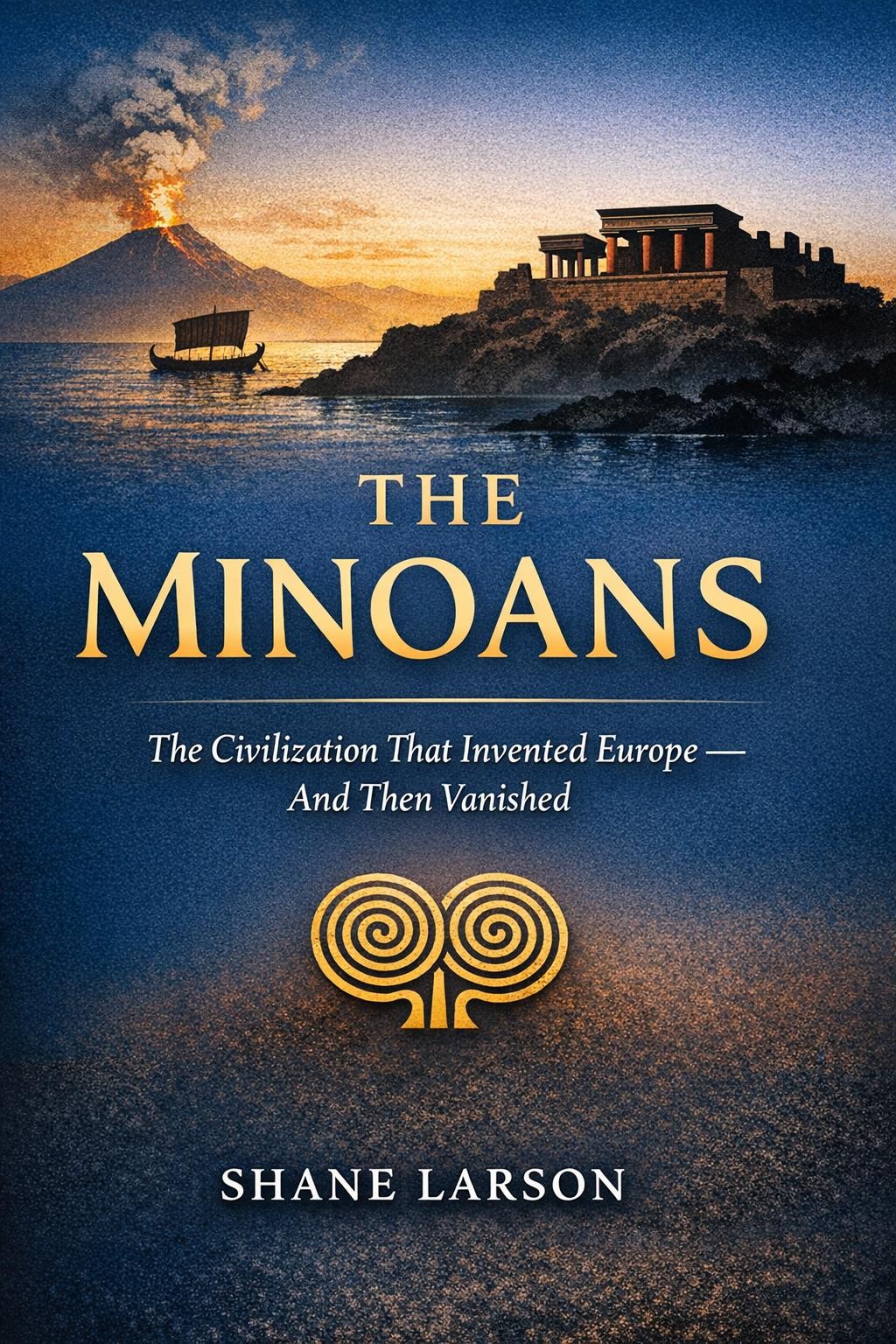
My new book, The Minoans: The Civilization That Invented Europe -- And Then Vanished, tells the full story. Not just the Atlantis question, but everything: the palaces, the art, the religion, the women who may have held power, the scripts nobody can read, the volcano, the Mycenaean takeover, Arthur Evans's brilliant and problematic excavation of Knossos, and what modern DNA and climate science are revealing about a civilization that has been silent for thirty-five centuries.
It is the deepest book in my Bronze Age catalog, and the one I am most proud of writing. If the Minoans have ever caught your imagination -- or if this post is the first time you've heard their story -- I think you'll find it worth your time.
The Minoans is available now on Amazon Kindle and Kindle Unlimited.
Shane Larson is the author of The Bronze Age World, Ancient Apocalypse, The Sea Peoples, The Hittite Empire, Lost Civilizations of the Ancient World, and more than a dozen other titles on ancient history, technology, and AI. Connect at @peakgrizzly on x.com.
The Minoans
New posts and releases, straight to your inbox. No spam, unsubscribe anytime.